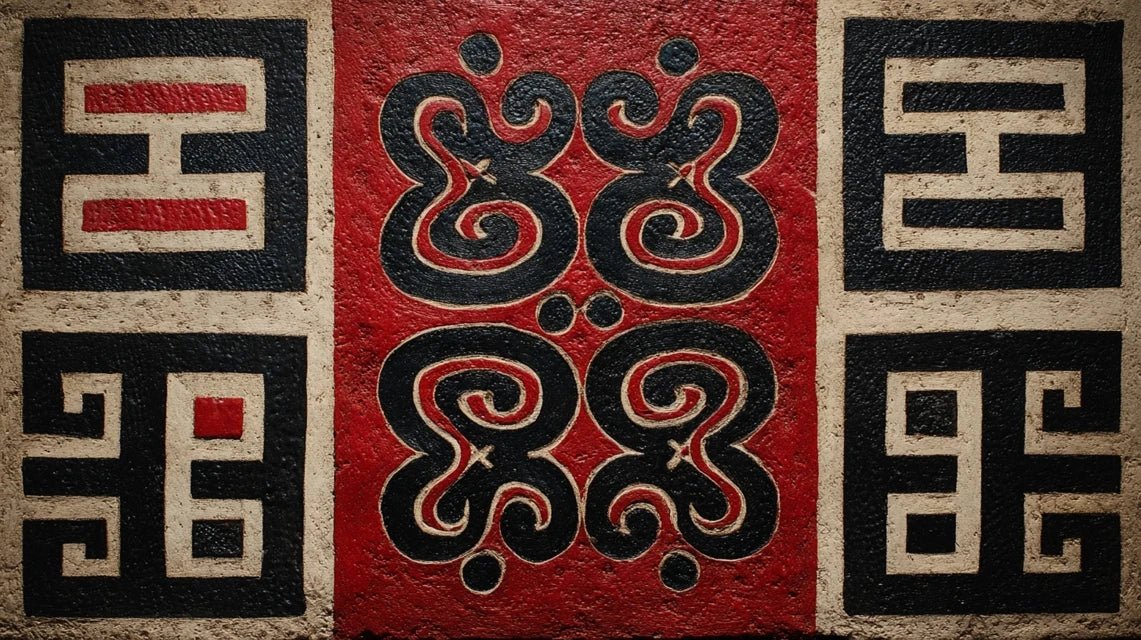
The first time I held a calabash stamp still wet with dye, my fingers stained a deep black, I didn't know that I was holding between my hands an alphabet centuries old. It was in a small workshop in Ntonso, Ashanti region, where red dust mixes with the smells of boiled plants. The master printer smiled at me: “These signs tell what words cannot say.” Adinkra symbols are not mere decorative motifs. They are capsules of philosophy, visual proverbs, guardians of wisdom that have crossed time from the Ashanti kingdom.
Here's what Adinkra symbols bring to your world: a narrative depth that transforms each object into a silent storyteller, an authentic connection with a millennial African tradition, and a universal visual language that speaks to the soul without uttering a word.
You may have already come across these geometric patterns on fabrics, jewelry or contemporary artworks. You find them beautiful, intriguing, even mysterious. But you feel this frustration: what do they really mean? Where do these spirals, stars, stylized hearts that seem to hold a secret come from?
Rest assured: each Adinkra symbol has a precise history, a clear meaning, a life lesson passed down from generation to generation. You don't need to be a historian or anthropologist to understand their language. In this article, I take you back to the origins of these extraordinary symbols, into the forests of Ghana where they were born, and I reveal how they can enrich your daily life and your decoration with a unique philosophical dimension.
The legend of the defeated king and mourning cloth
The story of Adinkra symbols begins with a war and a mourning. In the early 19th century, the powerful Ashanti Empire of Ghana entered into conflict with the neighboring kingdom of Gyaman, located in present-day Côte d'Ivoire. The king of Gyaman, Nana Kwadwo Agyeman Adinkra, rules over a people renowned for their exceptional textile craftsmanship.
In 1818, after a decisive battle, King Adinkra is defeated and killed by the Ashanti forces. But the conquerors discover something extraordinary in the royal palace: fabrics printed with geometric patterns of striking beauty, worn during funeral ceremonies. These cloths, called “Adinkra” in honor of the deceased king, fascinate the Ashanti people with their sophistication.
The word Adinkra literally means “farewell” or “goodbye” in the Twi language. Originally, these fabrics were exclusively reserved for funerals and moments of separation. Each printed symbol conveyed a message: acceptance of death, celebration of a life accomplished, consolation for the living, wisdom in the face of impermanence.
Ashanti artisans quickly adopted this printing technique, perfected it, and enriched the repertoire of symbols. From funeral textile, Adinkra gradually became a complete visual language, used for all important occasions of social and spiritual life.
A philosophical alphabet engraved in a gourd
The traditional manufacture of Adinkra symbols is based on ancestral know-how passed down from master to apprentice. The process begins in the forest, where the bark of the Badie tree, a sacred tree, is harvested. This bark is boiled for hours, sometimes days, until a deep and indelible black dye is obtained.
Meanwhile, artisans carve stamps from dried gourd pieces. Each stamp represents a specific symbol, engraved with millimeter precision. These printing tools are kept preciously, sometimes for several generations. I have seen century-old stamps, the handles polished by thousands of hands, which continue to produce perfect prints.
The fabric, traditionally white or ochre cotton, is stretched over a flat surface. The printer dips the stamp in vegetable dye and applies each symbol with meditative regularity. No rule, no guide: everything relies on expert eye and sure hand. Adinkra symbols are arranged in lines, grids, compositions that tell a story chosen by the wearer.
Each symbol has a name in Twi language and a specific philosophical meaning. Gye Nyame (“Except God”) evokes divine supremacy. Sankofa (represented by a bird looking backward) teaches that we must learn from the past to build the future. Dwennimmen (the horns of a ram) symbolizes strength and humility combined.

Discover this inspiring artwork
If you want to see Adinkra symbols being born before your eyes, you must take the dusty road to Ntonso, a small village about twenty kilometers from Kumasi, historical capital of the Ashanti kingdom. Here, time seems suspended between tradition and modernity.
The courtyards of houses transform into open-air workshops. White fabrics dry in the sun, gradually transformed into philosophical canvases. Women and men work side by side, perpetuating gestures identical to those of their ancestors. Children play among the clotheslines, growing up in a universe of symbols as we grow up surrounded by alphabet.
I spent several weeks in Ntonso, observing the daily ritual of printing. What struck me most was the spiritual dimension of the work. Before starting, some artisans recite a short prayer or invocation to their ancestors. Printing Adinkra symbols is not just an artisanal act: it's a transmission of wisdom, a cultural responsibility.
Master printers will tell you that each symbol must be applied with the right intention. If you print Fihankra (symbol of domestic security), you must think about protection. If you apply Boa Me Na Me Mmoa Wo (« Help me and I will help you »), you must feel the spirit of cooperation. Adinkra symbols are not inert decorations: they are consciousness activators.
The contemporary evolution of sacred motifs
Today, Adinkra symbols have largely crossed the borders of Ghana and the limits of textiles. They can be found engraved in architecture, tattooed on skin, printed on ceramics, integrated into modern graphic design. This global expansion is a testament to their universality: the values they embody speak to all cultures.
Contemporary African designers are reinterpreting Adinkra symbols in avant-garde creations. Architects integrate them into facades of modern buildings in Accra. Graphic designers fuse them with Western typography to create logos for pan-African companies. This creative vitality proves that Adinkra symbols are not frozen in the past: they evolve, reinvent themselves, and dialogue with our time.
Ten essential symbols and their hidden wisdom
Among the hundreds of Adinkra symbols recorded, some recur constantly, veritable pillars of Ashanti philosophy. Knowing their meaning is to access a reading grid of the world, a system of values transmitted through the centuries.
Gye Nyame is undoubtedly the most famous. Its stylized cross shape with volutes represents divine omnipotence. "Except God, I fear no one": this proverb recalls humility in the face of transcendence and the relativity of earthly powers.
Sankofa, the bird with a long neck turned around, embodies the wisdom of learning from the past. This symbol resonates particularly within the African diaspora, becoming an emblem of reconnecting with cultural roots. One cannot move forward if one does not know where one comes from.
Adinkrahene, the « king of Adinkra symbols », represents charisma, leadership and authority. Its concentric circular shape evokes the circles of power and influence emanating from a legitimate leader.
Nyame Dua (« tree of God ») symbolizes divine presence and protection. Traditionally, Ashanti planted a sacred tree in their courtyard as an altar for offerings. This symbol recalls the connection between the spiritual and the everyday.
Epa represents law, justice and the judicial system. Inspired by the handcuffs used to capture criminals, this symbol reminds us that freedom ends where another's begins.
Funtunfunefu Denkyemfunefu (yes, the name is complex!) shows two crocodiles sharing a common stomach. A powerful message: despite our differences, we all share the same destiny. This symbol promotes cooperation and participatory democracy.
How to choose your personal symbol
The Ashanti believe that everyone has an Adinkra symbol that particularly resonates with their life path. Some discover it through intuition, others after a period of reflection or existential crisis.
To identify your personal symbol, observe the recurring challenges in your existence. If you struggle to find balance, Dwennimmen (strength and humility) may guide you. If you are undergoing transformation, Nkyinkyim (the winding path) reminds us that detours are part of the journey. If you value family, Akoma Ntoso (linked hearts) celebrates emotional bonds.
Integrating an Adinkra symbol into your decor is not just an aesthetic choice: it's a statement of intent, a daily reminder of the values you want to embody. Every glance at this symbol reactivates its philosophical message, creating a moment of reconnection with your deepest aspirations.

Discover this inspiring artwork
Adinkra symbols in your interior: beyond decoration
Introducing Adinkra symbols into your home transforms your space into a narrative environment. Unlike purely decorative motifs, these signs generate conversations, provoke questions and invite reflection.
In a living room, a large painting depicting Sankofa becomes a focal point that tells of your appreciation for family history and culture. In a bedroom, Odo Nnyew Fie Kwan (“love is never lost on the way”) creates an atmosphere of tenderness and connection. In an office, Nea Onnim No Sua A Ohu (“he who does not know can learn”) encourages intellectual humility and perpetual curiosity.
Adinkra symbols work wonderfully in contemporary interior styles. Their clean geometry naturally integrates into a minimalist Scandinavian decor, bringing a touch of cultural depth to Nordic simplicity. In a bohemian interior, they add a layer of meaning to eclectic accumulations. In an industrial loft, their black contrast on light backgrounds creates a powerful visual impact.
The advantage of Adinkra symbols lies in their scale versatility. A small repeated motif creates a subtle rhythm. A single enlarged symbol becomes a graphic centerpiece. A composition of several symbols tells a personal story, a life manifesto.
Transform your interior into a space of wisdom and beauty
Discover our exclusive collection of African art that celebrates the heritage of authentic Adinkra symbols, creating a daily dialogue with Ghana's millennial philosophy in your home.
Preserving authenticity in a world of copies
The growing popularity of Adinkra symbols raises a crucial question: how to distinguish respectful appropriation from superficial exploitation? How to ensure that their use honors the culture that created them?
Artisans of Ntonso and Ashanti cultural guardians insist on a fundamental principle: know before you use. Displaying an Adinkra symbol implies understanding its meaning, respecting its original context, and ideally supporting the communities that perpetuate this tradition.
Favor works created by African artists or in direct collaboration with Ghanaian artisans. Look for pieces accompanied by explanations of the meaning of the symbols represented. Beware of purely decorative uses that strip the symbols of their philosophical substance.
This requirement for authenticity is not a dogmatic purism: it is an act of cultural reciprocity. Adinkra symbols offer us their wisdom; in return, we must protect their integrity and support the communities that are its custodians. Each conscious purchase becomes a vote for the preservation of an extraordinary intangible heritage.
Your life transformed by an alphabet of wisdom
Imagine your daily life enriched by this silent but powerful presence. Every morning, while preparing your coffee, your gaze meets Nyame Biribi Wo Soro (« God is in the heavens ») and you feel less alone facing the challenges of the day. Every evening, before sleeping, Akoma (the heart) reminds you to cultivate patience and understanding.
Adinkra symbols are not magical objects that will transform your existence overnight. But they act as cognitive anchors, constant reminders of the values you wish to embody. In a world saturated with superficial stimuli, they create contemplative pauses, moments of reconnection with what is essential.
Start simply: choose a symbol that resonates with a current challenge in your life. Place it in a location you look at daily. Let its message gradually permeate your consciousness. Observe how this presence subtly changes your reactions, your decisions, your way of inhabiting your space.
Adinkra symbols invite you to join a millennial conversation about the meaning of human existence. A conversation that began in Ashanti palaces, continued in Ntonso workshops, and continues today, perhaps, on the wall of your living room. You are no longer simply a decoration consumer: you become a carrier of wisdom, a link in the chain of transmission of an extraordinary philosophical heritage.
Frequently Asked Questions about Adinkra Symbols
How many different Adinkra symbols exist?
Researchers have recorded between 80 and 400 Adinkra symbols depending on the sources, but this number varies constantly. Some symbols are ancient and universally recognized, while others are more recent creations or regional variations. The artisans of Ntonso work with a repertoire of about 120 common symbols, passed down from generation to generation. This diversity allows everyone to find the symbol that perfectly matches their message or values. Rest assured: you don't need to know them all to begin incorporating this tradition into your life. A few essential symbols are enough to benefit from their philosophical wisdom and timeless beauty.
Can multiple Adinkra symbols be combined together?
Absolutely, and it is even encouraged in the Ashanti tradition! Authentic Adinkra fabrics typically feature many different symbols, creating a complex narrative composition. Each person can choose a combination of symbols that tells their personal story, their aspirations or the values they wish to convey. For example, combining Sankofa (learning from the past) with Musuyidee (good fortune) expresses the desire that ancestral wisdom guide towards a prosperous future. Some compositions follow traditional aesthetic principles, with symbols arranged in regular grids, while others adopt more contemporary and free arrangements. The essential thing is that each symbol retains its readability and that the whole creates visual and conceptual harmony.
Are Adinkra symbols still black on light backgrounds?
Traditionally, Adinkra symbols were indeed printed in black (or dark brown) on white, ochre or red fabric, especially because they were used for funeral ceremonies where these colors dominated. However, contemporary use has considerably expanded the color palette. Today, you can find Adinkra symbols in all imaginable colors, on all types of supports and backgrounds. This evolution does not betray tradition: it is a testament to its vitality and ability to adapt to modern contexts. For interior decoration, the choice of colors depends on your existing palette and the atmosphere you are looking for. Strong contrast (black on white or vice versa) emphasizes the geometry of the symbol, while softer tones create a more subtle and meditative presence. The essential thing is to preserve the clarity of the symbol so that its message remains readable.