You’ve just moved into your new living room, the furniture is perfectly arranged, the lighting carefully considered... But that wall facing the sofa remains desperately empty. You know it's missing that centerpiece that will transform the space, that artwork that will reflect your personality and inspire admiration from your guests.
You can already imagine that magnificent canvas that will attract everyone’s attention, that artistic presence that will instantly give character to your interior. The problem? Every time you browse galleries or websites, you end up with either abstract pieces you don't understand or banal reproductions found everywhere.
Perhaps you’ve already tried the adventure of a modern abstract artwork, thinking you were making the right “trendy” choice. But on a daily basis, you feel no emotional connection to those geometric shapes. Or maybe you opted for a classic reproduction, only to realize that your living room looks like a waiting room.
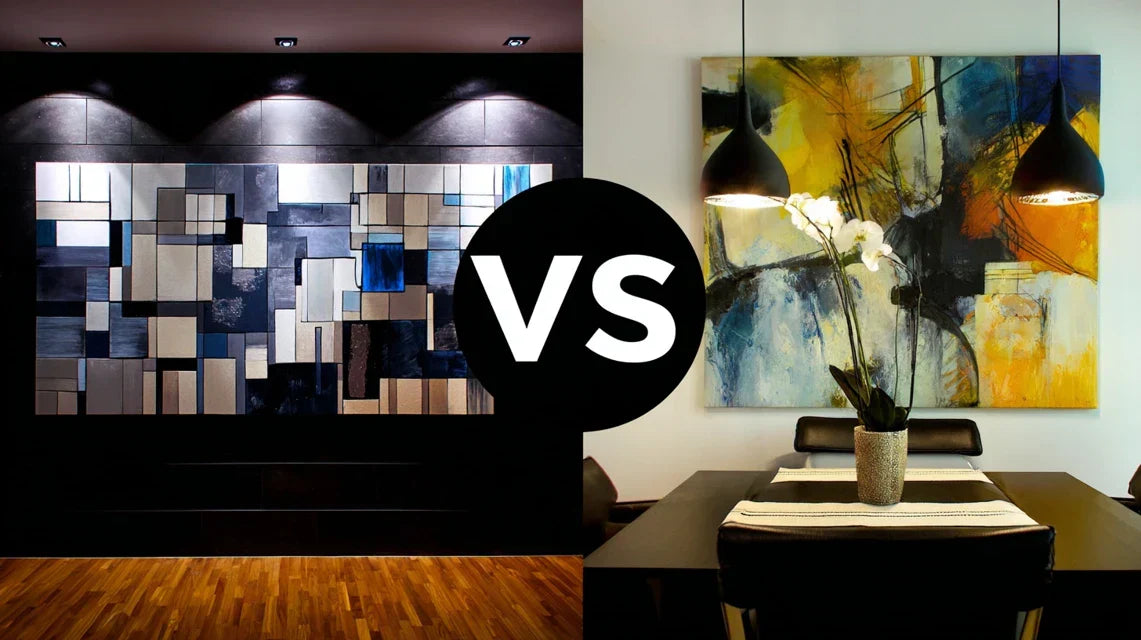
This frustration is perfectly understandable! The decorative art market has long been polarized between two extremes: conceptual abstraction and classical reproduction. This false opposition has created a void for all those seeking something different, authentic and personally meaningful.
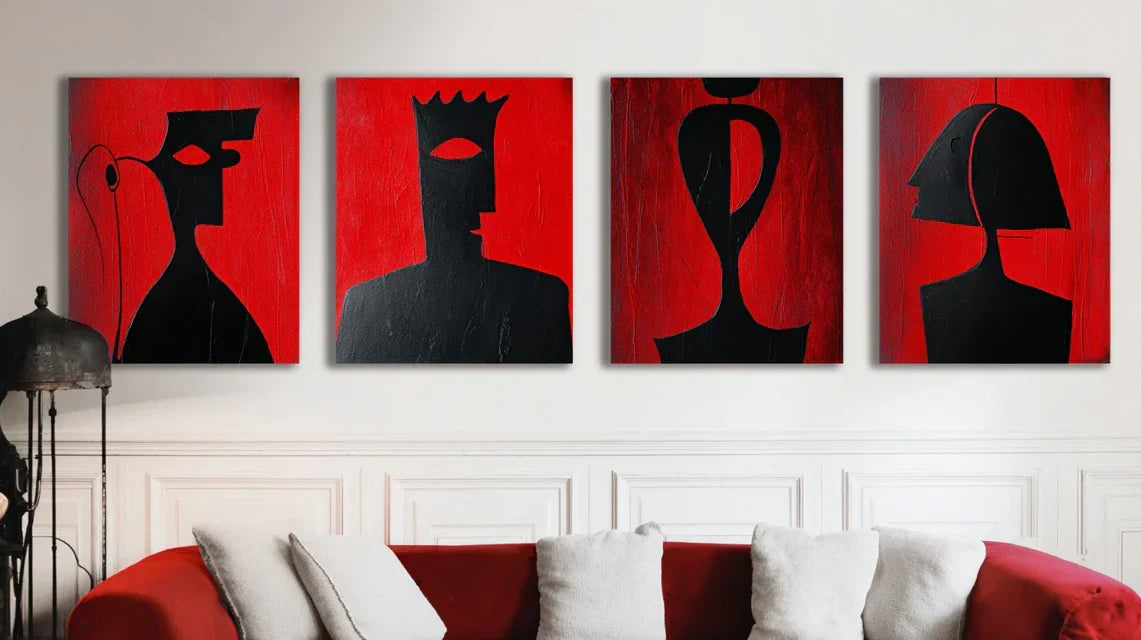
By the end of this article, you will master the art of choosing a stylized face painting that will transform your space into a sophisticated private gallery, and you will discover why contemporary figurative wall art represents the perfect evolution between tradition and modernity.
Why does modern figurative art revolutionize contemporary decoration?
Stylized figurative art is experiencing a spectacular comeback in 2025, and it's no coincidence. In a world saturated with abstract digital stimuli, our brains instinctively seek human references, faces, silhouettes. It’s like finding an authentic conversation after hours of social networks: the relief is immediate and profound. If you wait any longer, you risk seeing this trend become mainstream and lose its exclusive character.
🎨 Revelation from a collector: "Marie, a Parisian interior architect, says: 'I spent months searching for THE piece for my clients' living room. When I discovered this stylized portrait with clean lines, the effect was magical. Guests invariably stop in front of it, intrigued by a gaze that seems to follow them. It has become the conversation starter at every dinner.'"
💬 Conversation with a decor expert
The principle of emotional anchoring: A stylized face artwork instantly creates a human connection in your space, transforming a cold decoration into a warm and personal atmosphere. The effect is noticeable from the first days, and strengthens over time until it becomes indispensable.
What's really behind your hesitation about figurative art
If you are still hesitating, it’s probably because you are experiencing one or more of these situations: you wander around galleries without ever finding "the" piece, you are afraid of making a mistake and regretting your choice, or you fear that the artwork will seem pretentious or out of place in your home.
These blockages do not come from you, but from an industry that has long dictated what was "acceptable" in decorative art. For decades, we have been led to believe that one had to choose between "serious" art (often incomprehensible) and "accessible" decoration (often banal).
It's as if they told you that you could only wear haute couture or mass-market ready-to-wear clothing, with nothing in between. Absurd, isn’t it?
The tyranny of “good taste” is over
Contrary to popular belief, good taste in 2025 is no longer about reproducing rigid aesthetic codes, but about expressing your personality with subtlety and authenticity. Contemporary figurative wall art breaks this false rule.
Imagine your home as your personal signature: you don't want it to look like everyone else's, but you also don’t want to shock. That’s exactly what modern figurative art offers.
This aesthetic revolution finally liberates your power to choose artworks that truly speak to you, without worrying about external judgments. Your confidence in decorating will naturally develop.
✨ Instant test: Look at the walls of your living room for 30 seconds. If no element naturally catches your attention or makes you smile, it’s a sign that this emotional connection provided by a stylized face is missing.
Many people think that appreciating figurative art requires technical knowledge of art history or composition. It's a myth perpetuated by an elitist milieu that wants to keep its secret codes.
In reality, your eye instinctively knows how to recognize a stylized face artwork of quality: it’s like recognizing a sincere smile from a forced one, you feel it immediately without being able to explain it.
This natural ability, once you trust it, avoids impulsive failed purchases and guides you towards choices that you will be proud of for years.
The secret fear of judgment from others
Many people privately admit to fearing that their guests will find their artistic choices "bizarre" or "pretentious." This fear paralyzes and leads to "safe" but soulless choices.
Carefully observe reactions at your next party: do guests naturally linger somewhere in your living room? Is there a focal point that sparks conversations?
The absence of these moments reveals the invisible but real impact of a space without a strong artistic personality on ambiance and social interactions.
The 3 undeniable signals:
- Your guests always photograph the same angles: They subconsciously avoid visually "empty" areas, revealing spaces that lack character
- Conversations concentrate in the kitchen: This is often a sign that the living room lacks that "soul" that invites you to linger
- You regularly rearrange your furniture: This agitation reveals an unconscious search for balance that only a centerpiece can provide
The decisive moment: when everything aligns
There is a magical instant where all these elements converge: you come across this artwork that makes you feel exactly what you were looking for without knowing how to name it. This is the "artistic love at first sight" effect - like recognizing your future home from the first seconds of visiting. You will feel it in your posture straightening, your breathing calming, and that little inner voice saying "this is it" before even your rational brain gets involved.
The golden rule of first emotion: If a work makes you stop for more than 10 seconds spontaneously, it's already creating that connection. Trust this instinctive reaction - it never deceives you.
| ❌ Traditional approach | ✅ Modern figurative art | 💡 Why that changes everything | 🎯 Immediate benefit |
|---|---|---|---|
| Choosing according to "rules" of decor | Choosing according to your emotional instinct | Your personality shines through naturally | Confident assumption in your choices |
| Reproducing models seen elsewhere | Creating your unique visual signature | Your interior tells your story | Authentic and remarkable originality |
| Avoiding aesthetic risks | Embracing your crushes | Measured boldness impresses | Spontaneous admiration from guests |
| Waiting for the opinion of others | Trusting your eye | Your personal taste develops | Lasting pride in your choice |
The 3-step method to choose your figurative masterpiece
Rest assured: choosing a stylized face painting that will transform your space follows a logical and reassuring progression. It's like learning to cook a signature dish: first master the basics, then personalize according to your tastes, finally create your own unique version. At the end, you will have this centerpiece that will inspire admiration for years.
🗺️ Overview of your journey: First, identify your emotional style (what makes you feel alive?), then define the desired impact in your space (intimate, impressive, soothing?), finally validate the technical harmony. Each step reveals a dimension of your artistic personality.
This first step is crucial as it determines everything else. It's like choosing the foundations of a house: if it's solid and aligned with your deep needs, the rest will build naturally. You will feel that profound satisfaction of knowing exactly what you are looking for.
🔍 What you need to explore
- A moment of calm at home (20 minutes): No music, no distractions. Your brain needs to connect with your authentic emotions without interference. Avoid stressful or tired moments that distort your perception. Your smartphone or notebook: To note the words that come to mind spontaneously. The idea is not to analyze but to capture your instinctive reactions. Literary quality doesn't matter, only authenticity counts. Access to a few varied figurative works: Gallery websites, decor magazines, or online collections. You are looking for diversity of emotions, not aesthetic perfection. Even a blurry photo can trigger a revealing reaction.
🎯 How to proceed without making mistakes
The first glance exercise: Look at 10 different stylized faces for exactly 5 seconds each. Immediately note the first word that comes to mind - even if it seems strange to you. This instinctive reaction reveals your natural emotional language.
⏱️ Time: 15 minutes | ✅ Successful when: You have 3-4 words that naturally recur | ⚠️ Attention: Do not analyze your reactions - your rational brain will try to "correct" your instincts
The morning mood test: For 3 consecutive mornings, look at your favorite images as soon as you wake up. The one that makes you want to start the day reveals your deep energy need. It is the one that harmonizes with your natural rhythm.
⏱️ Time: 5 minutes per morning | ✅ Successful when: One image systematically "energizes" you | ⚠️ Attention: Don't force anything - if none stand out, it means your initial selection was too homogeneous
Projection into your space: Visualize each favorite work on your problematic wall. Imagine yourself looking at it while drinking your coffee, receiving friends, returning tired. Which one resists all these scenarios?
⏱️ Time: 10 minutes | ✅ Successful when: One work stands out in all your scenarios | ⚠️ Attention: Be wary of choices that only work in a single context
✨ Emotional signature validation:
RECOMMENDED PRODUCTS
Step 2: Defining the desired spatial impact (Personalization)
Now that you know your emotional signature, it needs to be adapted to your specific space. This is the transition from "I like this" to "it will transform my daily life." This step is more rewarding because you begin to visualize the final result concretely. The snowball effect begins: your confidence in your decorative choices naturally extends to other elements of your interior.
📐 Spatial evaluation tools
- A measuring tape: To accurately measure your wall and calculate the ideal proportions. A work that is too small gets lost, too large overwhelms. The golden rule: the artwork should occupy 60-75% of the width of your main piece of furniture.
- Your smartphone in photo mode: To capture your space under different lighting conditions. Photos reveal details that the accustomed eye no longer sees. Take them at different times of the day.
- Newspaper or kraft paper: To create a template with the exact dimensions of the artwork you are considering. Temporarily attach it to the wall to test the real visual impact. It's more revealing than any mental visualization.
🏠 Concrete adaptation actions
The lighting audit: Observe your target wall at 9am, 3pm and 9pm. Note where the shadows fall, from where the main light comes. A ⏱️ ⏱️