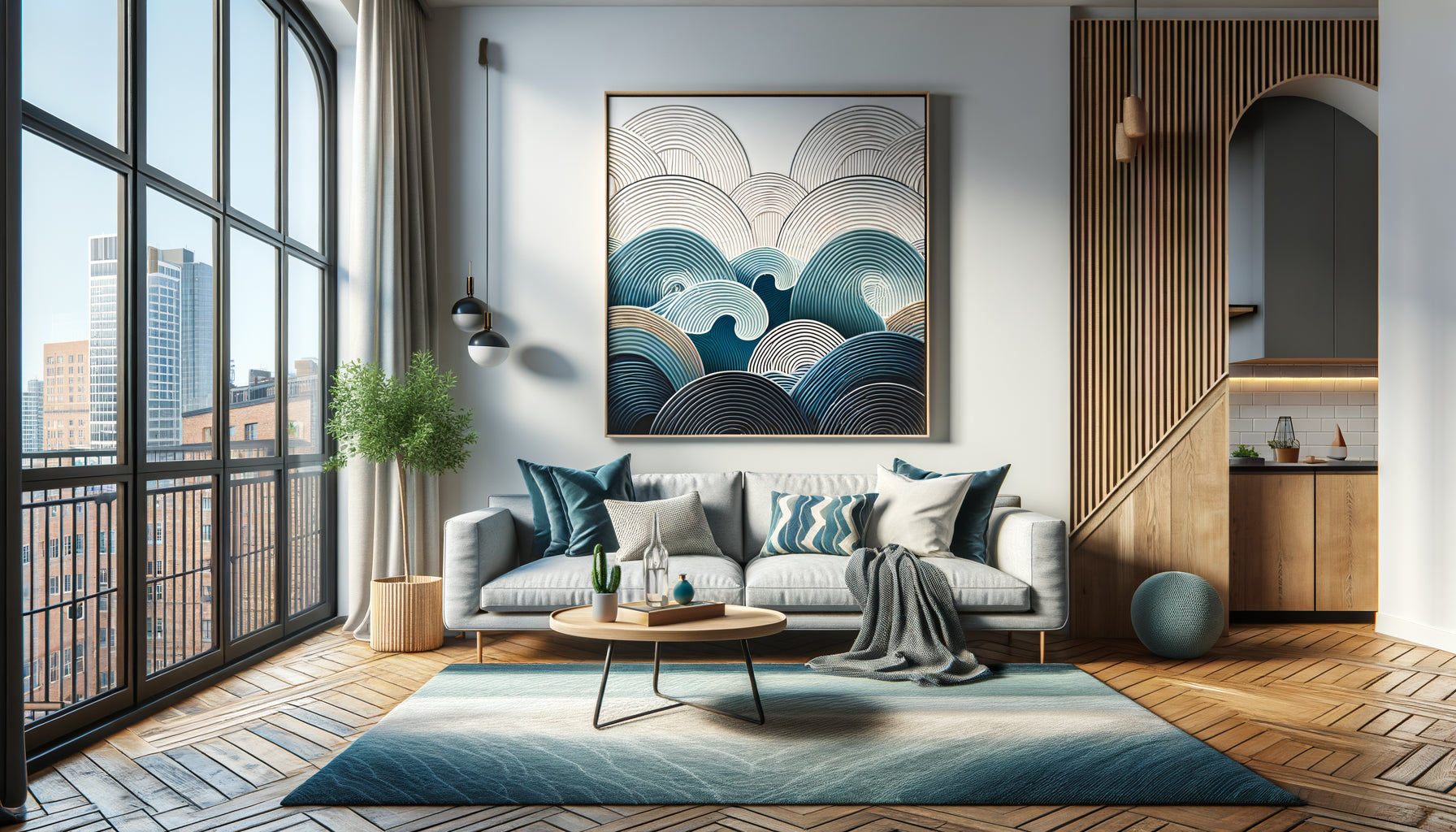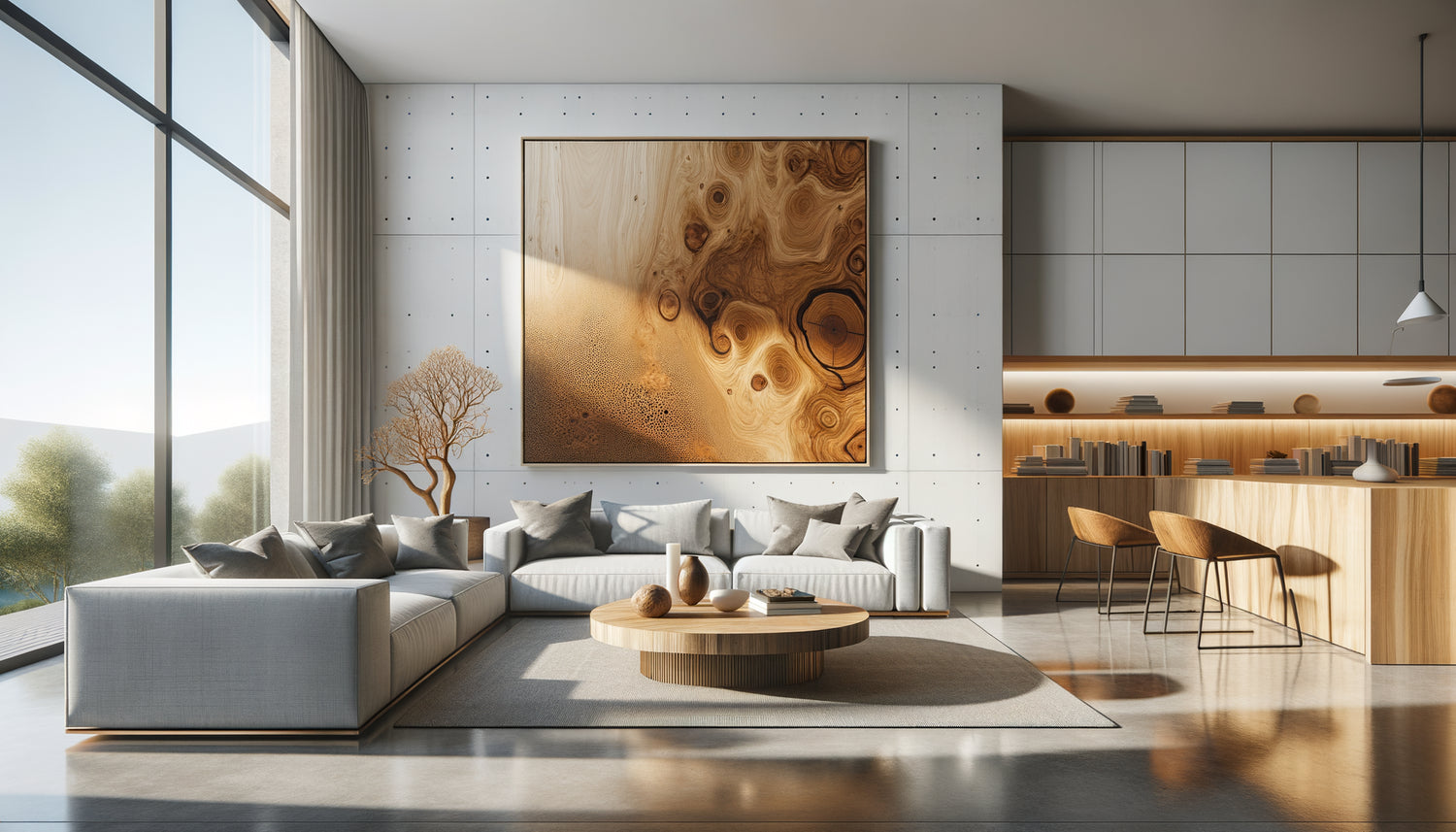
I've visited over 200 Airbnbs in three years. Impeccable apartments, photographed like in magazines. Polished concrete floors, pristine white walls, designer furniture with clean lines. Technically flawless. Yet, the comments came back as a refrain: "Very clean but a bit cold," "Lacks soul," "You don't really feel at home." The occupancy rate stagnated at 60%, despite an ideal location and high-end amenities.
Here’s what a wood texture painting concretely brings: a feeling of anchoring and natural warmth that transforms a clinical space into a welcoming refuge, an authentic focal point that humanizes contemporary architecture, and that organic touch that takes your rating from 4.2 to 4.8 stars.
You've invested in this Scandinavian furniture, these designer lighting fixtures, this state-of-the-art equipped kitchen. Your apartment looks like the Pinterest photos you pinned. But your guests don’t rebook. They rent your accommodation once, then choose that of your competitor for their next stay. This invisible coldness sabotages your rental income without you really understanding why.
The good news? It's not about doing everything over again. A single strategically placed element can reverse this perception. I’ve seen owners radically transform the ambiance of their rentals with a targeted intervention. In the lines that follow, you will discover exactly how a wood texture painting becomes your most powerful ally against this coldness that costs you bookings.
The showroom syndrome: when perfect becomes uninhabitable
Contemporary apartments suffer from a fascinating paradox. The more successful they are aesthetically according to current codes, the more psychologically uncomfortable they become. This smooth uniformity – resin floors, pristine walls, shiny surfaces – creates what environmental psychologists call a “sensory desert.”
Our brains have been programmed for millennia to react to natural textures. The grain of wood, the irregularity of stone, the variation of plant fibers: these imperfections reassure us unconsciously. They signal an inhabited environment, lived, human.
An Airbnb that is too contemporary looks like a high-end waiting room. Admirable, but not emotionally habitable. Your guests sleep there, but don't really
That’s exactly where the magic of a wood texture painting comes in. Not as a decorative accessory, but as a sensory bridge between mineral architecture and our biological need for natural connection.
Why wood speaks to our reptilian brain
The science behind this attraction to wood is fascinating. Japanese studies on Shinrin-yoku (forest bathing) have demonstrated that the simple visual presence of woody textures reduces cortisol by 12 to 15%. Even in reproduction.
A wood texture painting simultaneously activates several brain areas. Vision perceives chromatic variations – these shades of browns, ambers, silvery greys. The prefrontal cortex recognizes natural patterns, those growth rings that tell the story of decades of plant life. Even without physically touching the surface, our tactile memory is activated.
This neurological response is not intellectual. You don't « decide » to appreciate these textures. Your nervous system automatically relaxes, as in front of a fireplace or facing the ocean. It is this involuntary reaction that transforms a simple decorative element into a true wellness tool.
In a contemporary Airbnb with smooth and uniform surfaces, this contrast becomes a lifesaver. The wood texture painting creates a visual and emotional anchor point. It silently says: « Here, you can breathe. Here, it is alive. »
Warmth is not just a matter of temperature
When your guests write « warm apartment », they are not talking about the thermostat. They describe a feeling of environmental security. This diffused impression that the space welcomes them rather than merely tolerates them.
A wood texture painting precisely accomplishes this. It breaks the visual sterility. Its natural irregularity – these veins, knots, density variations – introduces a reassuring form of imperfection into an overly controlled environment. Paradoxically, this « controlled » imperfection makes the space more comfortable than absolute perfection.

Where to place this painting to maximize its impact
Location determines 70% of the effectiveness. A wood texture painting poorly positioned remains a pretty object. Strategically placed, it restructures the entire perception of your Airbnb.
The wall facing the entrance remains the king location. It's the first impression, the one that subconsciously programs the entire experience. Your guests walk through the door, put down their luggage, and their gaze falls on this wood texture. Instantly, their breathing deepens. The space already seems more welcoming before they have even explored the other rooms.
In a minimalist living room, position the artwork above or facing the sofa. It becomes the natural focal point, the one towards which gazes converge during conversations. This organic presence humanizes interactions, making them warmer without anyone really understanding why.
The bedroom deserves special attention. Here, the wood texture artwork acts as an emotional regulator. Above the bed or on the visible side wall from the pillow, it creates this essential visual cocoon for restorative sleep. Your guests fall asleep with this soothing image and wake up in an environment that already feels familiar.
Avoid placing it directly opposite a bright window: the texture would be lost against the backlight. Opt for indirect or lateral lighting that accentuates the reliefs and variations in material.
Choosing the texture that dialogues with your contemporary space
Not all woods are equal when facing a contemporary architecture. The choice of texture determines whether you create a sophisticated harmony or a visual cacophony.
Aged wood textures – patinated by time, in gray and silver tones – blend wonderfully into interiors with neutral colors. They bring that touch of history and authenticity without visually weighing down the space. Perfect for an Airbnb with white walls and light floors.
Warm woods – amber oak, deep walnut, bright teak – are suitable for contemporary spaces already playing on contrasts. If your furniture is predominantly dark, a wood texture artwork in warm tones creates the necessary visual breathing room.
Scandinavian light woods – natural pine, pale birch, bleached ash – harmonize with pure Nordic interiors. They extend the minimalist aesthetic while adding that tactile and organic dimension often lacking in this style.
Scale is as important as texture. In a 30m² studio, opt for a medium format (80x60cm) that structures without overwhelming. In a spacious loft, dare to use a large format (150x100cm) that fully embraces its role as a focal point.
The delicate balance between presence and discretion
An artwork with wood texture is effective when it doesn't shout its existence. It subtly infuses warmth into the space. Your guests shouldn’t think “Ah, a beautiful wooden artwork,” but rather feel “This apartment is really welcoming” without precisely identifying why.
This subtlety is achieved through chromatic consistency. Observe the undertones of your space: do they lean towards gray, beige, or ochre? Choose an artwork whose palette naturally dialogues with these existing nuances. Harmony arises from these discreet conversations between elements.

The return on investment that no one calculates
Let's talk numbers. A quality wood texture painting costs between 150 and 400 euros depending on the format and finish. Faced with the 15,000 euros invested in your contemporary renovation, it is statistically negligible. Yet, its impact on your rental income far exceeds that of your latest 800 euro espresso machine.
My Airbnb property owner clients consistently observe three developments after the strategic addition of natural textures. First, the average rating increases by 0.3 to 0.6 points. Then, comments spontaneously mention the « cozy » or « warm » atmosphere – vocabulary completely absent before. Finally, the booking rate increases by 15 to 25% within three months.
It's not magic, it's math. On rental platforms, an additional 0.3 rating points moves you into a different algorithmic category. You appear higher in search results. More visibility generates more bookings. The wood texture painting thus becomes the investment with the best cost/benefit ratio for your rental.
Not to mention the « digital word-of-mouth » effect. A photographically interesting space is shared more on Instagram. Each story mentioning your Airbnb with this wood texture painting in the background generates free advertising to a qualified audience.
Beyond the painting: creating a system of warmth
A wood texture painting rarely works alone. It acts as a catalyst for an atmosphere, but is best supported by a few strategic complementary elements.
Add a natural material throw to the sofa – crumpled linen, thick wool, woven cotton. This tactile texture physically extends what the painting evokes visually. Your guests can now touch this warmth they perceive.
Integrate some live plants: a robust ficus in a corner, succulents on a shelf. They amplify this biophilic connection initiated by the wood texture painting. The space becomes a coherent sensory ecosystem rather than a collection of disparate objects.
Work on ambient lighting. Multiple and dimmable light sources radically transform the perception of your contemporary space. A table lamp near the painting, indirect lighting behind the sofa: you create islands of visual warmth that counterbalance architectural coolness.
The ensemble forms a system. The wood texture painting is its centerpiece, but each element reinforces the others. Result: this perceptual transformation that makes your guests say « We really feel good here » without consciously analyzing why.
Your contemporary Airbnb deserves this touch of soul that sets it apart
Discover our exclusive collection of Airbnb paintings that transform cold spaces into warm refuges and concretely increase your occupancy rates.
Visualize the before/after transformation
Imagine your Airbnb in six weeks. A couple walks through the door after four hours of train travel. They are tired, a little on the defensive like all travelers facing the unknown of a rental. Their gaze sweeps across the entrance, the living room that opens up before them.
They see this white wall, this design furniture, this impeccable floor... and this wood texture painting that immediately catches their attention. Not in a screaming way, but as a natural anchor point. The woman puts down her suitcase and spontaneously says: « Oh, it's really cozy here. » The man, already more relaxed, sinks into the sofa with a sigh of relief.
Three days later, they leave five stars and this comment: « Beautifully decorated apartment with great taste. We felt immediately at home. The attention to detail makes all the difference. We will gladly return. » Your next guest reads this comment and clicks on « Book » without hesitation.
This scene is now systematically reproduced. Your occupancy rate climbs. Your average rating positions you in the top 10% of your city. You can slightly increase your rates without losing bookings. All because you understood this fundamental principle: the warmth of a space is not decreed, it is built through subtle touches.
The wood texture painting was just one element. But it was the trigger element, the one that shifted the perception of your contemporary Airbnb from « correct but cold » to « welcoming and memorable ». This nuance makes all the difference between an average rental investment and a rental that generates consistent income all year round.
Frequently asked questions about wood texture paintings in Airbnbs
Does a wood texture painting suit all contemporary Airbnb styles?
Absolutely, and that's precisely its strength. Whether your Airbnb is Scandinavian minimalist, industrial loft, or contemporary sleek, a wood texture painting adapts through the choice of its tones. For an industrial style with gray and metal hues, favor aged wood with silvery nuances that dialogues with the raw character. For a very light Scandinavian interior, opt for pale woods like bleached pine or birch which prolongs brightness without weighing down. The key is to consider the painting not as an added decorative element, but as a sensory bridge between contemporary architecture and our biological need for natural connection. Even in the most minimalist spaces, this organic touch never betrays the overall aesthetic – it humanizes it. I've seen owners hesitate, fearing that wood would « make it rustic » in their ultra-modern loft. Systematic result: once installed, the painting reveals the sophistication of the space rather than compromising it. The key lies in the format and finish: a large format with clean lines naturally integrates where a small country painting would clash.
What size of painting to choose to maximize the warmth effect?
The size depends less on the total surface area of your Airbnb than on the configuration of the wall and the visual distance. For a standard living room wall (3 to 4 meters wide), a format of 100x80cm or 120x80cm creates this structuring presence without dominating the space. In a more intimate bedroom, an 80x60cm is enough to establish the desired cozy atmosphere. The frequent mistake is to choose too small for fear of overwhelming: an undersized painting gets lost visually and does not fulfill its role as a warming focal point. The empirical rule: your wood texture painting should occupy approximately 60 to 75% of the width of the furniture below (sofa, bed, console). This proportion creates an instinctive visual balance. Test before hanging: cut out a cardboard rectangle with the intended dimensions, temporarily tape it to the wall, step back 3 meters. Your eye will immediately tell you if the size is right. When in doubt, prefer slightly larger: a generous painting structures the space and affirms its warming role, where a timid format will go unnoticed and not influence the overall perception of your Airbnb.
How to maintain a wood texture painting in a short-term rental?
Maintaining a wood texture artwork is remarkably simple, making it an ideal choice for high-turnover Airbnbs. Unlike textiles that absorb odors and stains, or plants that require constant monitoring, the artwork requires minimal intervention. A monthly dusting with a dry microfiber cloth is usually sufficient for smooth or slightly embossed textures. For more pronounced reliefs, a soft brush removes accumulations in the recesses. If the artwork is varnished or protected (which is the majority of works intended for decoration), it naturally resists ambient humidity and temperature variations in a normally heated home. Simply avoid direct exposure to intense sunlight, which over time could alter the pigments – but this precaution applies to any decorative element. Between rentals, during your usual cleaning routine, simply check that the artwork is securely mounted and dust if necessary. This almost non-existent maintenance contrasts favorably with other « cozy » decorative solutions such as thick rugs or numerous cushions that require frequent washing and regular replacement. The wood texture artwork lasts through the years without losing its visual impact or its warming role, making it a lasting investment for your rental.