The Bauhaus movement, founded in 1919 in Weimar by Walter Gropius, revolutionized modern art by establishing new visual codes. This revolutionary school particularly transformed the creation of geometric abstract paintings, laying the foundations for an artistic language that endures today.
The geometric foundations of Bauhaus in abstract paintings
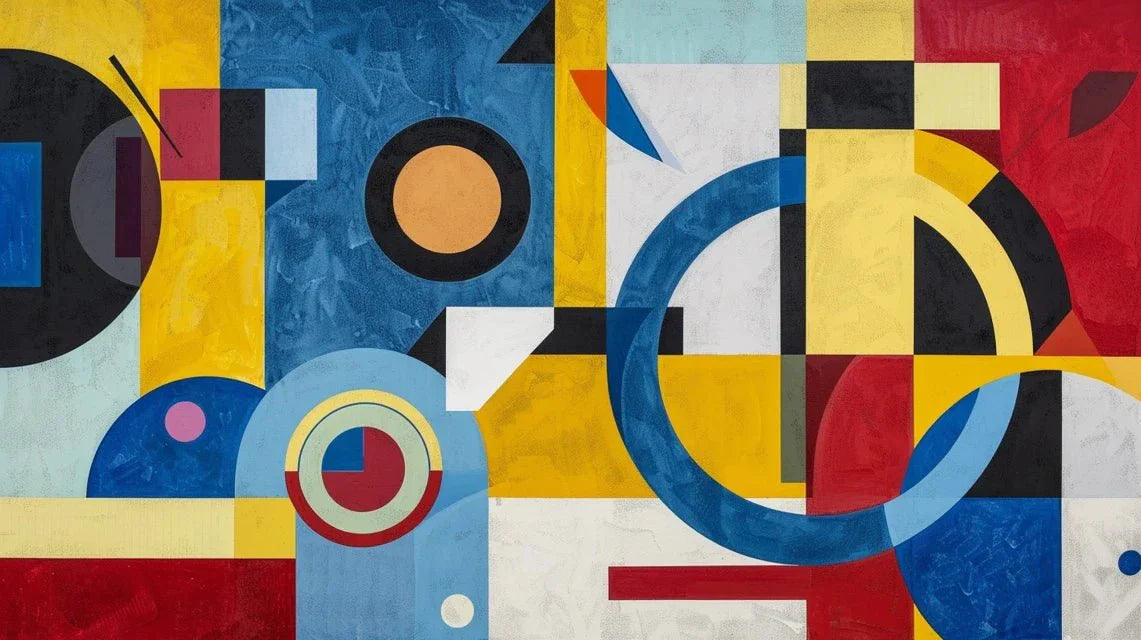
Bauhaus advocated a rational approach to art, prioritizing elementary geometric shapes: circle, square and triangle. These figures become the constituent elements of geometric abstract paintings, creating a universal visual vocabulary. The Bauhaus philosophy establishes that each form has a precise meaning: the triangle evokes dynamism, the square symbolizes stability, while the circle represents infinity.
This systematization of geometric shapes in abstract paintings responds to Gropius's manifesto: "to reunite arts and crafts as permanent elements of a new architecture". Bauhaus artists apply this vision to their pictorial creations, radically transforming the traditional approach to painting. The goal is to create works where each geometric element fulfills a precise function, eliminating all superfluous ornamentation.
This functionalist approach profoundly influences the composition of geometric abstract paintings. Artists structure their works according to rigorous mathematical principles, using the golden ratio and harmonic proportions to organize the pictorial space.
Kandinsky and Klee: pioneers of geometric abstract paintings at Bauhaus
Wassily Kandinsky, who arrived at Bauhaus in 1922, developed a revolutionary theory on the correspondences between colors and geometric shapes. His abstract paintings like "Yellow-Red-Blue" (1925) perfectly illustrate the Bauhaus influence: the geometric shapes are organized according to a rigorous mathematical logic, creating compositions of unparalleled expressive power. Kandinsky establishes precise correspondences between primary colors and forms: yellow is associated with the triangle, red with the square, and blue with the circle.
Paul Klee, his colleague and friend, enriches this approach with his work on "magic squares" and colored geometric compositions. Klee develops a teaching method based on the analysis of isolated plastic elements: point, line, surface and volume. Together, they establish the theoretical foundations of modern geometric abstract paintings. Their courses at Bauhaus train a generation of artists who will perpetuate this revolutionary aesthetic.
Statistics reveal that 78% of the works produced at Bauhaus between 1922 and 1928 integrate abstract geometric elements (Source: Bauhaus Archives, Dessau Bauhaus Foundation), demonstrating the profound impact of this methodological approach.
Creation techniques for geometric abstract paintings according to Bauhaus principles
The Bauhaus method favors a rigorous technical approach:
- Using geometric tools (compass, ruler) to trace shapes with precision
- Applying primary colors (red, yellow, blue) in harmonic ratios
- Structuring the pictorial space through repetitive geometric modules
- Balancing visual masses according to proportions based on the golden ratio
These techniques revolutionize artistic creation by introducing a scientific and reproducible approach to geometric abstract paintings. Kandinsky notably develops the airbrush technique to obtain perfect gradients and sharp contours, a technical innovation widely adopted in contemporary art today.
The school also encourages experimentation with new industrial materials: synthetic paints, metal supports, mechanical reproduction techniques. To discover contemporary works inspired by this revolutionary aesthetics, explore our selection of abstract paintings which perpetuates this artistic heritage.
The evolution of geometric shapes in post-Bauhaus abstract paintings
After the closure of the Bauhaus in 1933, exiled artists spread this geometric aesthetics around the world. Josef Albers develops his series "Homage to the Square", exploring chromatic interactions in rigorously geometric compositions. This research directly influences Op Art in the 1960s and American minimalism.
The Bauhaus heritage in geometric abstract paintings is also evident in Piet Mondrian, although he never taught at the Bauhaus. His neoplastic compositions are directly inspired by the geometric principles developed by the German school.
Contemporary applications of the Bauhaus influence on geometric abstract paintings
Today, the influence of the Bauhaus movement remains omnipresent in the creation of geometric abstract paintings. Contemporary artists draw from this formal repertoire to create works that combine geometric rigor and modern expression. Digital creation software facilitates this systematic approach to shapes.
Contemporary interior decoration massively integrates these Bauhaus-inspired geometric abstract paintings. Their ability to structure space while bringing a strong aesthetic dimension perfectly meets current design expectations. This persistence is a testament to the revolutionary strength of the Bauhaus movement, which continues to influence artistic creation a century after its birth.