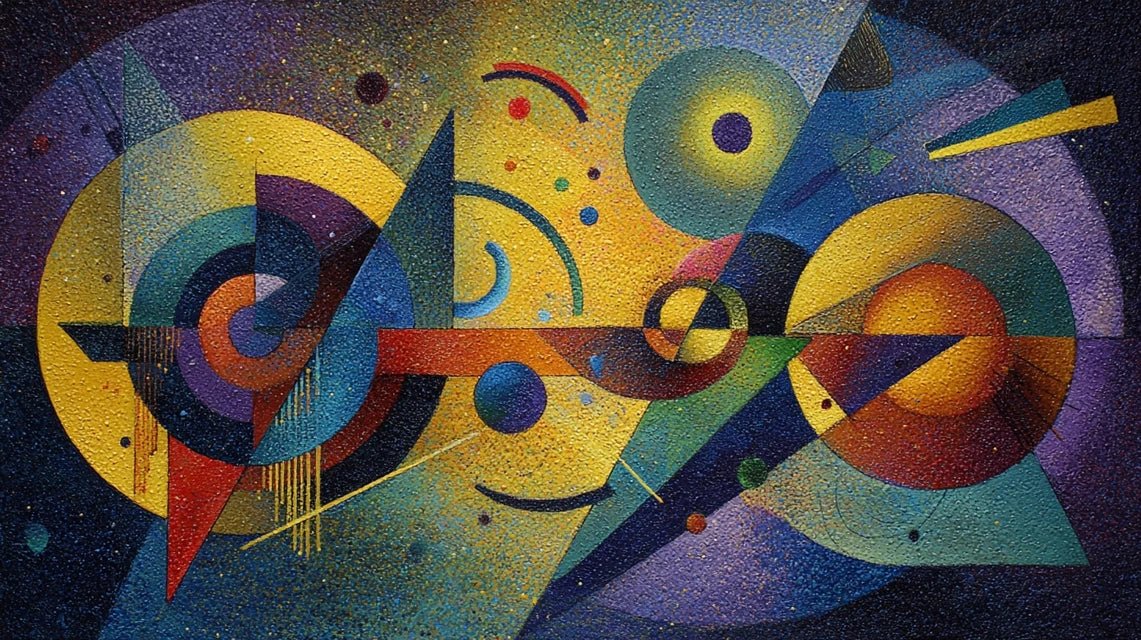
Wassily Kandinsky revolutionized art in 1911 with the publication of "Spiritual in Art," a foundational manifesto that transforms spirituality into a central principle of artistic creation. This major theoretical work establishes the foundations for a new aesthetic where art transcends simple representation to become a vehicle for spiritual elevation, influencing nearly 85% of 20th-century artistic movements (Source: Guggenheim Museum).
Kandinsky and Spirituality: The "Inner Necessity" as Esoteric Foundation
The inner necessity constitutes the cornerstone of Kandinsky's artistic philosophy. This spiritual force guides the artist beyond material contingencies towards the expression of universal truths. According to Kandinsky, this necessity arises from three distinct mystical sources: the artist’s personal element, the spirit of his time, and above all the pure universal artistry - an eternal dimension that directly connects the work to the soul of the viewer.
The Russian artist develops a revolutionary color theory where each hue possesses a specific and measurable spiritual resonance. Yellow evokes the corporeal and earthly energy, blue embodies the spiritual and celestial infinity, while red represents primordial vital movement. This esoteric approach transforms the palette into a veritable mystical language, codifying emotions according to quasi-scientific principles.
Kandinsky's Esoteric Theories: From Spiritual Triangle to Abstract Art
The famous spiritual triangle of Kandinsky perfectly illustrates his esoteric vision of progressive human evolution. This geometric metaphor places the artist-prophet at the top, guiding humanity towards a superior and enlightened consciousness. The wide base represents the popular mass, progressively illuminated by visionary artists who pierce the veils of material illusion.
This fundamental esoteric theory justifies the emergence of abstract art as an inevitable historical necessity. Kandinsky accurately predicts that figurative art, limited by imitation of the visible, will give way to a spiritual art capable of directly expressing the vibrations of the soul. His first abstract paintings from 1910 materialize this revolutionary artistic prophecy.
The main characteristics include:
- Pure geometric forms as new spiritual symbols
- Circles representing cosmic infinity
- Triangles evoking mystical elevation
- Abstract lines replacing traditional naturalist references
Kandinsky and Esoteric Doctrines: Influence of Theosophy on Creation
The decisive influence of Helena Blavatsky's theosophy profoundly marks Kandinsky’s entire work. This complex esoteric doctrine, which synthesizes Eastern and Western mysticism, directly nourishes his revolutionary conception of art as a path to spiritual elevation. Theosophy reinforces his unwavering conviction that the artist possesses a sacred universal mission: to reveal the hidden truths of human existence.
The synesthetic correspondences between colors and sounds, absolutely central to Kandinsky’s theory, are rooted in ancient esoteric traditions. This approach radically transforms the workshop into a veritable mystical laboratory where the artist methodically explores the secret resonances between different planes of reality.
Spirituality in Kandinsky's art: synesthesia and mystical correspondences
Kandinsky’s particular synesthesia - this rare neurological ability allowing to spontaneously associate colors and sounds - becomes the privileged tool of his profound esoteric explorations. He naturally perceives yellow as a strident and aggressive trumpet, blue as a melancholic and deep flute, thus creating a revolutionary musical palette.
These sophisticated mystical correspondences are directly inspired by ancient esoteric theories on the fundamental unity of the universe. Kandinsky progressively develops a veritable spiritual grammar where forms, colors and sounds participate harmoniously in a unified and universal cosmic language.
Artistic creation in Kandinsky: art as a universal spiritual language
For Kandinsky, authentic artistic creation definitively transcends aesthetics to become a transformative spiritual act. The authentic artist never passively copies nature but actively reveals its invisible dimension, its secret forces and hidden harmonies. This fundamental prophetic mission places art at the absolute heart of humanity’s spiritual evolution.
His spiritual legacy continues to massively inspire contemporary artists seeking an art capable of profoundly transforming human consciousness. Kandinsky’s innovative esoteric theories remain an inexhaustible source for all those who conceive art as a path of transcendence rather than superficial aesthetic entertainment.