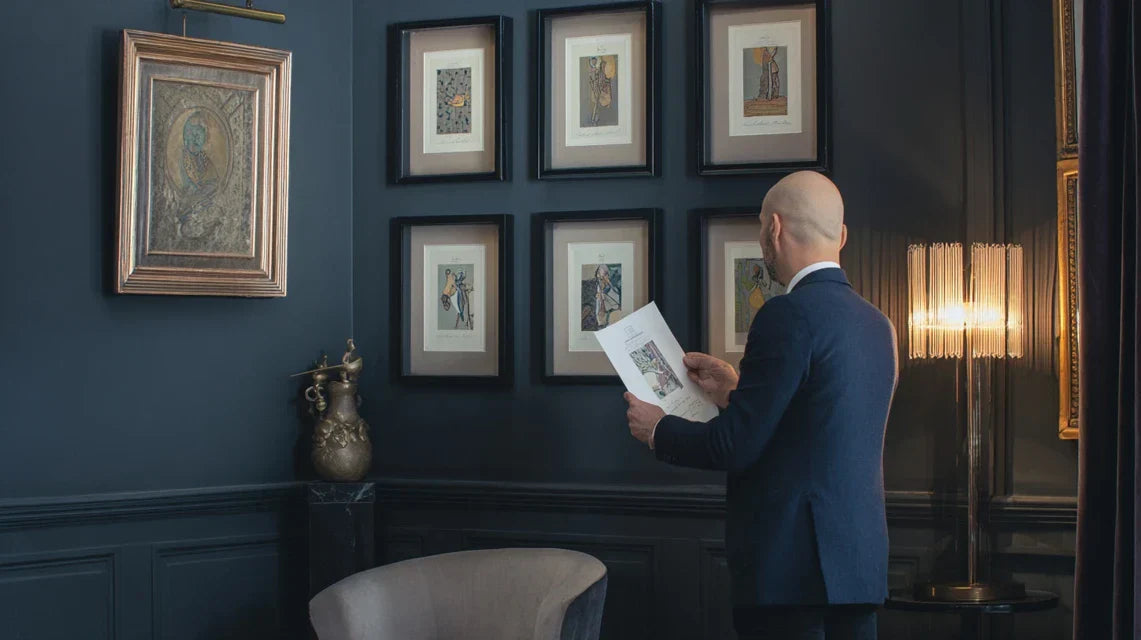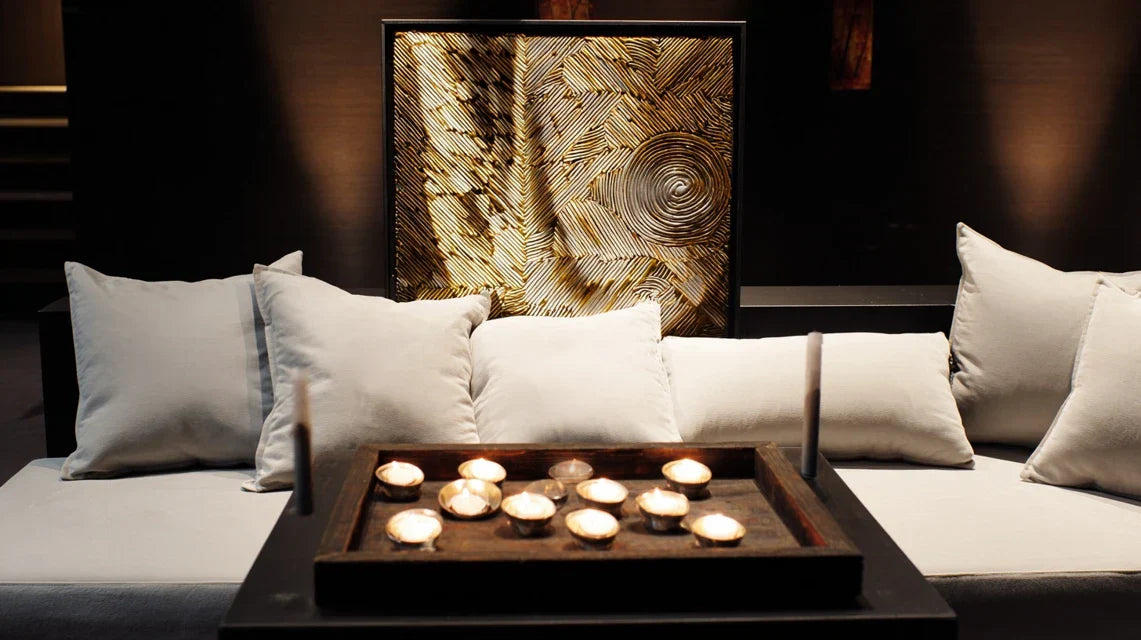
You come home after a long day, desperately searching for a corner of serenity in your living room... but your eyes fall on an empty, cold wall that inspires no inner peace.
This feeling of spiritual emptiness in your living space frustrates you: you would like to create a place of personal contemplation, but without the traditional religious codes that don't suit you.
You may have tried a few candles here and there, a plant or two, but nothing creates that sacred and soothing atmosphere you are looking for. The space lacks soul, depth, that secular spiritual dimension that would allow you to reconnect with yourself.
This is perfectly normal: creating a secular visual wall altar requires a thoughtful approach that goes far beyond simple decoration. Most people think it's enough to hang a few inspiring images, but they miss the essential.
By the end of this article, you will know exactly how to transform an ordinary wall into a true personal sanctuary, capable of offering you daily moments of pause and spiritual elevation that you need, without any religious reference.
Why does your wall have so much influence on your spiritual well-being?
Your visual environment directly shapes your inner state more than you imagine. If you are still waiting to create that sacred space, you are missing hundreds of daily opportunities to recharge. It's like having a source of pure water available but continuing to drink dirty water.
🏠 Lived testimony: Marie, an interior architect, says: "I had this wall facing my sofa that remained stubbornly white. Every evening, when I sat down to unwind, my gaze got lost in the void. I installed my visual altar with three earth-toned paintings, a floating shelf with pebbles and candles. Now, even just looking at that wall instantly calms me."
💬 Conversation with a decor expert
The golden rule of the secular wall altar: It should inspire contemplation without imposing belief. Like a Zen garden that soothes with its very presence, your wall becomes a visual refuge that reconnects you to what's essential in less than 30 seconds of looking.
What really happens when your space lacks sacred dimension
You come home tired and your gaze instinctively seeks a soothing anchor point, you feel the need to take a meditative break but the environment doesn't lend itself to it, or you would like a daily reconnection ritual but nothing in your space invites it.
This isn’t a lack of spirituality on your part; it's simply that your environment doesn’t support your natural need for contemplation. Your brain needs visual cues to switch into contemplative mode.
It’s like trying to relax in a train station: even with the best intentions, the environment doesn't favor the desired inner state.
First hidden cause: The confusion between spirituality and religiosity
Most people think that a spiritual space must necessarily contain traditional religious symbols. In reality, secular spirituality draws its strength from universal elements: nature, geometry, textures, light.
It’s like the difference between a chemical fragrance and the natural smell of a forest after rain: authenticity doesn't need artifice.
This confusion deprives you of the freedom to create your own visual spiritual language, adapted to your values and personal sensitivity.
🧪 2-minute test: Close your eyes, think of a place that naturally soothes you (forest, beach, mountain). Open your eyes and observe your wall: do you find even one element that evokes this natural serenity?
Many people think that it’s necessary to accumulate many objects to create a sacred space. It's exactly the opposite: spiritual strength is born from simplicity and intention.
Imagine a Japanese tea master: he only needs three perfectly chosen elements to create a profound ceremony. Too many objects disperse attention instead of concentrating it.
This belief leads you to over-decorate, creating visual noise where you seek peace.
Third hidden cause: The forgetting of the energetic dimension
Few people realize that the location and orientation of their wall altar directly influences its effectiveness. An inspiring painting poorly placed loses 80% of its impact.
You can easily spot it: if your gaze naturally slides over your wall composition without stopping, then the energy isn’t flowing well.
This turns your attempt at a sacred space into a simple background decoration, with no real soothing power.
3 signs that your wall lacks sacred dimension:
- The fleeting gaze: Your eyes pass over the wall without settling, as if nothing invites them to pause for contemplation
- Lack of emotion: You look at your wall without feeling peace or inspiration, just indifference - no emotional connection is established
- The need to escape: Paradoxically, you prefer to look at your phone rather than this wall, a sign that the space does not nourish your soul
The trigger element: The conscious intention behind each choice
What truly transforms a wall into a spiritual altar is the conscious intention you put into each chosen element. Like a chef who infuses their love into their cooking, your intention resonates in the energy of the space. You can identify it when every object has a deep reason for being and not just aesthetic.
The rule of sacred intention: Each element of your wall altar must resonate with a value or feeling you wish to cultivate. You check it by asking yourself "Why this object specifically?" - the answer should come from the heart, not the head.
| ❌ Classic decoration | ✅ Secular visual altar | 💡 The difference | 🎯 Felt benefit |
|---|---|---|---|
| Accumulation of pretty objects | Intentional selection of meaningful elements | Each piece has a spiritual purpose | Feeling of coherence and peace |
| Following decor trends | Expressing your personal spirituality | Authenticity versus conformity | Deep connection with yourself |
| Immediate visual impression | Invitation to contemplation | The eye stops and the soul settles | Moments of daily replenishment |
| Passing fashion effect | Durable spiritual anchoring | Evolution with your inner journey | Long-term emotional stability |
How to create your visual wall altar in 3 transformative steps
Creating a secular wall altar is not complicated once you understand the logic. It's like composing a soothing melody: you start by finding your fundamental note (the intention), then you add harmonies (the visual elements), and finally you create the rhythm (the arrangement). At the end, you get an space that sings serenity with every glance.
🎼 Overview of your creation: Step 1 - Define your sacred intention and choose the location (foundations), Step 2 - Select your visually meaningful elements (the melody), Step 3 - Harmonize the whole and create the usage ritual (final orchestration).
Step 1: Anchor your intention and define the sacred space
It all begins by clarifying what you're seeking in this spiritual practice. It’s like planting a seed: you must first prepare the inner ground before creating the outer expression. This step gives you an emotional compass for all your future choices.
The necessary elements of reflection
- Your personal spiritual intention: This is about precisely defining what you want to cultivate (peace, gratitude, connection with nature...). Don't choose what "should" inspire you according to others, but what resonates authentically within you. Dig beyond generic words to find your deep truth.
- The optimal energy location: Look for the wall that naturally attracts your gaze in your living space. Avoid passageways or walls facing screens. The location should invite pause, not distraction. Test at different times of the day to see how natural light interacts with the space.
- Your desired connection rhythm: Reflect on when and how you want to use this space: morning meditation, contemplative break when returning from work, evening gratitude moment. This clarification directly influences the design of your altar.
Now let's move on to the concrete creation of your space
Practical application of spiritual grounding
Define your spiritual keyword: Sit facing the chosen wall, close your eyes and feel what inner state you would like to cultivate daily. Choose ONE word that summarizes this aspiration (serenity, gratitude, inner strength...). This word becomes your guiding thread for all aesthetic choices.
⏱️ Time: 15 minutes | ✅ Success when: The chosen word truly moves you, it echoes a deep need | ⚠️ Attention: Avoid "trendy" or intellectual words - prioritize what touches your heart.
Delimit the sacred space: Use masking tape to trace the contours of your future wall altar (usually 80cm to 120cm wide). This materialization helps you visualize the space and test different proportions. The space should feel balanced in relation to your furniture.
⏱️ Time: 10 minutes | ✅ Success when: The delimited space attracts the eye without dominating the room | ⚠️ Attention: Don't go too big at first - it’s better to have a small perfect space than a large diluted one.
Test the energy of the location: Spend different times of the day sitting facing this space, observing how you feel. Note variations in light, ambient noise, your natural level of concentration. A good location will spontaneously soothe you.
⏱️ Time : 3 days of observation | ✅ Successful when : You feel a natural peace when looking at this space, even empty | ⚠️ Warning : If you feel agitated or distracted, test another wall.
✨ Validation of step 1 : Your intention is clear, the location naturally soothes you, and you have defined a space that already inspires you. If you feel doubts, take the time to refine rather than rush. This foundation determines the success of the entire project.
OUR RECOMMENDED PRODUCTS
Step 2: Selecting and harmonizing your sacred visual elements
Now that your foundations are solid, you will choose the visual elements that embody your spiritual intention. This is the most creative and personal part of the process. Each element must tell a part of your spiritual story while harmonizing with the others.
Types of elements to consider
- The central, meaningful element : It can be a artwork with natural tones, a photograph of a landscape that moves you, or an abstract artistic creation. Choose something that instantly makes you feel your spiritual keyword. Avoid images that are too detailed and disperse attention - prioritize evocative simplicity.
- Natural anchoring elements : Integrate authentic materials: driftwood, pebbles, succulents, crystals if it speaks to you. These elements connect your space to the earth's energy and bring a tactile dimension. Choose organic shapes rather than geometric ones to soften the whole.
- Soft light sources : Provide dim lighting: flameless LED candles for safety, warm white string lights, or a small ambient lamp. Warm light instantly creates a sacred atmosphere and invites contemplation.
Harmonious composition of your altar
Choose your centerpiece : Select the element that embodies your intention. Place it temporarily on the wall and spend 24 hours with it. It should move you every time you look at it, not just please you aesthetically. It's the soul of your altar.
⏱️ Time : 2-3 days of testing | ✅ Successful when : The element spontaneously inspires your desired spiritual state | ⚠️ Warning : Don't settle for the first choice - your intuition must really validate.
Create visual balance: Arrange your elements according to the rule of thirds: central element slightly off-center, secondary elements that create a harmonious triangle. Alternate heights, textures, and sizes. The eye should be able to flow smoothly from one element to another.
⏱️ Time: 45 minutes | ✅ Success when: The whole seems natural, nothing shocks the eye | ⚠️ Attention: Avoid perfect symmetry which makes the whole too static.
Integrate the dimension of time: Provide elements that evolve with the seasons or your mood: small interchangeable objects, fresh flowers, intention cards. This variability keeps the space alive and avoids routine.
⏱️ Time: 20 minutes | ✅ Success when: You have planned 2-3 modular elements without distorting the whole | ⚠️ Attention: Keep a stable base - change the details, not the structure.
Your visual altar is now installed, but it still lacks energy activation which will transform it into a true sacred space. It is your conscious and regular use that will give it its spiritual power. You are going to create a bridge between your intention and your daily life.
Ritualization of your sacred space
Create your daily activation ritual: Define a simple gesture that you will repeat each time you connect to your altar: light a candle, take three deep breaths, mentally say an intention. This regularity creates neurological anchoring of peace.
⏱️ Time: 2-5 minutes per day | ✅ Success when: The gesture becomes automatic and instantly triggers your state of serenity | ⚠️ Attention: Keep the ritual simple - complicating kills habit.
Schedule your connection moments: Choose 1 to 3 specific times in your day when you will stop in front of your altar. In the morning upon waking up, after returning from work, or before going to sleep. Regularity transforms the space into a reliable emotional refuge.
⏱️ Time: Commitment for 21 days | ✅ Success when: You feel like you're missing it on the days you forget | ⚠️ Attention: Start with one moment per day to create the habit.
Refine energy according to your feelings: After a week of use, subtly adjust: move an element, change the lighting, add a texture. Your altar must evolve with your spiritual practice and remain aligned with your needs.
⏱️ Time: 15 minutes of adjustment per week | ✅ Success when: The space still inspires you as much after several weeks | ⚠️ Attention: Change by intuition, not out of boredom - keep the consistency.
The rule of spiritual maturation: An altar truly becomes powerful after 21 days of regular use. Before that, it is normal not to feel all its power. Be patient and consistent - energy builds up gradually, like a spiritual muscle that strengthens.
You now master the fundamentals, but some expert subtleties can transform your practice from amateur to true spiritual art of living. These details make the difference between a beautiful space and a sanctuary that truly transforms you.
🎭 Master technique: seasonal intention: Every 3 months, rephrase your spiritual intention based on your personal evolution. Your altar then becomes a living mirror of your growth rather than a frozen decor. Then change 1 or 2 elements to reflect this new intention.
🤔 Expert reader question
"How do I know if my altar is really working or if it's just decoration that I like?"
Excellent question showing a real search for authenticity! An altar that "works" spiritually creates concrete changes in your daily life: you feel calmer facing stress, you naturally take a step back from problems, you feel more gratitude. It's a very simple test: after 3 weeks of use, do those around you notice that you are more serene? If so, your altar has become a true spiritual tool.
📝 Practical validation: Keep a journal one sentence per day for 21 days: "Today thanks to my altar moment, I felt..." This written record will reveal the real impact on your well-being.
The 5 mistakes that sabotage your sacred space (and how to avoid them)
Even with the best intentions, some mistakes can turn your altar into a simple soulless decoration. I want to spare you these classic pitfalls that dilute the spiritual energy of your space.
- 🎯 Wanting to impress rather than inspire: It is tempting to create an "Instagrammable" altar rather than authentically spiritual. The result: you create cold beauty instead of sacred warmth. Always prioritize what personally moves you, even if it's less spectacular. Authenticity touches more than aesthetic perfection.
- 📱 Placing the altar near screens: An altar facing the TV or near the computer fights against the dispersing energy of screens. Your brain remains in "stimulation" mode instead of switching to "contemplation" mode. Choose a wall away from all technology to preserve the sacredness of the space.
- 🔄 Constantly changing elements: Visual instability prevents energy anchoring. Your brain needs fixed reference points to associate this space with inner peace. Keep a stable base and vary only the small seasonal details.
- 🎨 Copying someone else's altar: Reproducing exactly the sacred space seen on a blog or at a friend’s kills your personal spiritual expression. Your altar should reflect your soul, not the tastes of others. Get inspired but create your own visual language.
- ⏰ Forgetting the temporal dimension: An altar that you glance at distractedly has no spiritual power. Without dedicated moments of conscious connection, your space remains decoration. Schedule your spiritual appointments as you schedule your important appointments.
🛡️ Weekly verification system: Each Sunday, ask yourself these questions: Does my altar instantly soothe me? Have I taken my daily connection moments? Is the space evolving with my needs? If one answer is “no,” adjust before energy dilutes.
🎁 Special offer for readers
Because you took the time to inform yourself, enjoy 10% discount on your first order:
⏰ Valid 72h after reading • Applicable on all our products
🙋♀️ Frequently asked questions about secular visual altars
Allow between €150 and €400 for a complete quality altar: €80-200 for the centerpiece (painting or artistic creation), €30-100 for natural elements and accessories, €40-100 for lighting and hardware. Start with the essentials and enrich gradually - it's better to have 3 perfect items than 10 average ones.
Most people feel an immediate soothing effect upon installation, but true spiritual benefits develop after 2-3 weeks of regular use. Your brain needs time to associate this space with a state of serenity. Be patient and consistent - it's a long-term investment in your well-being.
Absolutely! A 50cm x 30cm altar can be just as powerful as a large wall if the intention is clear. Prioritize verticality: slim wall shelf with 2-3 levels, portrait format painting, discreet LED lighting. Spiritual effectiveness does not depend on size but on energy consistency.
Review your spiritual intention every 3-4 months and adjust 1-2 elements if necessary. Always maintain a stable base (70% fixed items) and evolve the details (30% adaptable). Your altar grows with you like a spiritual garden that flourishes according to the seasons of your soul.
Yes, if you respect an emotional coherence rather than an aesthetic one. Mix styles that evoke the same spiritual emotion: a modern abstract painting with an ancient natural pebble, if both inspire serenity in you. The important thing is that the whole tells your spiritual story harmoniously.
Your spiritual transformation begins now
In a few weeks, when returning home, your gaze will naturally settle on your wall altar and you will instantly feel that inner peace you were seeking. Your daily stress will dissolve in a few breaths facing this space that you have created with intention. Your loved ones will notice your new serenity and ask you for your secret.
Beyond decoration, you will have developed a personal spiritual practice that accompanies you every day. This ability to create the sacred in your environment will spread to other areas of your life: your office, your bedroom, your relationships. You become architect of your well-being.
You now have all the keys in hand. The most difficult thing was to understand the spiritual logic behind the arrangement - now you just need to choose your first element and start this beautiful adventure. Your future serene self awaits you on the other side of this first gesture.
✨ Your first step towards serenity: Today, identify the wall that inspires you and formulate in one word your spiritual intention. Your personal sanctuary is waiting for you to be born and transform your daily life into a source of peace.