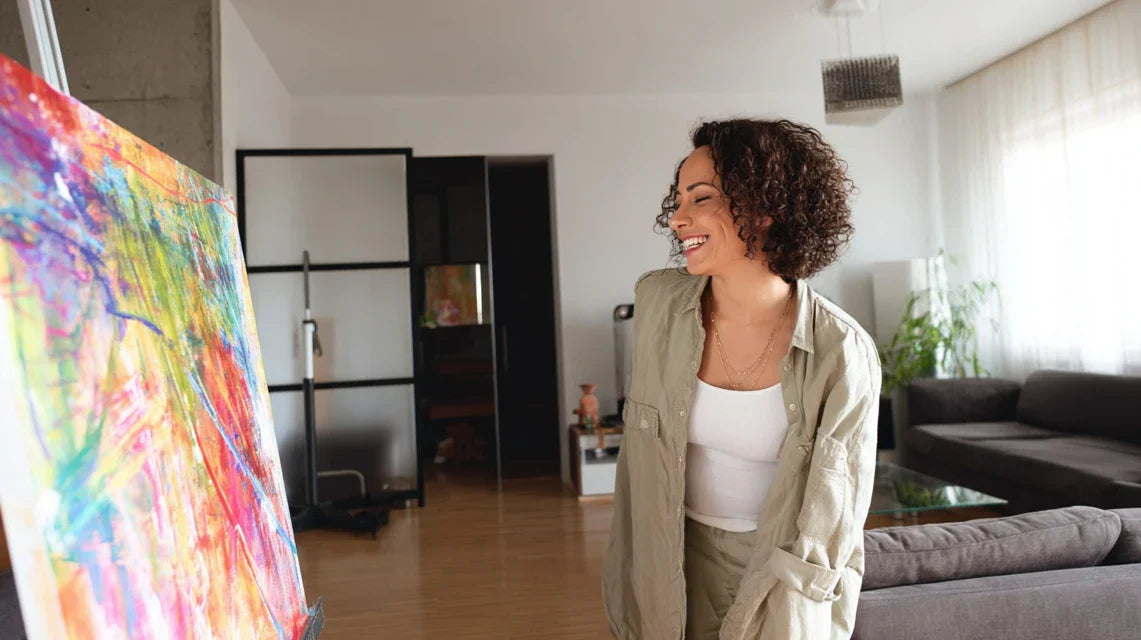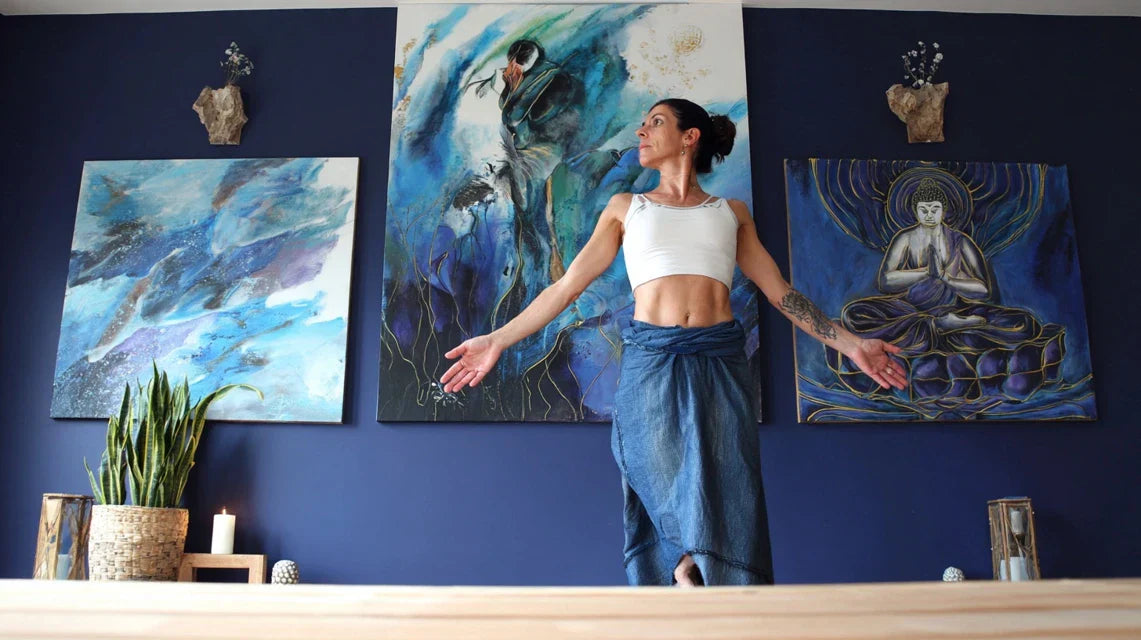
You come home after a tiring day, push open the door to your living room... and immediately feel that sense of coldness. Not physical, but emotional. This impersonal space where you spend so much time doesn't reflect you, doesn't soothe you, doesn't inspire you.
The furniture is well arranged, the lighting functional, everything is clean and tidy. Yet, something is sorely lacking: that spark that transforms a simple space into a true emotional cocoon. That feeling of truly being at home, in a place that understands and welcomes you.
You may have already tried adding some decorative objects, changing the cushions, arranging plants. But the result remains disappointing. The space remains cold and impersonal, as if your attempts only skim the surface of the problem without ever truly reaching it.
That's perfectly normal! The problem isn’t a lack of taste or a limited budget. It simply lacks the central element that will create this emotional bubble: an artistic focal point that tells your story and instantly generates the desired emotion.
By the end of this article, you'll know exactly how to choose and integrate a wall art piece that will transform your impersonal space into a true emotional sanctuary - a place where you’ll immediately feel like you’re truly at home.
Why does your space leave you cold when you live in it every day?
Creating an emotional connection with your interior is not a luxury, but a psychological necessity. Imagine spending years in a place that never nourishes you emotionally: the impact on your well-being is enormous. It's like eating nutritious but bland foods every day - your body survives, but your soul withers. If you wait any longer, you risk getting used to this cold neutrality and gradually losing your ability to feel the simple joy of being at home.
🏡 Real-life testimonial: Sarah, an interior architect, recently confided in us: "I lived in a perfectly arranged but totally impersonal apartment for 3 years. Every evening, I came home with the feeling of being in a high-end hotel room. The turning point came the day I hung my first abstract artwork with warm tones. Within 24 hours, the space became MY space."
💬 Conversation with a decor expert
Art wall doesn’t decorate your space, it reveals it: A well-chosen artwork acts like a photographic developer that brings out the hidden personality of your interior. In a maximum of 48 hours, you will feel this emotional transformation that you have been looking for for months.
Why haven’t your personalization attempts ever really worked?
Do you recognize these situations? You multiply small decorative objects without noticeable effect. You regularly change the textiles but the atmosphere remains flat. You rearrange the furniture in hopes of creating more warmth, but the space retains that institutional coldness that frustrates you.
What’s really happening is that you are trying to create emotion with functional elements. It's like trying to warm a room with scented candles when what you need is a real radiator. The problem isn't your approach, but the lack of a central element that generates emotion.
Think about your favorite restaurant: what marks you is not the napkins or cutlery, but that unique work of art that gives soul to the place. Your interior needs its "signature artwork".
First hidden cause: you are looking for perfect harmony instead of authentic emotion
Here’s something surprising: the interiors that touch us the most are never perfectly harmonious. They have that little “dissonance” that creates personality. Everyone believes that everything must “match”, but the reality of the most beautiful interiors is controlled contrast.
It's like in music: a perfectly smooth melody puts you to sleep, a melody with unexpected accents moves you. Your living room needs that artistic note that “stands out” slightly from the whole to create emotion.
This obsessive search for harmony keeps you in a bland and predictable universe. It deprives you of that spontaneous emotion that you feel when you discover a place with a strong artistic personality. The result? A space
Third Hidden Reason: You Choose With Your Mind Instead of Your Instinct
Here's what almost no one notices: we analyze our artistic choices too much instead of feeling them. How many times have you dismissed a crush because it didn't "match" your current decor style?
The signal to watch out for? You spend more time calculating than feeling when choosing a decorative element. You ask yourself "will this go with..." instead of asking yourself "does this make me vibrate?".
This excess of rationalization makes you miss out on the works that would have created that authentic emotional connection with your space. The result: a logical but soulless interior.
3 Signs Your Mind Is Sabotaging Your Decor Choices:
- You systematically photograph the object to "think about" it: Authentic emotion is not reflected upon, it is felt instantly - like falling in love with a landscape
- You consult 3 reviews before buying: Artistic tastes are intimate and unique - asking for someone else's opinion is like letting them choose your emotions
- You systematically prioritize price over feeling: A crush at €200 will transform your daily life more than a rational purchase at €50 - it’s the difference between investing in emotion or in the object
The Trigger That Changes Everything: Immediate Emotional Recognition
What really makes the difference is this instant connection you feel when looking at certain works. It's like a chemical click: your body relaxes, your gaze brightens, you smile involuntarily. This "artistic love-at-first-sight" effect acts as an emotional catalyst that will positively contaminate your entire space. You’ll easily recognize it: you can no longer tear your eyes away from the work, you want to touch it, you find yourself imagining the ideal place for it in your home. Your instinct has already chosen.
Golden rule of artistic connection: If a work makes you feel something within the first 10 seconds, it speaks your emotional language. Trust that first impression - your primitive brain already recognizes "its" art.
| ❌ Classic rational approach | ✅ Authentic emotional approach | 💡 Why it works | 🎯 Experienced benefit |
|---|---|---|---|
| "It has to match my furniture" | "It has to move me emotionally" | Art reveals decor, not the other way around | Your interior becomes magnetic |
| "I take the time to compare prices" | "I follow that immediate crush" | Emotion is non-negotiable | Every glance at the work nourishes you |
| "It has to be something discreet" | "It has to express me" | Personality embraces contrasts | The space becomes your signature | "It has to please everyone" |
How to create this emotional bubble that truly transforms your daily life?
Rest assured, creating this transformation is neither complicated nor expensive. It's more like planting a tree: you carefully prepare the location, choose the species that will thrive in your environment, and then let it work its magic. The result is felt immediately and intensifies over time, creating this bubble of well-being that you will find every day when you return home.
🎯 Overview of the transformation: 3 simple steps like cultivating an emotional garden - first you identify your emotional "soil" (the space and your needs), then you sow the "artistic seed" (the choice of artwork), finally you integrate it so that it flourishes and transforms the atmosphere. Result at each step: more clarity on your tastes, then the excitement of a crush, finally that magical feeling of truly being home.
Step 1: Identify your emotional signature (the foundation of everything)
Starting by understanding your personal emotional language is essential - it's like knowing your native tongue before learning to express yourself artistically. Without this solid foundation, you risk choosing with someone else's head rather than your heart. Once this step is completed, you will feel this liberating clarity: no more endless hesitations in front of artworks, you will immediately know what speaks to you.
What you need for this exploration:
- A moment of calm at home (30 minutes): No music, no TV, just you and your space - it's like listening to your pulse to understand your natural rhythm. Avoid busy weekends where your mind is cluttered with a thousand worries. This quality of presence determines the accuracy of your discoveries. Your smartphone to note your feelings: Emotion is fleeting, you need to capture it when it arises - like photographing a sunset. Use voice notes instead of writing: your intonation often reveals more than your words. These emotional traces will become your artistic compass. An attitude of curious explorer: Forget what you "should" like according to magazines - it's time to discover what YOU like. Let yourself be surprised by your own reactions: you might discover that you love atmospheres you thought you hated!
Now, let's move on to pure practice:
The emotional exploration of your space:
Stand in the center of your main room: Close your eyes for 30 seconds and breathe deeply. This pause allows your mind to calm down and your true feelings to surface. Then open your eyes and note the first emotion that arises - joy, sadness, boredom, frustration... No judgment, just pure observation.
⏱️ Time: 5 minutes | ✅ Successful when: you have identified 2-3 specific emotions without censoring yourself | ⚠️ Attention: many rationalize their emotions ("it's pretty but a bit cold") instead of feeling them - stay at the level of the body, not the mind
Slowly turn around scanning the walls with your gaze: Note which wall "calls" to your attention and which leaves you indifferent. It's like scanning a room to detect energy zones. Your eye naturally stops at places that have emotional potential - trust this intuitive intelligence.
⏱️ Time: 3 minutes | ✅ Successful when: you have identified 1-2 areas that "vibrate" differently | ⚠️ Attention: avoid looking for the "logical" wall (facing the sofa, etc.) - follow your natural attraction, even if it seems illogical
Imagine different styles of atmospheres in this space: Visualize your room with a large colorful abstract canvas, then with a black and white photo, then with a very graphic work. Observe which vision makes your heart beat faster. This projection technique reveals your deep affinities without the influence of what you already own.
⏱️ Time: 10 minutes | ✅ Successful when: one of the visualizations provokes a bodily reaction (smile, shiver, excitement) | ⚠️ Attention: do not choose with reason ("it would go better with my furniture") - listen to your body which never lies
✨ Validation of your exploration: You must have identified at least one area of your space that inspires you and an artistic style that makes you vibrate. If you still feel confused, do the exercise again focusing on your bodily sensations rather than your thoughts. This emotional clarity is your key to perfect artistic choice - everything else will follow naturally!
OUR RECOMMENDED PRODUCTS
Step 2: Choosing your favorite artwork (the magical moment)
You are now moving to the next level: the quest for your signature artwork. This step is infinitely more rewarding than the first because you are going on an artistic "hunt" with a precise emotional target. It's like looking for love knowing exactly what type of person makes you feel alive - you will recognize “the right one” instantly. The snowball effect begins here: each artwork you discover will further refine your taste and artistic confidence.
Your "emotion hunter" equipment:
- An online gallery specializing in wall art: Prioritize platforms that categorize by emotions rather than technical styles - it's like choosing a restaurant by ambiance rather than type of cuisine. Avoid generalist sites where you will get lost in thousands of options without emotional logic. Specialized galleries understand that you are buying a feeling, not just an object. Your list of emotional keywords from step 1: These terms become your magical search filters - "warm", “soothing”, “energizing”, etc. It's like having a translator between your heart and the art catalog. One emotional keyword is better than 10 technical criteria - it will lead you directly to artworks that speak your language. Your instinct freed from all calculation: For this step, forbid yourself from looking at prices or calculating dimensions - you are in pure exploration. Let your heart create its list of favorites before your reason intervenes. This total freedom reveals your true tastes without compromise.
The "guided love at first sight" method:
Navigate in "pure feeling" mode for 20 minutes: Click only on artworks that provoke an immediate reaction - smile, shiver, desire to touch. It's like speed-dating with art: no reflection, just authentic reactions. Create a “favorites” folder without censoring yourself - even choices that surprise you.
⏱️ Time: 20 minutes | ✅ Successful when: you have saved 5-10 artworks without calculation | ⚠️ Attention: paralysis by analysis - if you start to compare styles or imagine the arrangement, take a break and refocus on feeling
Test your favorites with the "emotional awakening" technique: Reopen each image after a 10-minute pause. The artwork that still vibrates with you after this pause contains your authentic emotional signature. This is the test of lasting attraction versus the simple effect of novelty - your future painting must pass this test.
⏱️ Time: 15 minutes | ✅ Successful when: 1-3 artworks resist the pause test | ⚠️ Attention: keep only the artworks that still give you emotion - familiarity should not kill attraction
You are now reaching the level of mastery where you orchestrate the meeting between your artwork and your space. This step distinguishes amateurs from true creators of atmosphere: you don't just "place" a painting, you create a permanent emotional dialogue. The final result will be that transformed space you dreamed of - a place that nourishes you emotionally every day and naturally impresses your guests with its authenticity.
The art of emotional integration:
Create a "dialogue" between the artwork and the space: Temporarily place the artwork (or its printed photo) in different locations and observe where it "breathes" best. A well-placed work seems to have always been there - it does not fight against the space, it reveals it. You will know it's good when your gaze naturally returns to the artwork without effort.
⏱️ Time: 30 minutes | ✅ Successful when: a location makes the artwork "magnetic" | ⚠️ Attention: do not choose the most "logical" location but the one that creates the most emotion - sometimes it's surprising!
Rule of artistic flourishing: Your artwork is well integrated when you can no longer imagine the space without it. This is a sign that you have created an authentic alchemy - neither forced decor, nor isolated art, but a true emotional bubble that resembles you.
Congratulations! You now master the subtleties of creating artistic atmosphere. Here are the expert tips that transform a beautiful installation into a truly permanent emotional experience. These details make the difference between a "pretty" interior and an "unforgettable" interior - those that your guests spontaneously photograph.
🎨 Secret of luxury decorators: Specific lighting for your artwork multiplies its emotional impact. A simple adjustable LED spotlight transforms your painting into a "light window" that naturally attracts attention and creates the cozy atmosphere of art galleries. An investment of €30 multiplies the "wow" effect of your artwork by 10 - it's the detail that turns your living room into a magazine space.
🤔 "What if I get tired of my choice after a few months?"
"This is my biggest fear: investing in an artwork and quickly getting tired of it..."
I perfectly understand this concern - it's even a sign that you are taking this decision seriously! But here is a reassuring truth: true artistic crushes never fade away. It’s like asking if you can get tired of a sunset – each look reveals new details, new emotions. A work chosen with your instinct grows with you and reveals unexpected facets according to your moods and the seasons. Trust this immediate connection - it is the guarantee of a lasting artistic relationship.
💡 Boredom test: Observe the artwork for 2 minutes imagining looking at it in 2 years. If it still intrigues you and leaves details to discover, then it has that depth which nourishes over time.
The pitfalls that sabotage your transformation (and how to avoid them)
⚠️ Attention, some mistakes can turn your good intention into lasting frustration. I will reveal the 5 most common pitfalls so you can completely avoid them. These errors are normal and perfectly avoidable when you know them in advance!
- ⚠️ Choosing a work of art that is too small for fear of doing "too much": It's tempting to play it safe with a modest format, but the effect will be disappointing - like putting a stamp on a giant envelope. An undersized painting disappears visually and creates no emotional impact. The golden rule: your artwork should represent about 60-75% of the width of the furniture it overlooks. Embrace your artistic choice, it deserves to be seen!
- ⚠️ Hanging too high "to be elegant": Many believe that hanging high makes it more sophisticated, but it's a beginner's mistake. A work of art hung too high cuts off the emotional connection - you can no longer appreciate it naturally. The center of the artwork should be at eye level when standing (about 1m50-1m60 from the floor). Your art should be within sight, not suspended from the ceiling!
- ⚠️ Asking 5 people for advice before validating: It's natural to want reassurance from those around you, but art is deeply personal. Too many different opinions cloud your instincts and make you doubt your true tastes. Result: you choose a compromise that satisfies no one, especially not you. Keep your crush secret until installation - the surprise effect will be magnificent!
- ⚠️ Systematically prioritizing price over emotion: It's tempting to tell yourself "I'll take the cheapest one that looks like it", but it's a false calculation. A work of art that doesn't transport you quickly ends up stored away or replaced - so you spend twice as much. Better to invest once in authentic emotion than three times in disappointing compromises. Your daily well-being deserves this investment!
- ⚠️ Wanting the artwork to "go perfectly with the rest": This obsession with perfect harmony kills the personality of your interior. A work of art that "goes too well" with everything is no longer noticeable - it becomes invisible. Your art should bring its own energy, not blend in with the crowd. It's this controlled little dissonance that creates charm and authenticity. Dare to contrast!
🛡️ Your anti-error checklist: Before finalizing, check these 4 points : Does your artwork still evoke emotion after 48 hours of reflection? Have you chosen the format that suits the space? Does the location allow it to be naturally admired? Are you proud to show this choice to your loved ones? Warning signs to watch out for : You are still hesitating after a week, you already imagine changing it, you find it "not bad" instead of "magnificent".
🎁 Special offer for readers
Because you took the time to inform yourself, enjoy 10% discount on your first order :
⏰ Valid 72h after reading • Applicable to all our products
The questions you really ask yourself about your artistic project
Allow between €150 and €400 for a quality work that will really transform your space. Below €150, you risk a result that lacks presence; above €400, you often pay for the artist's notoriety more than pure emotion. To optimize: choose an emerging artist rather than a star, prioritize high-quality digital art on premium support. Concrete example: Sarah transformed her living room with an abstract painting at €280 - the "wow" effect is guaranteed and the investment amortized in daily satisfaction!
The emotional impact is immediate - from the moment it's hung, you feel the difference. But the real transformation unfolds over 2-3 weeks, as your brain integrates this new “signature” of the space. After 1 month, you will no longer be able to imagine the room without this work - this is a sign of successful integration. Many write to us: "I smile now every time I enter my living room"!
Absolutely not! That's precisely the magic of a well-chosen artwork: it reveals and enhances what already exists. Your existing furniture, your current colors will suddenly seem more harmonious and intentional. At most, you will want to add dedicated lighting (€30-€50) to sublimate your work in the evening. Resist the urge to change everything at once - let your new artistic acquisition digest and reveal the natural adjustments.
Your type of home is less important than your personality. A studio can accommodate a powerful work, a loft can adopt a delicate piece. The key: respect the proportions (artwork = 60-75% of the width of the wall or reference furniture) and orientation (horizontal to enlarge, vertical to elongate). Studio/1 room: focus on 1 strong artwork of 60-80cm. Classic living room: dare 80-120cm. Large space: assume 120cm and more.
Forget categories, focus on emotion! Some people vibrate with abstract art that leaves room for the imagination, while others prefer figurative art that tells a specific story. The infallible test: which artwork makes you want to contemplate it for more than 30 seconds? That's your answer. Observed trend: analytical temperaments often love abstract (mental pause), emotional temperaments prefer figurative (direct connection).
Your new life in your transformed space starts now
Imagine yourself in 3 weeks: you open the door of your home and smile immediately. Your gaze naturally rests on this artwork that resembles you so much, this artistic signature that instantly transforms your mood. Your guests stop, intrigued by this particular atmosphere - they don't know exactly what makes your interior so endearing, but they feel good there immediately. You feel the discreet pride of living in a space that truly expresses you.
This transformation goes far beyond simple decoration. You have developed your artistic eye, learned to trust your aesthetic instinct, and dared to express your personality through wall art. These new skills will enrich all your future decor choices - you will never again suffer from an impersonal space. Your confidence in your tastes will naturally radiate into other areas of your life.
The hardest part is behind you: you now know exactly how to proceed. All that remains is to trust the crush that awaits you and take the plunge. Your emotionally nourishing home awaits you - one where you will feel deeply good every day. Start this artistic exploration now: your daily well-being depends on it!
🌟 Your transformation starts with a click: Your dream space is just one artwork away. You have all the tools to succeed, you lack only your action. In 1 month, you will live in this emotional bubble that you have imagined for so long!