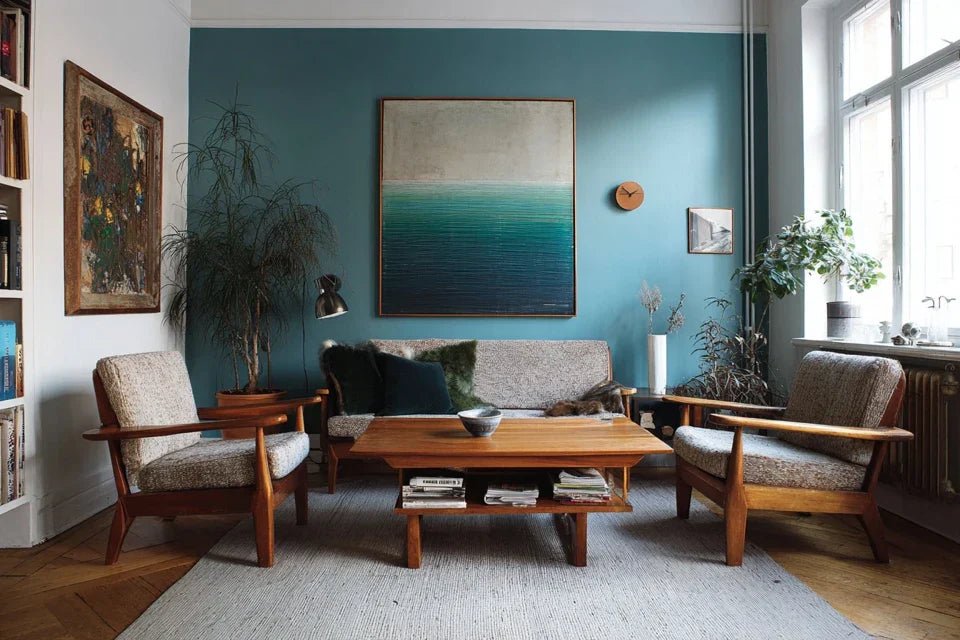
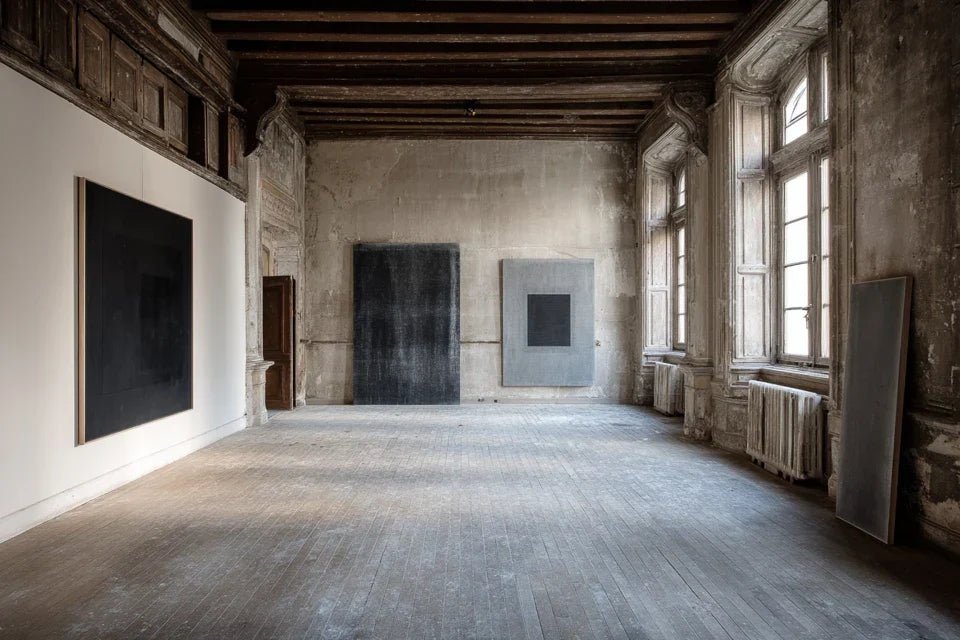
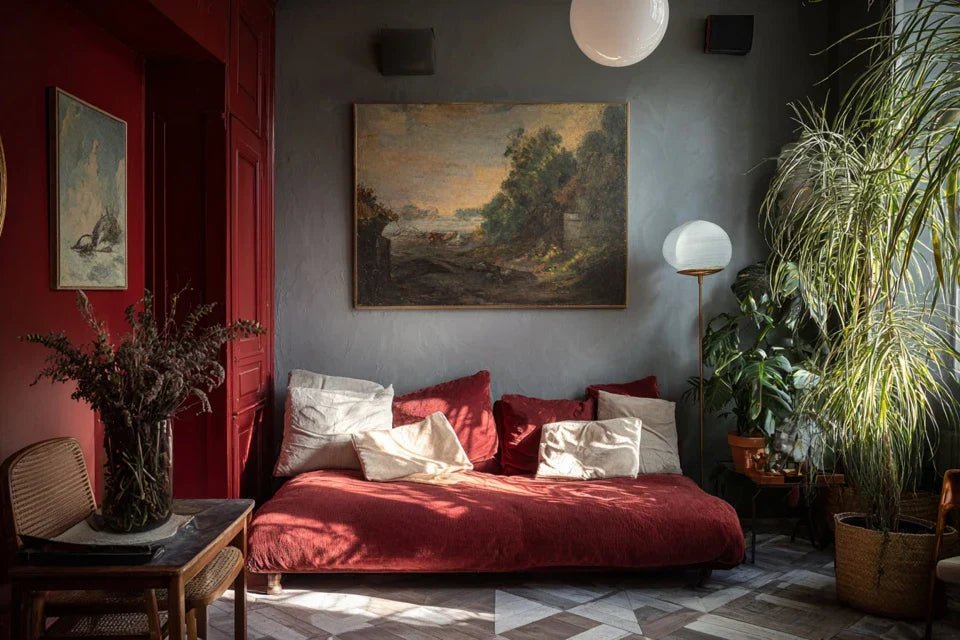
Transitioning from Scandinavian to Industrial Style: What to Do with Your Old Paintings?
By Alexandre MARY
⏱️ Reading time: 8 minutes
You look at your Scandinavian paintings hanging on the white walls of your living room, and suddenly you feel that weariness. These works that made you vibrate a few months ago now seem too soft, too refined for your new desire for industrial character.
You already imagine these walls transformed into exposed brick or painted in matte black, metal luminaires replacing your light wood suspensions. But what to do with these pastel-toned paintings that now seem totally out of sync with your vision?
You may have already tried repositioning them, changing the lighting, or even considered starting from scratch. Result: this growing frustration of not knowing how to operate this transition without wasting your former favorites.
It's perfectly normal! The transition between these two aesthetic universes opposes, and most classic decor advice ignores this specific problem. The real difficulty lies in the 'art of cohabitating' pieces from different stylistic eras.
By the end of this article, you will know exactly how to reinvent your Scandinavian paintings in your new industrial universe, and even how this transition can reveal unsuspected aspects of your favorite works.
Why your Scandinavian paintings can become your best industrial assets?
This transition is not just a question of aesthetics: it's an unique opportunity to rediscover your pieces in a new light. Contrary to popular belief, art does not close itself within a single style. Think of contemporary art galleries that exhibit classic works in ultra-modern spaces.
If you wait until you have finished your transition to think about your paintings, you risk missing the 'visual surprise effect' that can be created by a controlled contrast between Scandinavian softness and industrial harshness.
🎨 Customer testimonial: Sarah, an interior architect from Paris, had three Nordic watercolors in her old loft. During her industrial renovation, she chose to frame them in raw metal and illuminate them with spotlights. Result: her guests first notice these works that seem to "tell a story" between two worlds.
💬 Conversation with a decor expert
"I'm afraid my Scandinavian paintings will look ridiculous in an industrial setting..."
Relax! It’s exactly the opposite. A thoughtful contrast creates personality where a monolithic style can seem cold. It's like wearing a silk shirt with a leather jacket: elegance is born from mixing!
"But I was told that you had to remain consistent in your decor choices..."
Who told you that? Modern decor is all about subtle contrasts. A painting in muted tones on a brick wall is like a violin note in a rock song: it brings depth!
The golden rule of mixing styles: Harmony comes from the balance of opposites, not their uniformity. Your Scandinavian paintings can become the visual breaths that prevent your industrial decor from becoming cold, creating that sought-after "lived-in" effect in contemporary decoration.
What's really happening when you mix Scandinavian and Industrial
You may be feeling this paralyzing hesitation: fear of making a mistake, the impression that your tastes lack consistency, or even the feeling that your old paintings are "judging" you from their frames. This guilt of "betraying" your former style is more common than you might think.
In reality, this blockage comes from a limiting belief: the idea that you have to choose a side and stick with it. However, the most striking interiors are those that tell a story, that evolve with their inhabitants. Your indecision is not a flaw; it's a sign of an artistic sensibility that refuses simplicity.
It's like a musician who hesitates between classical and jazz: the richness comes from the ability to navigate between universes, not to lock oneself in one of them.
The first hidden cause: the illusion of incompatibility of materials
You were probably led to believe that light Scandinavian wood and industrial metal cannot coexist. It's totally false. This belief comes from a simplistic vision that opposes "warm" and "cold" without understanding the nuances.
Think of a modern kitchen: no one finds it strange to have wooden countertops on metallic structures. The secret lies in the proportions and transitions, not in mutual exclusion.
This understanding will revolutionize your approach: instead of seeing your paintings as "elements to be placed", you will consider them as visual bridges between your old and new aesthetic choices.
🔍 Immediate test: Temporarily place one of your Scandinavian paintings against a dark wall or next to a metallic object. Observe for 2 minutes: you will notice that the colors of the work seem more vibrant and sophisticated than before.
The second hidden cause: confusion between style and atmosphere
Many think that adopting an industrial style means creating a cold and masculine atmosphere. This fundamental confusion explains why your Scandinavian paintings seem unsuitable to you.
In reality, the industrial style defines materials and shapes, but the atmosphere depends on how you orchestrate them. It's like the difference between the ingredients of a dish and how it is cooked.
Your Scandinavian paintings won’t "soften" your industrial style; they will personalize it and give it that sophistication that makes the difference between an impersonal loft and a true home.
The third hidden cause: overlooking temporal evolution
Here's what no one tells you: the best industrial interiors don’t come out fully formed from a catalog. They simulate the accumulation of time, the mix of eras that you find in real New York artist lofts.
You can spot this authenticity in the details: a recent artwork is alongside a vintage piece, raw materials welcome refined touches. It's this temporal stratification that creates depth.
By keeping your Scandinavian paintings, you are not making a compromise; you are creating this narrative richness that transforms a simple change of decor into a true evolution of habitat.
3 signs that your transition is going in the right direction:
The gaze lingers differently: Your visitors notice details they had never seen in your paintings, indicating that the new context reveals their hidden potential.
The balance is felt immediately: The room doesn't seem too soft or too hard, but finds that creative tension that maintains visual interest.
You rediscover your own tastes: This transition reveals aspects of your personality that you haven’t explored, creating a sense of personal accomplishment.
The trigger element: mastering intentional contrasts
What really makes the difference is your ability to create voluntary contrasts rather than imposed ones. It's like the difference between a musician who masters dissonances and one who suffers them.
The key factor lies in the intentionality of your choices: each element must have its reason for being in the overall composition. You will recognize this mastery when your decorative choices seem obvious to your guests, even if they would never have thought of that combination themselves.
The rule of mastered contrast: A Scandinavian element gains impact when it is minority but valued in an industrial environment. Test immediately by moving your paintings to the best lit areas of your new rooms.
❌ Limiting belief
✅ Creative reality
💡 Simple explanation
🎯 Immediate benefit
You have to change everything to be consistent
Progressive transitions create more depth
The eye appreciates surprises in continuity
Savings and unique personalization
Styles mutually exclude each other
Mastered contrasts create character
Like in mode: the mix makes the signature
Memorable and distinctive interior
My past tastes were a mistake
They reveal your deep tastes
Evolution enriches, it doesn’t deny
Confidence in aesthetic choices
The industrial must be cold and masculine
It can be warm and sophisticated
The atmosphere depends on orchestration, not style
Personalized and welcoming home
The progressive method to succeed in your transformation
Rassurez-vous : cette transition ne nécessite pas de bouleversement radical. Like a gardener who gradually adapts his plantings to the seasons, we will orchestrate this evolution in logical steps.
The goal is to create a harmonious dialogue between your past and future acquisitions, where each element finds its natural place in your new decorative narrative.
🗺️ Overview of the transformation: We will proceed in three phases: first the audit and revaluation of your existing pieces, then the gradual integration of industrial elements, and finally the final harmonization which will reveal the full potential of this mix. At each stage, you will notice visible improvements that will strengthen your confidence in your choices.
Step 1: The creative audit of your existing paintings
Starting with this step is crucial because it avoids you costly regrets and reveals the hidden potential of your pieces. It's like cleaning your glasses before choosing a new pair: you finally clearly see what you already own.
This phase will give you that immediate satisfaction of rediscovering your own treasures from a new angle.
The tools to reveal the potential of your works
A variable directional lighting: An adjustable intensity lamp (type architect's lamp or floor LED spotlight) will allow you to test different revelation angles of your paintings. Avoid fixed ceiling lights that flatten the artworks. Invest in a model with adjustable color temperature: Scandinavian works often reveal unsuspected nuances under warmer lighting.
Temporary background tests: Get several large sheets of kraft paper, black matte cardboard, or anthracite fabric that you can place behind your paintings to simulate different walls. This stylist technique allows you to preview the impact of each work in your future industrial environment without committing any works.
A quality camera: Use your smartphone in portrait mode or a camera to capture your ambiance tests. The photographic lens often reveals harmonies that the naked eye does not perceive immediately, and you can objectively compare different configurations.
Let's move on to practicing this revealing audit now
How to reveal the hidden qualities of each work
Dramatic contrast test: Place each artwork individually against a dark background and illuminate it with directional lighting. This technique reveals the subtle color nuances and textures that the former white Scandinavian environment tended to neutralize. Don't worry if this seems "theatrical" at first.
⏱️ Time: 10 minutes per piece | ✅ Success when: You discover details or colors you had never noticed | ⚠️ Attention: Some artworks may seem "too intense" - that's normal, you are discovering their true personality.
Graphic strength evaluation: Photograph each artwork in its test setup and convert the photo to black and white. This designer technique reveals the compositional structure of the work, regardless of its colors. Pieces that remain interesting in black and white have a graphic strength compatible with an industrial aesthetic.
⏱️ Time: 5 minutes per piece | ✅ Success when: The artwork retains its visual impact without its colors | ⚠️ Attention: Don't judge very colorful artworks too quickly - they can create powerful focal points.
Material association test: Temporarily place metallic objects (frame, tool, utensil) near each artwork to assess the visual resonances. This experiment reveals which artworks naturally dialogue with the industrial universe and which will require more subtle accompaniment.
⏱️ Time: 15 minutes of overall testing | ✅ Success when: Some associations pleasantly surprise you | ⚠️ Attention: Initial visual clashes can mask beautiful harmonies - give your eye time to adjust.
✨ Validation of this first step: You should have identified at least 60% of your artworks as having a potential for reinvention in your new decor. If not, repeat the tests with different lighting and backgrounds. This step gives you confidence for the next one by revealing that your past tastes were more astute than you thought.
OUR RECOMMENDED PRODUCTS
Step 2: The progressive integration of industrial elements
Now that you know the potential of your artworks, we are going to create their perfect industrial setting. This phase is more rewarding because each addition creates an immediate visible effect. The snowball effect begins here: each new industrial element reveals and enhances your Scandinavian paintings.
Essential transition elements
Architectural lighting: Invest in track spotlights or adjustable industrial wall lights. These luminaires create theatrical zones for your artworks while asserting your new style. Choose models with a dimmer: you can adjust the intensity according to your mood and reveal different facets of your paintings.
Design hanging systems: Replace your discreet fixings with exposed metal or matte black systems (hanging rails, threaded rods, industrial clamps). These functional elements become decorative and create a visual continuity with your new aesthetic.
Background and contrast elements: Prepare paint samples in industrial tones (anthracite gray, matte black, rust brown) or panels of materials (oxidized metal, brick, polished concrete) to test the combinations with your artworks.
Implementing the integration
Installation of highlighting lighting: Start by installing specific lighting for your main works. This first transformation immediately creates a professional gallery effect that legitimizes your Scandinavian paintings in their new context. Directed lighting transforms each work into an intentional focal point.
⏱️ Time: 2-3 hours of installation | ✅ Successful when: Your paintings seem "staged" professionally | ⚠️ Attention: Avoid overly cold lights that harden Scandinavian artworks.
Creation of contrast zones: Gradually apply dark backgrounds behind your strongest works (wall panel, recess, or even a large metal frame). This technique of mise en abyme creates depth and highlights the graphic qualities of your paintings.
⏱️ Time: 1 weekend per zone | ✅ Successful when: The artwork seems to have always been intended for this location | ⚠️ Attention: Always test the effect before painting definitively.
Adding linking metal elements: Gradually integrate metallic objects (shelves, hooks, accent lighting) that create visual echoes with your new hanging systems and unify the whole in an industrial aesthetic.
⏱️ Time: Evolution over several weeks | ✅ Successful when: The metal elements form a coherent network in the space | ⚠️ Attention: Avoid clutter - the industrial style favors impact over quantity.
Step 3: Final harmonization and master touches
You are now reaching the level of aesthetic mastery where every detail counts. This final step transforms your space into a true decorative signature, the one that will make your guests say "I would never have thought of that, but it's perfect". You will create this sophisticated balance between industrial character and artistic sensitivity that distinguishes exceptional interiors.
The finishing touches that make the difference
Light intensity calibration: Fine-tune each light source to create a visual hierarchy between your artworks. Main pieces benefit from more intense lighting, while secondary works create a soft ambiance. This modulation avoids the "museum" effect while retaining theatrical impact.
⏱️ Time: 2 hours of fine adjustments | ✅ Success when: Lighting naturally guides the eye through the space | ⚠️ Attention: Settings may require several adjustments depending on the time of day.
Creating visual breaths: Integrate some elements of softness (textiles, plants, organic objects) that prevent your industrial decor from becoming cold. These touches create natural transitions towards your Scandinavian artworks and unify the whole into a "lived-in" atmosphere.
⏱️ Time: Refinement over several days | ✅ Success when: The space feels naturally inhabited, not staged | ⚠️ Attention: Dose subtly - a few elements are enough to create balance.
The rule of progression towards expertise: You can move on to the next step when the previous one seems natural and obvious. The key indicator: you start seeing possibilities for improvement rather than problems to solve. Cultivate patience - each step builds the foundation for the next.
Congratulations! You now master the subtleties of stylistic mixing. These techniques give you a considerable advantage over those who simply apply a "pure" style without personalization. Your interior now tells your personal story.
💎 Pro secret: Experienced decorators use the "70-20-10 rule": 70% of elements from the main style (industrial), 20% of secondary style (Scandinavian via your artworks), and 10% of personal accents. This proportion creates the perfect balance between affirmed character and nuanced sophistication.
❓ Frequent question from our readers
"I'm afraid my guests will find my mix of styles strange or unprofessional..."
This concern is totally understandable - we have all been conditioned by magazines that present "perfect" but impersonal interiors. In reality, thoughtful mixes intrigue and mark more than mono-style decors.
Think of the most memorable restaurants and hotels: they all mix influences to create their unique signature. Your interior gains authenticity what it could lose in conformity, and that's exactly what will make it unforgettable.
🎯 Reassuring action: Organize a small aperitif a few weeks after your transformation. You will notice that your guests will spontaneously notice and compliment your choices - this is the validation that your personalization has succeeded.
The pitfalls to avoid at all costs in your transition
After supporting hundreds of transformations, we have identified the recurring pitfalls that can compromise your success. These errors are tempting because they seem logical, but they create exactly the opposite effect of what is sought.
⚡ Trying to change everything at once: The enthusiasm for the new project often leads to wanting to revolutionize everything immediately. Result: an interior that lacks soul and a hefty bill. The art of blending requires time for elements to naturally dialogue. Proceed zone by zone, letting each transformation "settle" before the next.
🎨 Underestimating the importance of lighting: Many focus on the large elements (furniture, colors) while neglecting lighting. Yet, it is what reveals or kills your Scandinavian works in their new context. Poor lighting can make your most beautiful paintings appear dull and out of place. Invest in quality lighting before any other purchase.
🖼️ Keeping old frames to save money: Thin, clear frames typically Scandinavian can sabotage your transformation. They create a visual dissonance that makes your works appear "forgotten" in the new decor. Budget for re-framing from the start - it is often this detail that makes the difference between success and failure.
🏠 Copying Pinterest photos without adaptation: Online inspirations show specific cases that do not necessarily correspond to your space or your works. Result: a frustrating sense of "failed copy". Use these references as a starting point, but adapt them to your reality and specific constraints.
🔧 Neglecting the consistency of metallic finishes: Mixing brushed steel, wrought iron, brass and chrome creates a visual cacophony that disrupts the reading of the whole. Choose one or two finishes maximum and stick to it for all your metal elements (luminaires, accrochages, accessories).
🛡️ Continuous verification system: Photograph your evolution every week and compare with your initial goals. If you notice that the atmosphere is becoming too cold, immediately add elements of softness. If your paintings seem lost, reinforce their lighting. Monitor these warning signs: impression of "showroom", difficulties in relaxing in the space, or negative reactions from your loved ones.
Because you took the time to learn, enjoy 10% off your first order:
ART10
⏰ Valid for 72h after reading • Applicable on all our products
Your most frequent questions about this transition
💰 How much does this transformation really cost without breaking the bank?
The good news: this transition can cost between €300 and €800 depending on the extent of your changes. The main investment is in lighting (€150-€300) and re-framing your main artworks (€100-€400). To optimize: start with a single area, buy lighting on promotion at the end of series, and negotiate a group rate with the framer for several artworks. One customer successfully completed their transformation for €340 by spreading it over 6 months.
⏱️ How long before I see satisfactory results?
You will notice an initial impact from the first week with improved lighting. The "wow" effect generally appears after 3-4 weeks when the first re-framings are in place. The complete transformation takes 2-3 months by proceeding gradually, but this duration allows your eye and habits to adapt naturally. Be careful: resist the temptation to speed up - the best transformations mature slowly.
🔨 Do I necessarily have to do heavy work to succeed?
Absolutely not! 80% of the effect can be achieved without drilling a wall. Floor or rail lighting solutions, repositionable hanging systems, and even painting delimited areas (behind a piece of furniture for example) are often sufficient. If you are renting, focus on removable elements: mobile lighting, large metal frames placed on the floor, temporary decorative panels.
🎨 What to do if some of my paintings really don't fit in?
It is normal that 10-20% of your artworks do not find their place in the new decor. Three smart options: move them to more intimate spaces (bedroom, office), evolve them to other rooms of the house that retain a softer style, or consider them as future currency for new acquisitions. Never force it - a painting that is poorly integrated spoils the whole.
⚡ How to avoid the "too cold" effect that I fear?
The key lies in the rule of 3 temperatures: always keep warm elements (wood, textiles, golden lighting), tempered (brushed metal, beige tones) and cold (black metal, concrete) in each room. Your Scandinavian paintings naturally bring the necessary warmth. If the atmosphere becomes too cold, immediately add a plaid, a cushion or a plant - these small elements have a disproportionate impact on feeling.
Your new look at your interior in 3 months
Imagine yourself in three months, welcoming friends into your new interior. They discover this sophisticated balance between industrial character and artistic sensitivity that perfectly resembles you. Your former Scandinavian paintings, sublimated by their new frame, now tell the story of your personal evolution. You feel this quiet pride of someone who has managed to create something unique, far from standardized catalogs.
This transformation will have revealed unsuspected facets of your creativity and your ability to harmonize opposites. These skills in balance and nuance will serve you well beyond decoration: in your professional choices, your relationships, your way of facing challenges. You have developed this expert eye that knows how to see potential where others only see obstacles.
The most difficult - accepting that your tastes can evolve without denying the past - is now behind you. All that remains is to make the first move: turn on that architect's lamp to test the lighting of your first artwork. This transformation awaits you, and it will be more beautiful than anything you can imagine today.
✨ Your moment is now: Every day you wait is one less day to enjoy your new interior. You have all the tools to succeed, and your artistic sensitivity will guide you better than any advice. Trust your instinct - it has already led you to beautiful choices in the past.
📚 To go further in your decor approach
Now that you master the art of stylistic mixing, discover our other guides to optimize every aspect of your wall decoration: professional hanging techniques, color association, creation of a harmonious gallery wall.