I've seen entryways that resembled soulless corridors, and others that captivated you from the very first step. The difference? A monumental mural telling a story spanning millennia. When you decide to immortalize the twelve labors of Hercules on a wall, you’re not simply installing decoration: you’re creating an epic, invoking the power of a founding myth. But this artistic ambition raises a crucial question from day one of the project: what dimensions should be adopted so that this heroic narrative finds its balance between grandeur and elegance?
Here's what a mural depicting the twelve labors of Hercules brings to your entryway: an architectural presence that transforms a passageway into a private gallery, a constant conversation with classical art history, and a visual signature that imprints your universe on the minds of your visitors from the moment they cross the threshold.
Many hesitate for months over this decision. Too small, and the narrative composition suffocates; the twelve episodes become illegible. Too large, and the mural devours the architecture, creating an overwhelming imbalance. This hesitation paralyzes magnificent projects, leaving bare walls where the strength of Hercules vanquishing the Nemean lion could radiate.
Rest assured: determining the ideal size of a mural depicting the twelve labors rests on clear principles, tested in Italian palaces as well as contemporary homes. It’s not about guessing, but measuring, observing and understanding how your entryway interacts with a narrative composition as dense as this one.
In this article, I reveal the precise method for calculating the perfect dimensions of your mural depicting the twelve labors, taking into account architectural proportions, viewing distance, style of representation, and desired visual impact. You’ll discover how to transform your entryway into a modern sanctuary where mythology and design naturally intertwine.
Architecture dictates, the mural responds: deciphering your entryway
Before even thinking about the dimensions of the mural, I always observe the space as a choreographer observes a stage. The ceiling height is the first indicator: an entryway with 8 feet (2.50 m) will accommodate a horizontal narrative mural, while a height of 13 to 16 feet (4 to 5 meters) allows for a spectacular vertical composition where the twelve labors of Hercules are stacked in superimposed registers, in the manner of Renaissance frescoes.
The width of the available wall then dictates the narrative breathing room. To represent the twelve labors in a readable way, count at least 10 feet (3 meters) wide for a stylized version, 16 to 26 feet (5 to 8 meters) for comfortable narration, and up to 40 feet (12 meters) for a truly immersive mural where each episode unfolds with its mythological details.
The rule of thirds architectural works wonderfully: your mural should occupy between one third and two thirds of the total wall surface. Below that, it floats without anchorage. Above that, it suffocates the space. In an 130 square feet (15 m²) entryway, a 60 to 100 square feet (6 to 10 m²) mural creates this perfect balance between presence and breathing room.
The contemplation distance: your invisible ally
Measure the distance between the wall bearing the mural and the furthest point from the entrance hall. This data determines the minimum size of the narrative elements. With 2 meters of viewing distance, prioritize a mural no more than 2 to 3 meters wide, where the twelve labors of Hercules condense into refined vignettes. With 4 to 5 meters of viewing distance, you can deploy a 4 to 6 meter long mural rich in detail, where the Lernaean Hydra, the Augean stables, and the Stymphalian birds appear in all their complexity.
I apply this simple formula: optimal mural width = viewing distance × 0.8 to 1.2. It ensures that your eye captures the composition in a single glance without uncomfortable head movement, while allowing for an approach to savor the details of each heroic labor.
Composing the twelve labors: narrative formats and adapted dimensions
The twelve labors of Hercules are not twelve isolated images, but a sequential epic. This narrative structure directly influences the dimensions of your mural. I identify four major formats, each calling for specific proportions.
The horizontal frieze format (ratio 3:1 to 5:1) aligns the twelve episodes in a linear procession. Ideal for a hall with a long, low wall: 6 meters wide by 1.20 to 1.50 m high. The labors parade like on the metopes of the Temple of Zeus at Olympia. This format requires generous width but works admirably with standard ceilings of 2.50 to 2.70 m.
The panoramic tableau format (ratio 2:1) organizes the twelve labors into two registers of six episodes each. Classic dimension: 4 meters wide by 2 meters high. This balanced composition is suitable for square or slightly rectangular halls. The mural then becomes a monumental window open onto mythology, without violently dominating the architecture.
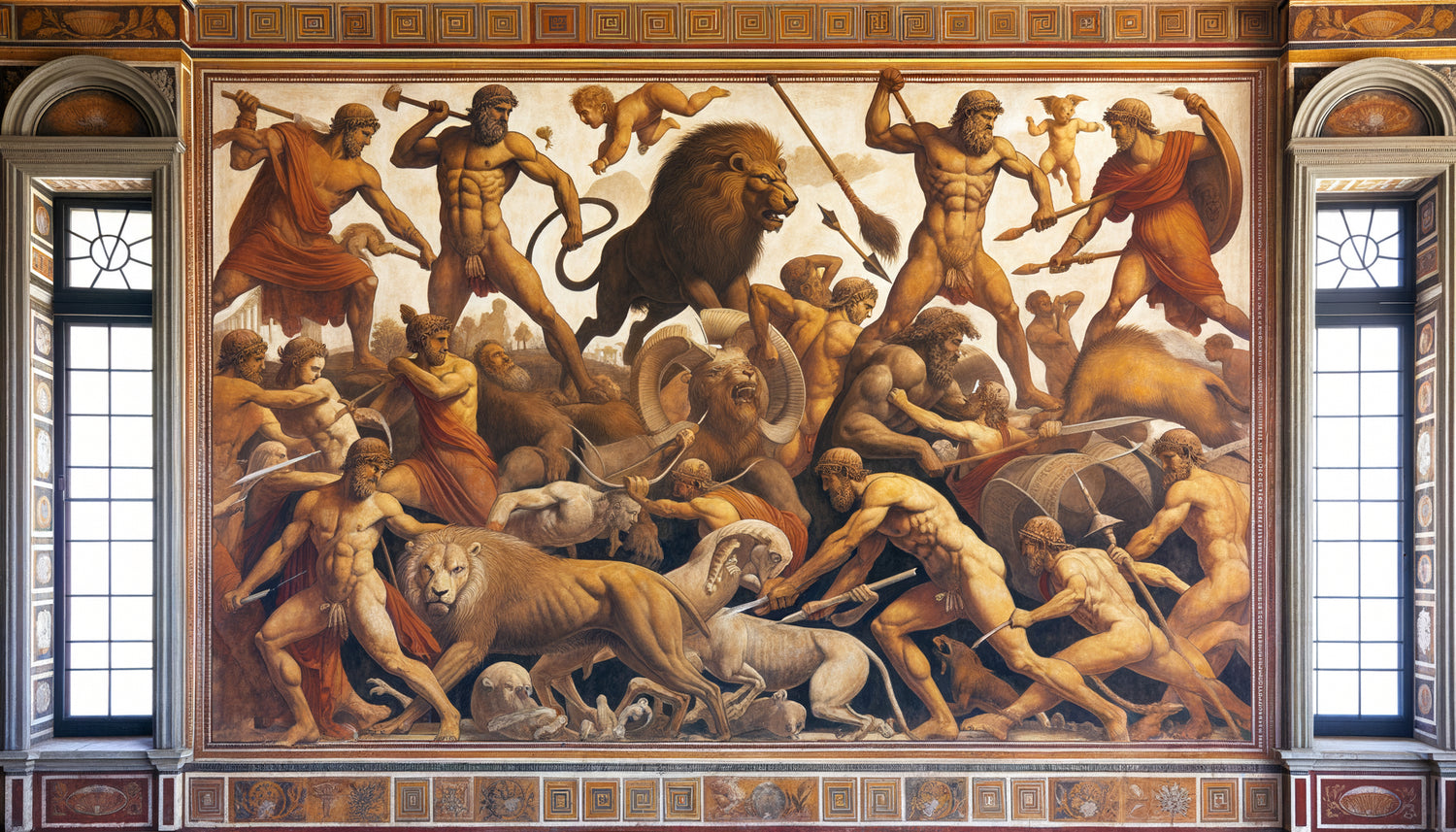
The monumental vertical format (ratio 1:1.5 to 1:2) stacks the labors in three or four levels. Reserved for entrance halls with beautiful ceiling heights: 2.50 m wide by 3.50 to 5 m high. This spectacular composition transforms your hall into an Italian atrium, evoking the frescoes of the Palazzo Farnese where verticality amplifies Hercules' heroic power.
The triptych option: divide to conquer
If your hall presents architectural constraints (doors, windows, stairs), the triptych offers an elegant solution. Divide the twelve labors of Hercules into three panels of four episodes each: central panel of 2 m × 2 m, flanked by two side panels of 1.50 m × 2 m. This modular composition embraces architectural irregularities while preserving the narrative coherence of the mural.

The visual style dictates the dimensions: realism or stylization
A hyperrealistic mural depicting the twelve labors of Hercules in trompe-l'oeil requires generous dimensions. Why? Because realism demands anatomical details, lion skin textures, armor reflections that only work from a certain scale. For an immersive rendering, count at least 4 m² of total surface area, ideally 8 to 12 m² for a mural where each muscle, each facial expression tells the story of the hero's titanic effort.
Conversely, a streamlined graphic treatment, with black silhouettes on gold background in the manner of Greek craters, remains legible and powerful on 2 to 3 m². The simplified lines, blocks of color carry from afar without requiring gigantism. I installed a stylized mural depicting the twelve labors of 2.40 m × 1.20 m in a narrow hallway, and it captured the eye as intensely as a composition three times larger.
The desired level of detail guides your choice: do you want to distinguish the nine heads of the Lernaean Hydra, count the golden apples of the Garden of the Hesperides? Then plan large. Do you prefer a poetic evocation where the labors are guessed more than enumerated? A more compact mural will be enough to create the desired mythological atmosphere.
Practical calculation: your ideal dimensions in three measurements
Let's move on to the concrete method that I systematically apply. Grab a meter and note three measurements of your entrance hall.
Measurement 1: Available wall surface. Width × height of the wall intended for the mural, subtracting doors, windows, switches. Example: wall 5 m wide, 2.60 m high, with a door 1 m = usable area of 4 m × 2.60 m = 10.4 m².
Measurement 2: Maximum viewing distance. From the load-bearing wall to the furthest point where you see the mural. Example: 3.50 meters in a standard rectangular hallway.
Measurement 3: Eye height. Between 1.40 m and 1.70 m from the floor for an adult standing. The visual center of your mural depicting the twelve labors of Hercules should be located within this band for optimal comfort. If your composition is 2 m high, position it between 0.50 m and 2.50 m from the floor.
With these three data points, apply: mural width = viewing distance × 1, mural height = 60 to 80% of ceiling height. In our example: a mural 3.50 m wide × 2 m high, or 7 m². Perfect for a detailed narrative of the twelve labors in panoramic format.
Adjust according to the desired impact

Light and materiality: the often overlooked factors
A dark entrance hall absorbs details. If your space lacks natural light, compensate with a mural featuring strong contrasts and slightly increase the dimensions so that the labors of Hercules remain visible. A 5 m² composition in a bright hallway is visually equivalent to a 7 m² composition in a poorly lit hallway.
The technique used also influences proportions. A fresco painted directly onto the wall can support monumental dimensions without physical limits. Panoramic wallpaper comes in standard rolls (often no more than 3 m high), which constrains the height. A framed painting adds relief and shadow play that visually reduces size: a 3 m × 2 m painting framed occupies more psychological space than a flat mural of the same dimensions.
I also observe the interaction with furniture. A console, a bench, a luminaire under the mural create a visual dialogue. Allow 20 to 40 cm between the top of the furniture and the bottom of the mural to avoid a pasted-on effect. If the twelve labors of Hercules start too close to a 90 cm high console, raise the composition or enlarge it towards the ceiling.
Transform your entrance hall into a mythological gallery
Discover our exclusive collection of Myths and Legends paintings that capture the power of Hercules and ancient heroes in formats designed for your living spaces.
Common mistakes and last-minute adjustments
After twenty years of installing murals, I immediately spot the classic pitfalls. The number one mistake: choosing dimensions before defining the visual style. Always start by deciding whether your twelve labors of Hercules will be realistic, neoclassical, contemporary or abstract. The style determines narrative density, and therefore the necessary surface area.
Second pitfall: ignoring adjacent architectural elements. A 4 m wide mural placed 30 cm from a corner creates an unpleasant visual tension. Always center your composition on the wall, or assume a deliberately asymmetrical placement if architecture dictates it, but never between the two.
Third mistake: underestimating visual clutter. If your entrance hall already contains a monumental staircase, a spectacular chandelier, and elaborate moldings, reduce the mural by 30% compared to the initial calculation. The twelve labors of Hercules should converse with what exists, not compete with it.
And if you realize after ordering that the dimensions are not suitable? With a wall painting, the artist can adjust. With panoramic wallpaper or a painting, modifications are limited. Hence the importance of making a scale drawing with masking tape before any validation. Physically visualize the footprint of the mural for a few days, observe it morning and evening, under different lights.
When to dare the monumental: exceeding conventions
Some halls call for extravagance. If you have an exceptional volume – double height, mezzanine, skylight – dare to create a mural of the twelve labors of Hercules that defies standards. I designed a composition 8 m wide by 5 m high in a renovated private hotel hall. The first labor (the Nemean Lion) started at eye level, the twelfth (Cerberus brought back from the Underworld) culminated near the coffers ceiling. This narrative verticality transformed the visual ascent into an initiation journey.
For these exceptional projects, I recommend a digital mockup or a full-size video projection. Augmented reality applications now allow you to visualize your mural in real space before ordering. Invest in this step if your project exceeds 10 m²: it prevents costly regrets.
Monumental murals also require dedicated lighting design. Adjustable LED spotlights, light bands integrated into the ceiling that evenly bathe the twelve labors of Hercules. Without appropriate lighting, a large-scale mural remains in the shadows, wasting its dramatic potential.
Your hall, your epic: making the project a reality
You now have the keys to determine the ideal dimensions for your wall painting. But beyond calculations, imagine the moment when you cross your threshold and receive, every day, the mythological energy of Hercules defeating his adversaries. It's not just decoration: it’s an invitation to daily self-improvement, a visual reminder that challenges can be overcome.
The twelve labors of Hercules in an entryway are not just for impressing visitors. They tell who you are, what stories you carry, what cultural heritage you claim. Every morning, as you leave, you encounter this hero who cleaned the stables of Augeas, captured the Cretan bull, tore off Hippolyta's belt. This silent presence nourishes a form of domestic courage.
Start by precisely measuring your entryway according to the shared method. Sketch several dimension options on millimeter paper. Materialize them on the floor and wall with adhesive tape. Live with these ghost markings for a few days. The right size will naturally impose itself: neither too timid, nor overwhelming, just that presence which was missing for your entryway to truly become yours.