You've just acquired this perfect work of art that perfectly matches your decorative vision, but here's the thing: after a few months on display, you notice unsightly waves, edges curling slightly, and that frustrating feeling that your investment is losing its luster.
The worst? This gradual deformation that turns your artistic crush into a source of daily annoyance. You walk past this painting grimacing inwardly, questioning your initial choice.
You've probably tried classic solutions: traditional frame, stretched canvas, basic support... But nothing works. Humidity, temperature variations and time continue their destructive work.
Rassurez-vous : this is absolutely not your fault. The problem comes from the support itself, not your artistic choice. Most conventional supports are simply not designed to withstand modern environmental constraints.
By the end of this article, you will perfectly master the advantages of aluminum support and can finally enjoy wall art that retains its brilliance and perfect shape for decades.
Why the choice of support determines the future of your wall decoration?
The support of your painting is not just a technical detail: it's the life insurance of your artistic investment. Imagine buying a luxury car with low-quality tires. Even the most beautiful engine in the world won’t get you anywhere. That's exactly what happens with a painting on an unsuitable support. The longer you wait to make this decision, the more likely you are to see your current works degrade irreparably.
🏠 Customer testimonial: "Marie-Claire had invested €800 in a contemporary art reproduction for her living room. After 18 months on traditional support, she had to replace it entirely due to visible deformations even from afar. Today, with her new aluminum paintings, it’s been 3 years and they are still perfect.”
💬 Conversation with a decor expert
The golden rule of modern supports: An excellent support is so good it disappears while enhancing the artwork. Like a fine wine with the right glass, aluminum reveals nuances you’ve never noticed before. Visible result from the first hanging, lifetime satisfaction guaranteed.
Finally understand why your paintings lose their vibrancy
Do you recognize yourself in these situations? Your painting seems dull in humid weather, the corners start to peel away discreetly, or that feeling that the colors don't "pop" like they did on the first day. These symptoms reveal a fundamental problem that 90% of art lovers ignore.
What’s really happening is a constant battle between your artwork and its environment. Humidity, temperature variations, and even daily vibrations attack an unsuitable support. It's not your fault: it's physics!
Imagine your painting as a delicate skin: on a support that doesn't "breathe" well, it ends up developing imperfections. Aluminum, on the other hand, acts like a high-end dermal protection.
The first hidden cause: dimensional instability
Contrary to what most people think, it’s not humidity that destroys your paintings, but humidity variations. A wood or composite support constantly "works," expanding and contracting like an invisible accordion.
It's exactly like a tile joint: perfect at first, but which ends up cracking from repeated microscopic movements. Your artwork undergoes the same silent torture.
The impact on your daily life? That nagging frustration of seeing an artistic investment deteriorate despite all your care. With aluminum, no more micro-movements: absolute stability guaranteed.
🔍 Revealing test: Look at your current paintings under a flat light. Do you see micro-ripples? Irregular reflections? That's proof of an unstable support. An aluminum support remains perfectly flat even after 10 years.
The second cause: destructive resonance effect
Here’s a truth that few decorators know: your home vibrates constantly. Passing trucks, washing machines, simply walking up the stairs... These micro-vibrations are transmitted to the walls and make your paintings “dance” imperceptibly.
It's like a drop of water falling regularly in the same place: individually insignificant, but which ends up carving the stone. Your traditional supports accumulate this vibrational fatigue.
Result? Your fixings gradually loosen, and you find yourself constantly readjusting the hanging. Aluminum, due to its exceptional rigidity, absorbs and neutralizes these parasitic vibrations.
The third cause: invisible chemical degradation
Here’s the factor that no one suspects: the chemical interaction between the ambient air and your support. Glues, varnishes, and composite materials evolve chemically over the years, releasing compounds that can alter your colors.
Carefully observe: are your artworks slightly yellowed on the edges? Do some areas seem less vibrant than before? These are signs of progressive chemical degradation.
Aluminum is chemically inert: it reacts with nothing, releases nothing, and protects your artwork like an airtight cocoon. Your colors remain pure for decades.
The 3 warning signs to watch out for:
- Irregular reflections under direct lighting: Indicates deformation of the support. Like looking in a distorted mirror, your artwork loses its visual accuracy.
- Corners that gradually lift: Reveals loss of adhesion due to movement of the support. Like a sticker losing its glue, ultimately irreversible.
- Colors that seem less vibrant: Symptom of harmful chemical interaction. Like a photo fading in the sun, but from within.
The trigger point: critical degradation mass
There is a point of no return in the life of an artwork with an unsuitable support. Like a domino effect, once the first deformation appears, it triggers others exponentially. Aluminum acts as a anti-degradation barrier: it stops this destructive process before it even begins. You can identify this critical point by observing if your artwork "wobbles" slightly when you pass your hand 2cm from its surface.
The 1000-day rule: An unsuitable support shows its limits after 1000 days of exposure. Check the age of your current artworks: do those over 3 years old show defects? Aluminum guarantees you 10,000 days of perfection.
| ❌ Traditional support | ✅ Aluminum support | 💡 Explanation | 🎯 Practical benefit |
|---|---|---|---|
| Deforms with humidity | Perfectly stable | Aluminum does not react to hygrometric variations | Your investment retains its value |
| Heavy and fragile to handle | Ultra-lightweight and robust | Optimized density and mechanical strength | Easy, secure hanging |
| Colors that tarnish | Permanent brilliance guaranteed | Inert surface that protects pigments | Beauty preserved for decades |
| Complex and risky maintenance | Cleaning of absolute simplicity | Smooth, non-porous surface | Time saving, zero stress |
The foolproof method for choosing and optimizing your aluminum support
Don't panic: choosing the right aluminum support is simpler than assembling furniture. We will proceed like a chef: first select the best ingredients, then follow the proven recipe. In 3 logical steps, you will perfectly master the art of optimal support. The result? Immediate and lasting satisfaction that transforms your perception of wall art.
🎯 Your transformation overview: Step 1 = Selecting the right type of aluminum (your solid foundations), Step 2 = Optimizing the mounting system (your safety system), Step 3 = High-end finishes (your expert signature). Like building a house: from foundations to finishes, each step reveals its importance to the next.
Starting with material selection is like choosing the quality of your foundations: you don't go back on it afterward. This step determines the longevity and beauty of your installation. Once mastered, you will feel that quiet confidence of someone who knows they have made the right choice.
The 3 essential criteria for your aluminum
- Optimal thickness (minimum 3mm): Resembles a plate of dark chocolate - firm under pressure but without breakage. Source from a wall art specialist. Check the flexibility: must withstand firm pressure without bending. Avoid thin "economy" aluminum that sags like paper.
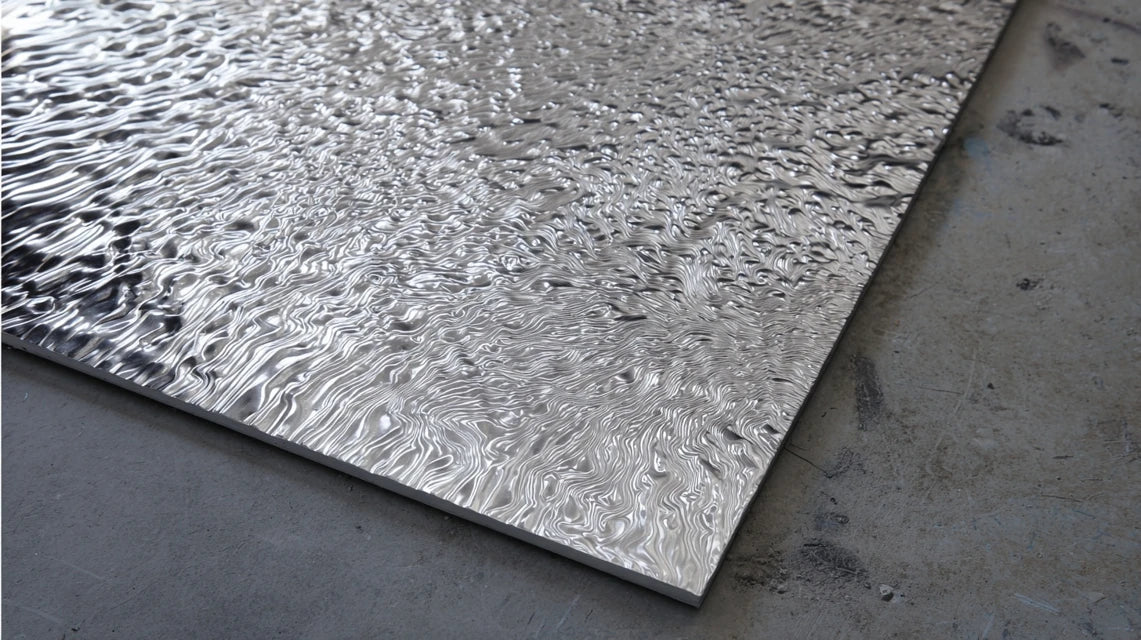
- Brushed or matte surface: Silky appearance that diffuses light without glare. The principle: like frosted glass that reveals without dazzling. Recognize quality by its velvety touch. Final impact: your colors gain depth and sophistication.
- Certified anti-corrosion treatment: Invisible but crucial protection for durability. Like life insurance for your artwork. Check for "anodized" or "anti-corrosion treated" mention. Visible benefit: no alteration even after 20 years of exposure.
Your first selection with confidence
Calculate the exact dimensions: Measure your artwork and add 2cm of margin on each side. This margin allows for perfect mounting without precision stress. Crucial detail: always round up to the nearest centimeter to avoid adjustment cuts. Easier than you think!
⏱️ Time: 5 minutes | ✅ Success when: You can center your artwork with 2cm of free space on all edges | ⚠️ Attention: Many measure "just right" - the artwork then slightly overlaps, creating constant stress
Check the flatness of your support: Place a 50cm ruler on different areas of the aluminum. No gaps should be visible between the ruler and the surface. This verification guarantees a perfect final rendering. Simple gesture that avoids 90% of subsequent disappointments.
⏱️ Time: 2 minutes | ✅ Success when: The ruler perfectly follows the surface along its entire length | ⚠️ Attention: Do not check this flatness - defect only visible once the artwork is mounted
Test the material's rigidity: Hold the support at an angle and observe if it flexes under its own weight. Good aluminum remains perfectly rigid even when cantilevered. This test instantly reveals structural quality. A gesture that definitely reassures your choice.
⏱️ Time: 30 seconds | ✅ Successful when: No visible flexing even with an 80cm cantilevered support | ⚠️ Caution: Do not confuse "light" and "fragile" - good aluminum is light AND rigid
✅ Validation of your step 1: Your aluminum resonates like quality metal when you tap it (not like plastic), its surface is uniform without scratches or defects, and it exudes that reassuring impression of solidity. If in doubt about any point, it's better to start again now - you are 30% along the way to perfection!
OUR RECOMMENDED PRODUCTS
Step 2: Mastering Secure and Aesthetic Mounting
You are now moving to the next level: transforming your excellent material into a professional mounting system. This step brings particular satisfaction because you see your work take its definitive place. The snowball effect is triggered: the more securely it is fixed, the more confidence you have, and the more daring locations you dare.
Your high-end mounting kit
- Invisible rear fixing system: Rails or hooks integrated that completely disappear once installed. Purchase from a specialist store or order online. Quality criterion: must support 3 times the weight of your painting. Unadvisable economical alternative: adhesive fasteners that come loose without warning.
- Wall fixings adapted to your partition: Expansion anchors for solid walls, special plasterboard fixings for partitions. The principle: distribute the weight over as much surface area as possible. Quality index: declared resistance greater than 15kg per fixing point. Impact on result: invisible and secure mounting for life.
- Precision spirit level: Essential tool for a professional finish. Like the difference between a bespoke suit and ready-to-wear. Choice criterion: minimum length of 40cm to check horizontality across the entire width. Immediate benefit: that satisfaction of "perfectly straight" which catches the eye.
Installation step by step
Mark your fixing points: Use a grey pencil to mark the exact locations on the wall. Double-check measurements before drilling. Important technical detail: space the fixings 60% of the total width for optimal distribution. More methodical than difficult!
⏱️ Time: 10 minutes | ✅ Successful when: Your marks form a perfect rectangle, measurements verified | ⚠️ Attention: Mark "by eye" - errors are only visible once drilled, impossible to correct properly
Drill with precision: Use a drill bit suitable for your anchors, drill perpendicular to the wall. This step determines the long-term hold of your installation. Professional technique: start with a small pilot hole to guide. Immediate reassurance: you feel the difference between an approximate and precise drilling.
⏱️ Time: 8 minutes | ✅ Successful when: Perfectly cylindrical holes, anchors that insert with slight resistance | ⚠️ Attention: Drilling too quickly - the hole widens, the anchor no longer holds properly
You are now reaching the level of mastery that makes the difference between an informed amateur and a true connoisseur. This final step reveals all the details that transform a correct installation into an exceptional achievement. The end result? That deep pride in contemplating a perfectly showcased work, and the confidence to advise those around you.
The finishing touches that make all the difference
Adjust complementary lighting: Position your artwork to avoid direct reflections while benefiting from a highlighting illumination. Aluminum reveals its beauty under well-oriented light. Expert technique: test different times of day to find the optimal exposure. Spectacular result guaranteed!
⏱️ Time: 15 minutes | ✅ Successful when: No annoying reflections, colors revealed in all their intensity | ⚠️ Attention: Neglecting orientation - even the most beautiful artwork can appear dull if poorly lit
The professional progression rule: You can move on to the next step when the previous one seems natural and obvious to you. Objective criteria: no hesitation in gestures, result conforms to your expectations, desire to go further. Balance patience (doing well) and ambition (daring more)!
Congratulations! You now master the subtleties that 95% of art lovers ignore. This knowledge gives you a decisive advantage: you know how to recognize quality, avoid pitfalls, and above all reveal the maximum potential of your works. You are no longer just a buyer, you have become an informed connoisseur.
🎖️ Expert secret: Professionals always test the "resonance" of their support by tapping it gently. Good aluminum produces a clear and metallic sound, never dull or plastic. This trick instantly reveals structural quality and avoids 90% of bad choices. Test on your next selection!
🤔 Frequent question from our readers
"I'm new to wall art... isn't aluminum too technical for me?"
I completely understand this apprehension! Many think that quality rhymes with complexity. In reality, it’s exactly the opposite: aluminum simplifies everything. No deformations to watch out for, no adjustment retouching, less stress on durability. Imagine driving a modern car versus an old one: fewer breakdowns, more pleasure. Start with a medium format (40x60cm) to familiarize yourself gently.
💡 Reassuring action: Ask to handle a sample in store before buying. You'll immediately notice the difference in stability and finish. This 30-second handling will convince you better than all speeches!
The 5 mistakes that can ruin your project (and how to avoid them)
Be careful, these mistakes are tempting because they seem logical at first glance. I prefer to tell you about them now to avoid the disappointments I've seen too often. Rest assured: these are classic traps, even experienced enthusiasts sometimes fall for them!
- ⚠️ Choosing the cheapest aluminum available: It’s tempting to "test" with low-end materials, but you risk being permanently put off this solution. Aluminum that is too thin behaves exactly like traditional supports! Prefer to invest in one quality artwork rather than three mediocre ones. A very common mistake for beginners. ⚠️ Neglecting the importance of the fixing system: Even the best aluminum is useless with approximate fixings. It’s like having premium tires on defective rims. The consequence: risk of falling, but above all a shaky hanging that spoils the aesthetics. Invest 10% of the total budget in the fixings. ⚠️ Mounting your artwork "by eye" without a level: This mistake seems harmless but it is fatal to the aesthetics. Even slightly crooked artwork immediately attracts the eye and generates a subconscious discomfort. Simple alternative: use a level app on your smartphone if you don't have a tool. 2 minutes that change everything! ⚠️ Underestimating the impact of lighting: Aluminum reveals colors differently depending on the light. Installing without testing different lighting is missing out on 50% of the aesthetic potential. Frustrating consequence: a magnificent artwork in store that disappoints at home. Always test at different times of the day. ⚠️ Wanting to do everything at once: The excitement of the project leads to installing everything at once. But haste rhymes with approximation. It's better to proceed methodically, even if it takes a few days. Result: perfect installation that lasts for years versus approximate DIY work that needs to be redone. Patience rewarded!
🔍 Your safety checklist before finalizing: (1) Aluminum resonates "metallic" when tapped, (2) Mountings tested to 150% of the artwork's weight, (3) Level perfectly horizontal verified, (4) No distracting reflections under main lighting. Warning signs: dull sound from the support, mounting that "moves" slightly, artwork that "tilts" visually even when straight.
🎁 Special offer for readers
Because you took the time to inform yourself, enjoy 10% discount on your first order:
⏰ Valid 72h after reading • Applicable to all our products
❓ Your most frequently asked questions about aluminum
Expect around 30 to 50% more than a traditional support, but this difference is amortized in 2-3 years thanks to durability. Budget optimization: start with your main artworks (living room, entrance) which have the most visual impact. Concrete example: a 60x80cm artwork costs €180 in aluminum versus €120 in traditional, but lasts 15 years instead of 5. Simple calculation: €12/year vs €24/year!
Absolutely not! If you know how to use a drill and a level, you already master 90% of the necessary skills. Aluminum being lighter, it's even easier to handle than a traditional frame. Only specificity: use mountings adapted to the weight (supplied with our artworks). Rest assured: our 70-year-old customers manage perfectly by following our illustrated guide.
Excellent question! Aluminum remarkably adapts to all styles because it enhances the artwork without imposing its own aesthetics. In a classic interior, it brings a touch of discreet modernity. In an industrial loft, it integrates naturally. The trick: matte or brushed finish harmonizes with 95% of atmospheres. Only exception: avoid shiny aluminum in very traditional interiors.
That's precisely its major strength! Aluminum has a dilation coefficient 3 times lower than wood and does not react to humidity. Concretely: in a bathroom or kitchen, zero deformation. Even direct exposure to sunlight: perfect stability. Verification technique: our aluminum artworks undergo tests in a climatic chamber (from -10°C to +60°C, humidity from 20% to 90%) without any alteration. Your normal interior poses no challenge!
It's surprisingly simple! A microfiber cloth slightly dampened with water is usually enough 99% of the time. For a thorough cleaning (1-2 times/year): spray a classic glass cleaner onto the cloth, never directly onto the artwork. Avoid: abrasive products, strong alcohol, acetone. Time required: 30 seconds per artwork. Compared to traditional frames that yellow and scratch, it's an enormous time saving!
🌟 Your new reality as an enlightened art lover
In a few weeks, you will pass by your artworks with the deep satisfaction of knowing that they will remain perfect for decades. Your guests will immediately notice this particular visual quality, this sharpness and presence that the works on aluminum support exude. You will feel this quiet pride of those who make the right choices, and your surroundings will naturally ask you for advice for their own decoration projects.
This mastery of wall art goes far beyond simply choosing a support. You have developed an expert eye for quality, a fine understanding of materials, and that confidence that allows you to dare more artistic choices. These skills will serve you in all your future decoration and interior design projects.
The technical part was ultimately the easiest to understand. Now that you know exactly what to look for and how to proceed, your first concrete step can be to visit the nearest exhibition to observe the difference between traditional supports and aluminum. This visual experience will confirm everything you have just learned and give you an irresistible desire to take action!
🚀 Your transformation starts now: You are never again obliged to endure the distortions and degradation of your wall art. This freedom to choose quality awaits you, and each artwork you install will now reflect your newly acquired expertise. Excellence is within your reach!