The first time I saw a baobab, I was twelve years old, on the edge of a Senegalese village where my grandmother still wove traditional pagnes. This colossal tree with branches reaching towards the sky like inverted roots fascinated me to the point of returning every summer for twenty years. Today, as I browse contemporary interiors from Dakar to Paris, I notice that the baobab has established itself as the quintessential emblem of African decor — far beyond a fleeting trend.
Here's what the baobab brings to your decor: a symbolic depth that transforms a space into a living memory place, a readily recognizable aesthetic that anchors your interior in a strong cultural identity, and a surprising versatility that adapts as well to minimalist atmospheres as to maximalist compositions. Yet, many hesitate to integrate this motif for fear of falling into ethnic clichés or creating a mismatch with their existing furniture. This concern is understandable, but it misses the essential point: the baobab in decor is not a frozen folklore, it's a living visual language that dialogues with all styles when you understand its symbolic grammar. I will reveal to you why this millennial tree continues to fascinate designers and decorators, and how to integrate it properly into your world.
The world tree: when cosmogony becomes ornamentation
In the Wolof tradition, it is said that God, displeased with the incessant chatter of the baobab, planted it upside down to silence it. This legend visually explains why the baobab in African decor has this recognizable silhouette: its bare branches resemble an exposed root system in the sky. But beyond the anecdote, this inverted image conveys a profound philosophy — that of the link between the visible and the invisible, between the nourishing earth and the spiritual world.
When you hang a baobab representation in your living room, you are not simply installing a plant motif. You introduce a cosmogonic pillar that symbolically structures the space. In Mandinka cultures, it is called 'the palabre tree', a place of gathering where stories and community decisions are transmitted. In decor, this function becomes metaphorical: the baobab visually creates a convergence point, a gravitational center around which to organize sofas, armchairs and conversations. I have observed this phenomenon in dozens of interiors — the presence of the baobab unconsciously modifies the circulation and use of rooms, as if the tree retained its original vocation as a meeting place.
The sacred geometry of the trunk
The trunk of the baobab tree, with its characteristic swollen shape, translates into volumes what West African architects have always known: beauty lies in function. This massive silhouette stores survival water in arid regions. In decoration, this particular geometry—wide at the base, tapering towards the top—offers exceptional visual stability. Tables depicting baobabs naturally possess a strong anchoring at the bottom of the composition, creating a reassuring balance for the eye. It is precisely this geometry that allows the baobab motif to coexist harmoniously with clean Scandinavian lines or Art Deco curves—it has its own structural logic that dialogues rather than imposes.
Color palette: the ochres of survival
The representation of the baobab in African decoration systematically invokes a range of colors that goes beyond simple naturalistic reproduction. The ochres, burnt sienna earths, silvery greys and deep oranges that dominate these compositions are not arbitrary choices—they reflect the Sudanese-Saharan landscapes where the tree thrives. After traveling through the valley of the Senegal River at sunset, I understood why these shades possess such evocative power: they capture the particular light of African late afternoons, this golden luminosity that transforms baobabs into monumental sculptures.
This palette offers a considerable advantage for contemporary decoration: it naturally integrates into neutral interiors dominated by beiges, off-whites and stone greys. Unlike wax prints with saturated colors which require a carefully orchestrated composition, the baobab in its earthy tones works as a transition element. It warms without aggression, characterizes without monopolizing attention. I have seen baobab paintings transform minimalist lofts into soulful spaces, simply because these ochres brought the human warmth that was lacking in concrete and steel surfaces.
Contemporary variations of the palette
Current creators are no longer limited to traditional registers. Some artists offer African baobabs reinterpreted in shades of indigo blue, evoking fabrics dyed with natural dyes. Others explore almost monochrome versions, where the baobab stands out in deep black on an off-white background, creating an aesthetic close to Japanese prints. This chromatic plasticity explains in part the ubiquity of the motif: the baobab lends itself to all stylistic variations while preserving its symbolic charge intact.

Discover this inspiring artwork
Three decorative incarnations of the giant plant
The omnipresence of the baobab in African decoration is also explained by its remarkable formal adaptability. There isn't one, but several ways to visually invoke this tree, each corresponding to different decorative intentions.
The baobab landscape: This is the classic representation, often at sunset, where the tree fits into a larger scene with animals, villages or human silhouettes. This narrative version works beautifully in large living rooms where it becomes a visual window, an invitation to travel. It is particularly suitable for interiors that fully embrace their African reference and seek to create an immersive atmosphere.
The architectural baobab: Here, the tree is isolated, abstracted from its context, treated almost like a monumental sculpture. This is my preferred version for minimalist interiors — the baobab becomes pure form, dialogues with the white space around it. This minimalist approach reveals the fascinating geometry of the tree and allows for bold scale games, such as these large-format representations where the massive trunk occupies the entire height of the wall.
The graphic baobab: Contemporary designers have developed stylized versions, sometimes reduced to a few essential lines, which capture the essence of the baobab without faithful reproduction. These graphic interpretations, often in screen printing or linocut, make it possible to introduce the motif into very modern contexts, from professional offices to children's rooms. The characteristic silhouette remains immediately identifiable even in these refined versions, proof of the iconic strength of the tree.
The baobab as an identity marker
Why the baobab rather than the acacia, the fromager or the palm tree? This question intrigued me for a long time until a conversation with an antique dealer in Saint-Louis du Sénégal enlightened me: the baobab belongs exclusively to the African continent. Unlike the palm tree, present in all tropical latitudes, the baobab (Adansonia) is endemic — eight species of which six only grow in Madagascar. This geographical exclusivity makes it a powerful identity marker, a symbol immediately and universally associated with Africa.
Within the African diaspora, I’ve observed that the baobab in decor functions as a mnemonic anchor. It reactivates sensory memories — the cool shade under the branches at the height of heat, the tangy taste of monkey bread (the fruit of the baobab), the tales of elders under the talking tree. For generations born outside the continent, it becomes a symbolic bridge to sometimes distant roots. This emotional dimension explains why the motif transcends simple aesthetic considerations — it carries an emotional charge that few decorative elements possess.
Beyond Folklore: A Universal Language
Paradoxically, this cultural specificity does not prevent universality. The baobab also speaks to those who have no connection with Africa, because it conveys transcultural values: resilience, rooting, longevity, generosity (the tree nourishes, heals, shelters). In Scandinavian interiors that crave nature and sustainability, the baobab finds its place as a symbol of a respectful relationship with living things. In urban lofts seeking authenticity, it brings this organic dimension that contrasts with the surrounding artificiality.

Discover this inspiring artwork
Composing with the Baobab Without Falling into Pastichery
The omnipresence of the baobab in African decor can paradoxically create apprehension: how to use it without falling into pastiche or museum reconstruction? This question deserves a nuanced answer, because the main pitfall is not the motif itself, but the disordered accumulation of references.
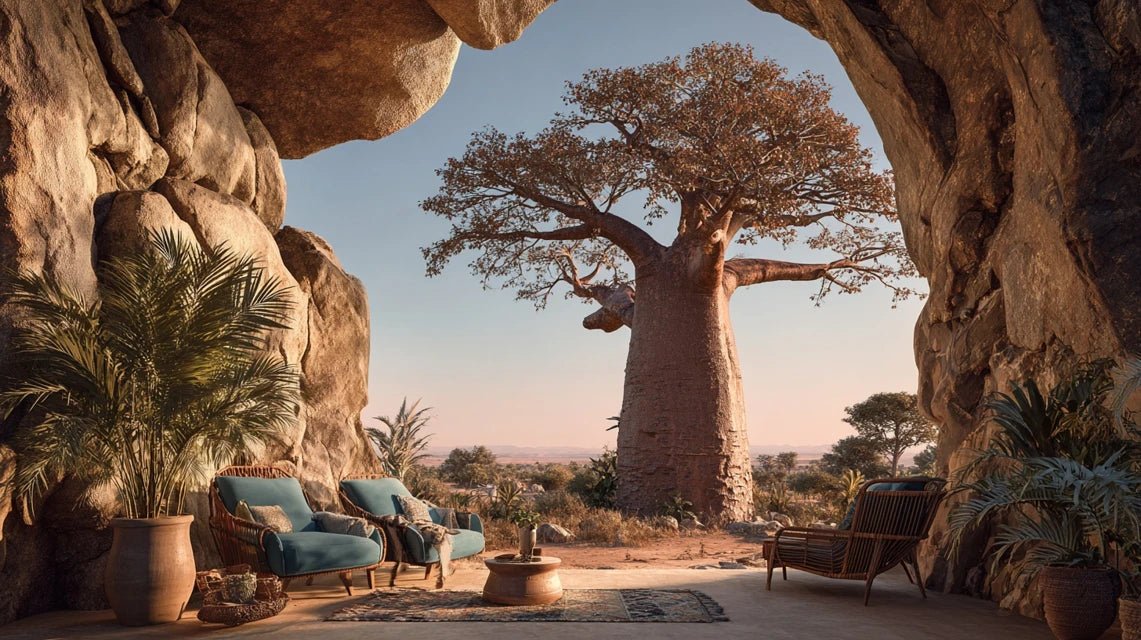
The rule that I systematically apply: let the baobab breathe. A quality painting depicting a magnificent baobab has enough presence to visually structure an entire room. There’s no need to surround it with masks, woven baskets and kente fabrics — you would create a saturation that would undermine each element. On the contrary, associate the baobab with contemporary materials: polished concrete, brushed brass, natural linen, matte ceramics. This contrast of temporalities (the millennial tree, today's materials) generates a fascinating creative tension.
Another effective principle: playing with scale. A very large format where the baobab becomes architectural completely transforms the perception of a room. Conversely, a series of small formats in similar tones creates an effect of personal collection, less imposing but equally characterizing. I recently realized that the size of representation modifies the emotional register: monumental, the baobab impresses and structures; intimate, it comforts and soothes.
Transform your interior into a living memory space
Discover our exclusive collection of African paintings that capture the timeless majesty of the baobab in carefully selected contemporary compositions.
The promise of longevity that transcends generations
If the baobab has dominated African decoration for decades without ever going out of fashion, it is because it escapes the ephemeral logic of trends. A baobab can live three thousand years — some specimens date back to the time when the Egyptians were building the pyramids. This dimension of permanence mysteriously transmits to decorative representations. A baobab painting does not age, it matures. Earthy colors never go out of style. The characteristic silhouette crosses eras without ever seeming dated.
I inherited a small watercolor of a baobab painted by my grandmother in the 1970s. Hung today in my contemporary living room with white walls and design furniture, it does not clash — it dialogues. This timelessness may be the ultimate explanation for the ubiquity of the baobab: in a world of accelerated consumption where interiors are redone every five years, it offers a stable anchor point, a reassuring continuity. Choosing a baobab for your decoration is to bet on durability, to enroll your interior in a long time that exceeds the fluctuations of the decorative market.
Imagine your space transformed
Visualize your living room bathed in that late afternoon light we all know. Your gaze rests on the wall facing the sofa, and there, a majestic baobab reminds you that beauty often arises from resilience — this tree that thrives in aridity, that nourishes when everything is lacking, that gathers when isolation threatens. You no longer see just a decoration, but a soothing presence that transforms your interior into a place full of meaning.
Start modestly if the African universe is new to you: a medium format, in ochre and gray tones, paired with natural linens and a few green plants. Observe how the baobab changes the atmosphere of your room, how conversations are organized differently, how your own perception of space evolves. The baobab is not just a decorative motif—it's an everyday invitation to slow down, to take root, to cultivate long-term vision. And that’s precisely why it remains, forever, at the heart of authentic African décor.
Frequently Asked Questions About Baobab in Decor
Is the baobab suitable for all decorating styles?
Absolutely, and that’s precisely what explains its ubiquity. The baobab has a geometry and color palette neutral enough to dialogue with very different universes. In a Scandinavian interior, choose a refined, almost graphic representation in shades of gray and beige—the baobab will bring the organic warmth that sometimes lacks in minimalist Nordic spaces. For an industrial style, opt for a large format where the baobab stands out like a monumental sculpture against a brick or concrete background. In a bohemian interior, indulge in more colorful and narrative versions that will tell stories. The key lies in choosing the artistic treatment rather than the motif itself: the baobab adapts to your style, not the other way around. I’ve even seen total black and white versions that worked beautifully in classic Haussmann apartments, proof that this tree transcends usual stylistic categorizations.
How to avoid baobab decor looking too ethnic?
This concern is legitimate, but it’s based on a confusion between motif and accumulation. It's never the baobab alone that creates the ethnic effect, but its combination with a multitude of other cultural references—masks, printed fabrics, statues, baskets, musical instruments. The solution is simple: practice complementary restraint. If you choose a baobab painting as a centerpiece, surround it with neutral and contemporary elements. Favor natural but refined materials: plain linen, unworked light wood, matte ceramics, brushed metal. Play on textures rather than additional patterns. A solid ribbed velvet sofa, natural hemp cushions, a rough-hewn solid oak coffee table—these elements allow the baobab to express all its power without visual competition. Also think about negative space: let your composition breathe, don't try to fill every surface. The baobab itself, in nature, asserts its presence by its solitary stature, not by its integration into a dense forest. Reproduce this logic in your decor.
What size representation to choose for a baobab in decoration?
The size radically changes the effect produced, and this choice must correspond both to the dimensions of your room and to the decorative intention. For a spacious living room with high ceilings, dare the very large format — minimum 120 x 80 cm — which transforms the baobab into a structuring architectural element. The tree then becomes a powerful focal point that visually organizes the entire room, exactly as it would in a real landscape. In a medium-sized room, prefer an intermediate format (approximately 80 x 60 cm) that characterizes without overwhelming. For a bedroom or office, more intimate formats (40 x 30 cm) create a soothing presence without monopolizing attention — the baobab then becomes a discreet companion rather than an affirmed statement. A particularly elegant option that I have experienced: a series of three small vertical formats representing the same baobab at different times of the day. This triptych composition tells a temporal story while maintaining a measured scale. Last practical rule: the more minimalist your interior is, the more you can dare to use a large format — empty space will enhance the presence of the baobab instead of creating visual competition.