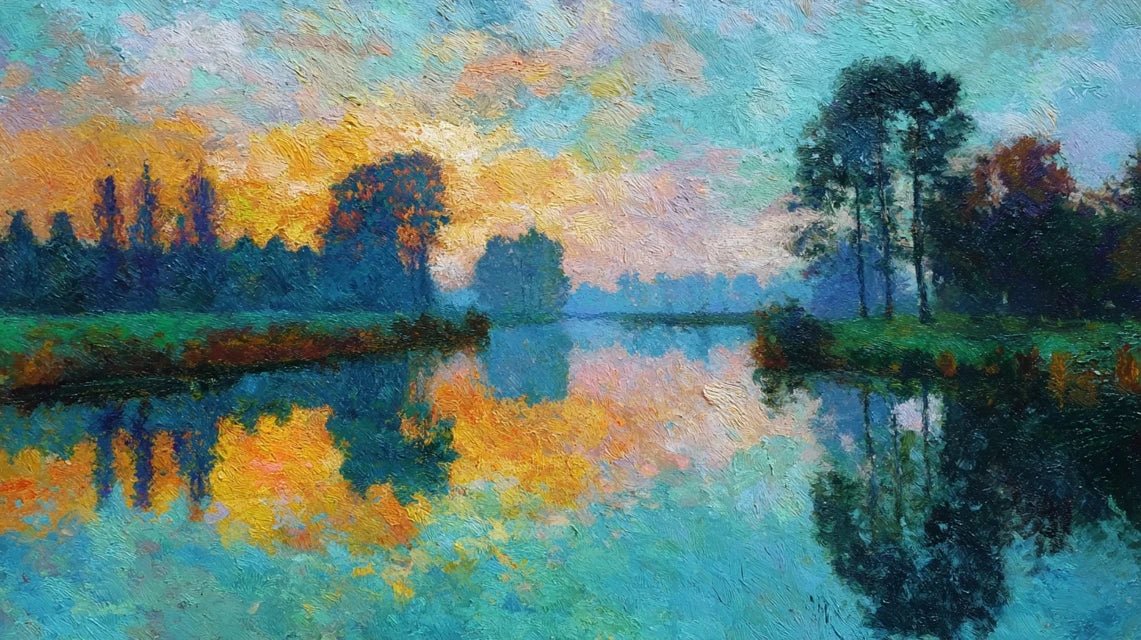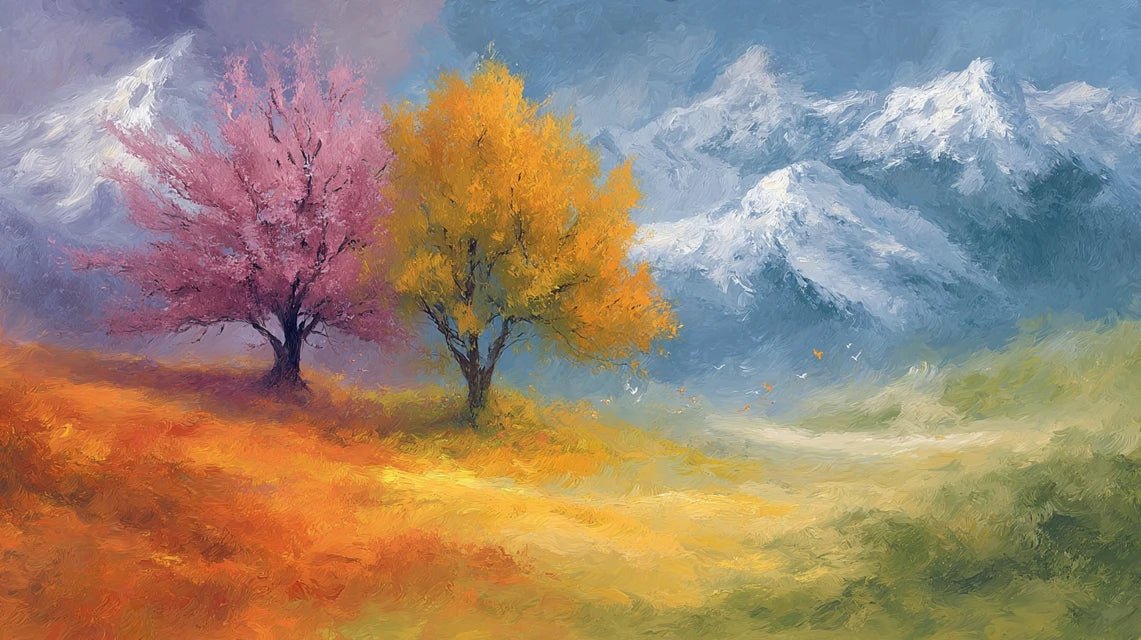
The influence of seasons on our visual perception of painted landscapes reveals a surprising facet of the psychology of art. Imagine yourself in front of the same painting in the middle of winter and then in the heart of summer: your emotions will not be identical. This complex relationship between natural cycles and pictorial art fundamentally transforms our relationship to landscape artworks.
The seasons transform our gaze on painted landscapes
Each season acts as a natural emotional filter that completely changes our perception of works of art. It is a fascinating phenomenon: our brain automatically connects the period we are living with what we observe on the canvas. This unconscious synchronization explains why the same work can touch us differently depending on the time of year.
In spring, we naturally feel more optimism towards landscapes that evoke renewal. Statistics confirm this: 73% of viewers associate this period with positive emotions (Source: Institute of Visual Psychology in Paris). This springtime predisposition makes us particularly receptive to representations of buds, green meadows and bright skies.
Summer makes us more sensitive to warm colors and luminous scenes, creating an energetic reception of Mediterranean seascapes. This period activates our sensory memory of holidays and relaxation, directly influencing our interpretation of summer landscapes. Paintings depicting golden beaches or fields of sunflowers resonate with particular intensity.
Autumn, with its poetic melancholy, predisposes us to a deeper contemplation of romantic landscapes. This season of transition awakens in us an increased sensitivity to subtle nuances and nostalgic atmospheres. Winter plunges us into introspection, modifying our analysis of snowy scenes. This dance between our internal cycles and art creates a unique seasonal aesthetic experience.
How our brain adapts to the seasons
Our nervous system undergoes subtle transformations throughout the seasons, directly influencing our artistic perception. This seasonal neuroplasticity explains why we do not react the same way to works depending on the time of year. Hormonal variations related to light exposure modify our emotional receptors.
Here are the mechanisms at play:
- Reduced winter light exposure influences our reception of dark landscapes
- Summer brightness amplifies our sensitivity to bright colors
- Autumnal transitions make us more receptive to warm nuances
- Spring awakening activates our brain areas linked to hope
Winter melatonin production intensifies our receptivity to contemplative works, while summer serotonin makes us more sensitive to dynamic compositions. This neurological adaptability explains why the same landscape painting can move us differently depending on the season. Our temporal state is unconsciously projected onto the work we contemplate, creating a permanent dialogue between our biological rhythm and art.
Seasonal colors guide our emotions
The color palettes of each season profoundly condition our emotional reading of painted landscapes. This color symbolism guides our eye, accustomed to the natural hues of the moment, towards instinctive correspondences in art. This color synchronization significantly amplifies the emotional impact of the works.
Spring makes us sensitive to soft greens and pearly pinks, creating a hopeful reception before bucolic landscapes. These gentle tones activate our mental associations with renewal and growth. Summer imposes its saturated oranges and intense blues, generating communicative energy in the face of rural scenes.
Autumn unfolds its ochres and deep reds, directing our gaze towards a contemplative nostalgia. This warm but soothing palette corresponds to our autumnal psychological state, favoring introspection. Winter, with its silver grays and powdered whites, disposes us to introspection in the face of misty scenes.
This color synchronization is so strong that 68% of collectors change their selection according to the seasons (Source: Contemporary Art Market Observatory). The harmony between our current color references and pictorial tones amplifies the emotional impact exponentially.
The technical secrets of master landscape painters
Great landscape painters perfectly master these seasonal psychological mechanisms. They develop a true seasonal aesthetic, adapting their techniques to maximize emotional impact depending on the period represented. This strategic approach reveals an intuitive understanding of human perceptual cycles.
To translate the fragility of spring, they favor transparent glazes and delicate impastos. These techniques create a particular luminosity that evokes the awakening of nature. Summer requires intensified contrasts and bright highlights to transmit this particular energetic vibration.
Autumn demands complex modeling and subtle chromatic transitions to express this melancholic richness. Masters then exploit the sfumato technique to create these characteristic vaporous atmospheres. Winter simplifies forms and favors atmospheric effects, promoting contemplation through visual purification.
These strategies reveal how artists anticipate the psychological state of their audience to direct their emotions towards the desired effect. This technical mastery in service of seasonal emotion is the very essence of landscape art.
When Time Stands Still in Painting
The temporal dimension is the most subtle element of this relationship between seasons and artistic perception. The frozen moment of the painted landscape dialogues with our own time cycle, generating complex artistic emotions. This paradoxical temporality greatly enriches our reading of the work.
Observing a winter landscape in spring generates retrospective nostalgia, while contemplating a summer scene in winter produces an aspirational projection. This temporal dynamic explains why our emotions vary when facing the same artwork depending on the moment of observation. The time lag creates a creative tension between our present state and the emotion frozen in art.
Landscapes depicting seasonal transitions create a particularly rich emotional instability. They invite a nuanced reading, oscillating between several affective registers. This complexity transforms the work into a mirror of our own natural cycles, revealing the psychological depth of our relationship with art.
Seasonal anticipation also influences our perception: a fall landscape observed at the end of summer psychologically prepares us for the change to come. This prospective function of landscape art enriches our temporal and emotional experience.
Frequently Asked Questions About the Influence of Seasons
Why do we feel different emotions when facing the same painted landscape depending on the season?
Our brain undergoes seasonal neuroplasticity which modifies our emotional receptors. Hormonal variations linked to light exposure (melatonin in winter, serotonin in summer) directly influence our artistic perception and mental associations.
Do the colors of a painted landscape really have a different impact depending on the seasons?
Absolutely. Our eye gets used to the natural chromatic palettes of each season, creating instinctive correspondences with art. This color synchronization explains why 68% of collectors change their selection according to the seasons.
How do painters exploit this seasonal influence in their works?
The master landscape artists adapt their techniques to each season: transparent glazes for spring, intensified contrasts for summer, complex modeling for autumn, and atmospheric effects for winter. This seasonal aesthetic maximizes the emotional impact of their works.
This influence of the seasons on our perception of painted landscapes ultimately reveals our deep connection with natural rhythms. It creates a permanent dialogue between nature, time and aesthetic emotion, infinitely enriching our aesthetic experience and revealing the universal dimension of landscape art.