The art of landscape painting tells a fascinating story. Imagine: in the Middle Ages, nature was merely a golden backdrop behind the saints. Then, the Renaissance changes everything. For the first time, artists truly look at nature and decide that it deserves to exist for its own sake on their canvases.
This revolution begins slowly. Joachim Patinier, this 16th-century Flemish painter, paints panoramas so detailed that you feel like you could walk through them. Dürer calls him "the good landscape painter" - a revolutionary compliment for the time. Because before, no one called themselves a "landscape painter!"
When technique transforms vision
The Renaissance brings its innovative painting techniques like artistic superpowers. The use of oil paint and the implementation of Albertian linear perspective change everything. Leonardo da Vinci invents sfumato - that hazy technique that makes his backgrounds so mysterious.
The numbers speak for themselves: only 15% of works from the 14th century give significant space to landscape, compared to 60% in the 16th century (Source: Institute of Art History of Florence). It's a true explosion in art history!
In the 17th century, the Dutch revolutionize the approach even further. No more dusty studio! Artists create preparatory sketches outdoors and then produce the painting in the studio. They discover that natural light changes depending on the hour, season, and weather. This direct observation transforms their way of painting.
The Barbizon School takes this logic to the extreme by completely abandoning the studio. These revolutionary painters develop a whole arsenal of techniques:
- Portable paint tubes invented in 1841
- Folding easels for mobility
- Reduced palettes favoring pure colors
- Brushes adapted to quick impasto
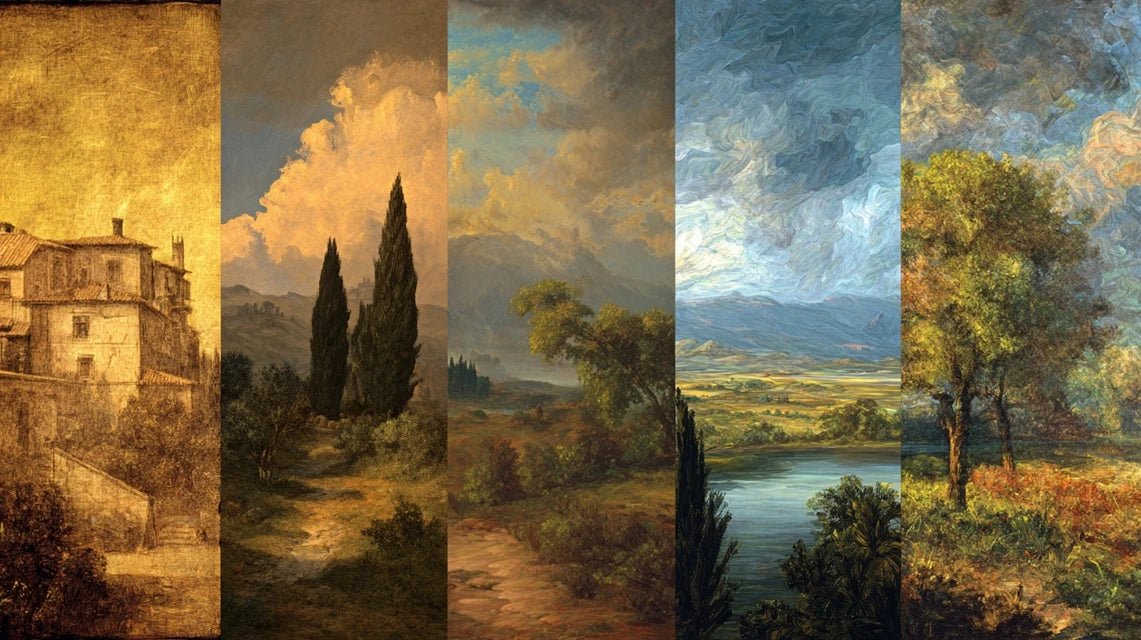
The exceptional collection of wall art landscapes perfectly illustrates this technical evolution, from classic compositions to contemporary interpretations.
The Impressionist revolution: painting the elusive
Impressionism, named in 1874 after Impression, Sunrise, had been foreshadowed by precursor signs: a decisive break had revolutionized landscape painting. This time, it's a real visual revolution among art movements!
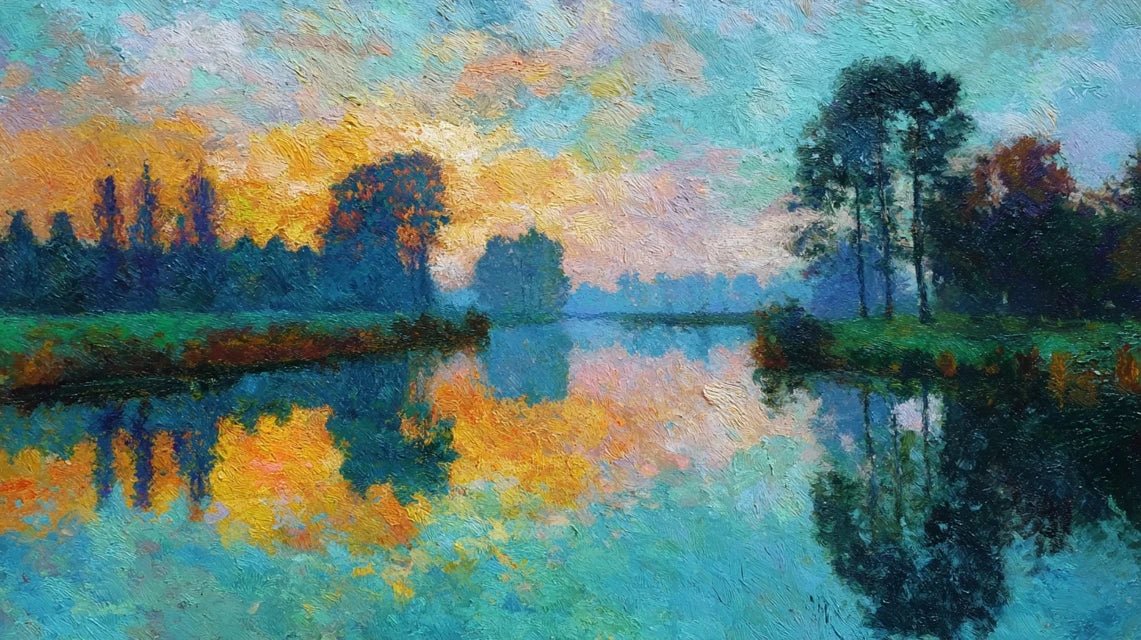
Monet and his friends change everything. Imagine their audacity: instead of painting a green tree, they paint it purple if that's how they see it in the evening light. Bright touches of color, which are juxtaposed to form outlines and volumes, without resorting to a clear and continuous line.
Commercial success follows quickly: Impressionist landscapes represent 70% of works sold between 1880 and 1900 (Source: Durand-Ruel Archives). The public eventually adopts this new way of seeing.
Monet, Renoir, Sisley and Bazille left Gleyre's Parisian studio for Chailly-en-Bière and outdoor work. Their goal was to capture the moment, that light which would not last. They develop a remarkable mastery of atmospheric perspective.
Landscape motifs also diversify:
- Bourgeois gardens and their pleasures
- Sunday boating scenes
- Lively Parisian boulevards
- Smoky train stations of modernity
Renoir develops his own vision of the Impressionist landscape. But around 1883, he questions everything: "I had gone to the end of Impressionism and I realized that I didn't know how to paint or draw." This crisis leads him to new explorations.
Contemporary art: when landscape becomes pure emotion
The 20th century explodes traditional codes. Abstract landscaping is part of a spontaneous and sometimes unconscious evolution. Artists no longer paint what they see, but what they feel.
Around 1965, in reaction to this form of abstraction, Minimal art insists on the fundamental reduction of plastic means. Each artistic movement reinvents its relationship with landscape.
Contemporary art explores a thousand directions:
- Lyric abstraction: Zao Wou-Ki mixes Chinese traditions and Western modernity
- Abstract Expressionism: Joan Mitchell creates a striking "abstract impressionism"
- Spiritual Art: Alfred Manessier transforms his religious emotions into colorful landscapes
- Conceptual Art: complete redefinition of what a landscape is
Edward Hopper (1882-1967) is known for being able to render the solitude that can emanate simply from a viewpoint on a place. This ability to express states of mind through places characterizes modern art.
Today, technology further enriches possibilities. Artists mix traditional painting and digital tools. 45% of contemporary landscape exhibitions blend different mediums (Source: Centre National des Arts Plastiques). This diversity is a testament to limitless creativity.
The pictorial landscape continues to evolve, reflecting our new relationships with the environment, urbanization, climate change. Each era reinvents its way of looking at and representing the world around it.
FAQ - Evolution of landscape in painting
Q: When does landscape become an autonomous genre in painting?
R: Landscape emancipates as an independent genre in the 16th century with painters such as Joachim Patinier. Before this period, it only served as decorative background for religious scenes.
Q: How does Impressionism revolutionize landscape painting?
R: Impressionism transforms the landscape into a visual experimentation laboratory. Artists abandon the studio to paint outdoors, use pure juxtaposed colors and prioritize capturing instantaneous light rather than faithful representation.
Q: What becomes of landscape in contemporary art?
R: Contemporary art liberates the landscape from all mimetic constraints. It evolves towards lyrical abstraction, abstract expressionism and explores new digital mediums, expressing more emotions than real places.