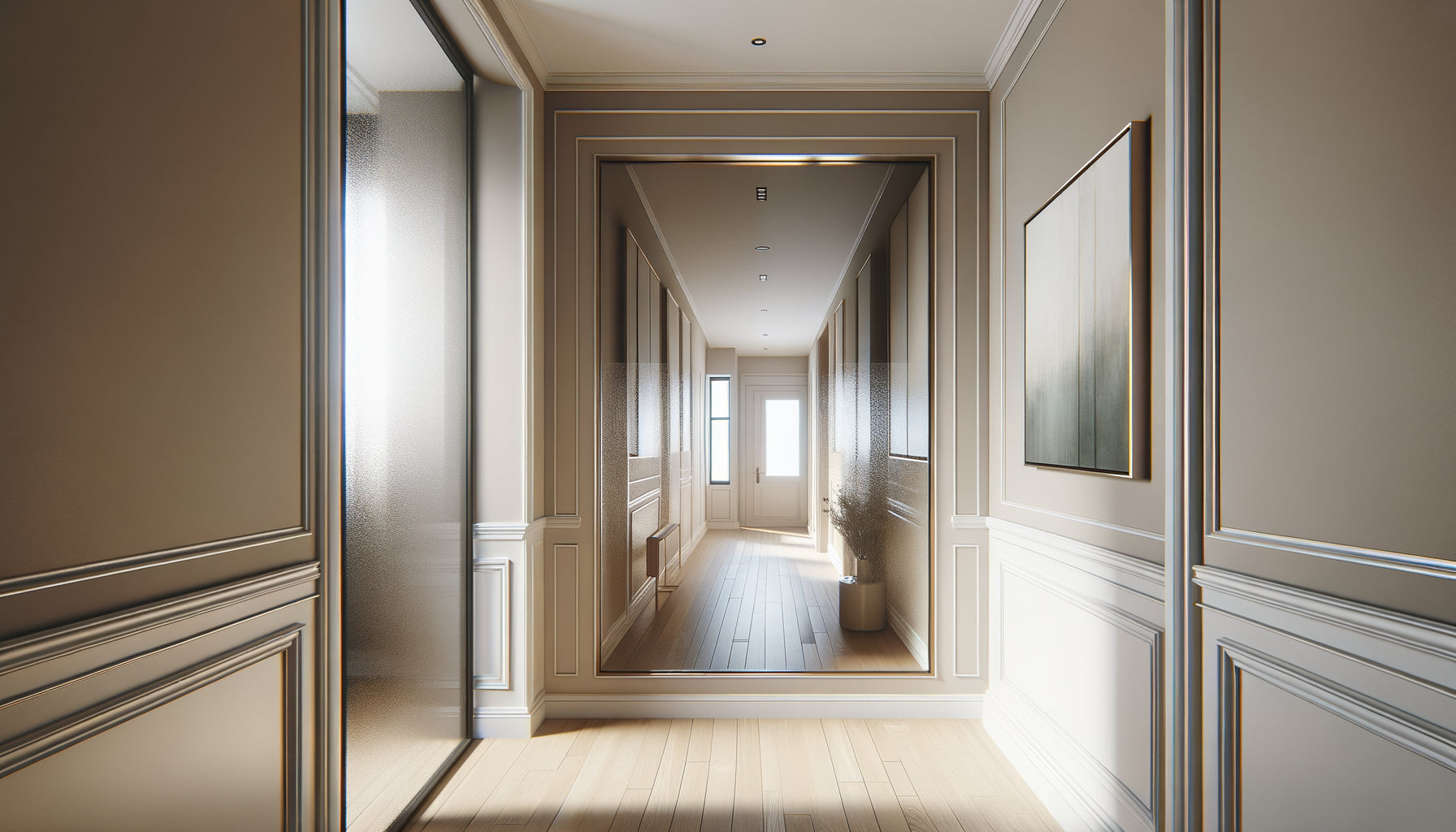
I've spent fifteen years visiting hundreds of apartments for my clients, and there's one question that consistently comes up during our initial consultations: "Can I really hang this artwork on this partition wall? Won’t it collapse?” I’ve seen this concern in the eyes of Parisian homeowners as well as young couples in the suburbs. Because plasterboard, this lightweight and practical material that structures our modern interiors, sometimes seems so fragile that we hesitate to fix anything to it.
Here's what a lightweight picture frame brings to your plasterboard hallway: an elegant decoration without risking weakening your partition walls, simple installation without drills or complex anchors, and above all the freedom to transform this passageway into a true personal gallery. The secret lies not in the fixing strength, but in the intelligence of choosing the frame.
The frustration is real: you've found the perfect artwork, the one that would transform your dull hallway into a bright passage, but you remain paralyzed in front of this plasterboard wall. You can already imagine the hole getting bigger, the frame falling in the middle of the night, the plaster crumbling. Some give up completely, leaving their walls bare for fear of doing it wrong. Others multiply the fixings to the point of turning their partition into a Gruyère.
Yet, the solution exists, and it's simpler than you might think. Frame manufacturers have long understood this problem, and hanging techniques have evolved considerably. Plasterboard can perfectly accommodate your favorite works, provided that a few fundamental principles are respected. Follow me, I will show you how to choose the ideal frame for your hallway, one that combines lightness, elegance and solidity.
Brushed aluminum: the lightweight champion of modern framing
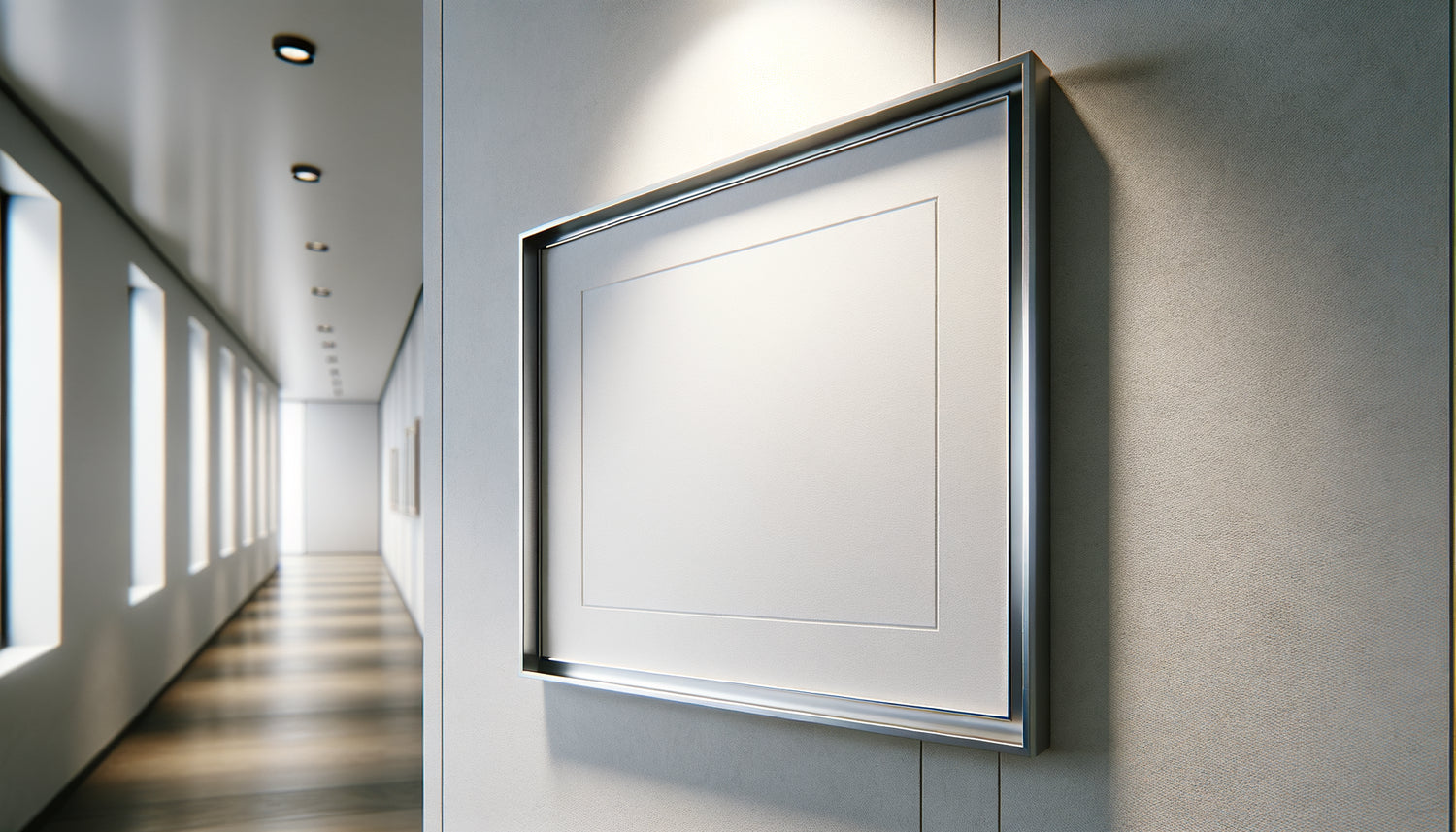
During a renovation in Le Marais, a client introduced me to an eight-meter hallway with five plasterboard partition walls. She wanted to create a family photo gallery. My first recommendation? Brushed aluminum. This material embodies the perfect solution for lightweight partitions.
An aluminum frame weighs up to 70% less than a solid wood frame of equivalent dimensions. For a 40x50 cm format, count around 300 to 400 grams only, glazing included. This lightness radically changes the game: you can use standard fixings without risking tearing off the plasterboard.
Aluminum also has another considerable advantage for hallways: its thinness. Frame profiles are generally between 8 and 15 millimeters wide, creating an almost invisible effect that highlights the artwork without smothering it. In a narrow passageway, this visual discretion expands the space.
The finishes that enhance your decoration
Aluminum comes in several finishes suitable for hallways: brushed matte, which absorbs light and creates a soothing contemporary atmosphere; anodized black for an assumed industrial style; or champagne gold for more classic interiors. I installed silver aluminum frames in a Haussmannian hallway: the effect was striking, blending modernity with respect for heritage.
Light wood: when nature comes in without weighing it down
Not all woods are equal when facing plasterboard. Forget solid oak or thick beech that can weigh a kilogram for a simple medium-sized frame. Opt for light essences such as paulownia, linden or Nordic pine.
Paulownia deserves special attention. Native to Asia, this ultralight wood has a density of less than 300 kg/m³, compared to 700 to 900 kg/m³ for traditional European woods. A paulownia frame measuring 50x70 cm weighs approximately 500 grams, or just slightly more than an aluminum frame, while offering that natural warmth only wood can provide.
In a recent project in Lyon, I equipped a long hallway with Nordic pine frames stained white ceruse. The owner wanted to maintain a consistent Scandinavian atmosphere with his apartment. The frames, only 2 centimeters wide, created a perfect visual rhythm along the seven meters of circulation.
Thin profiles that change everything
Favor thin profiles between 15 and 25 millimeters wide. Beyond that, the framing becomes too visually present and unnecessarily weighs down the structure. These thin profiles exist in all shades: natural raw, bleached, matte black, or even two-tone for lovers of daring decoration.

Noble plastic: when technology catches up with aesthetics
Five years ago, I would have hesitated to recommend plastic frames. The available materials lacked nobility and yellowed quickly. But new generation polymers have radically transformed this category of framing.
High-density polystyrene or textured ABS frames now perfectly mimic wood or metal, for a negligible weight of 200 to 300 grams in standard format. I used these frames for a seasonal rental in Bordeaux: the plasterboard partitions were particularly thin, and the owner regularly changed his decoration. The absolute lightness of these frames allowed easy rotation without weakening the fixings.
The true advantage of noble plastic lies in its resistance to moisture. In a windowless hallway or one leading to a bathroom, hygrometric variations can warp wood. The polymer remains stable, does not swell or crack. For a hallway leading to a laundry room or cellar, it is a particularly wise choice.
Floating frames: the illusion of absolute lightness
Allow me to share a personal anecdote. At a decoration fair in Paris, I discovered floating frames and immediately understood their potential for plasterboard partitions. The principle is ingenious: two transparent acrylic plates hold the artwork between them, secured by four discreet screws at the corners. The whole thing rarely weighs more than 400 grams for a 40x60 cm format.
The visual effect is spectacular in a hallway. The painting seems to levitate against the wall, creating a three-dimensional depth that immediately catches the eye. Light partially passes through the frame, playing with shadows on the plasterboard. I installed this system for an architect in Nantes: her initially dark and narrow hallway became a bright contemporary art gallery.
Floating frames have a major technical advantage: the weight is distributed over four fixing points rather than one or two. The load on the plasterboard is thus divided, significantly reducing the risk of tearing. For a hallway with multiple paintings, this solution also offers exceptional visual consistency.
Drill-free installation
Some floating frame systems are fixed with structural adhesives 3M double-sided tape. These strips can support several kilos and adhere perfectly to plasterboard, provided it is clean and painted. I recommend them for formats less than 50x70 cm and lightweight works such as paper prints or photographs.

Suspension systems on rail: the embodiment of flexibility
Here is a solution that I particularly like for those who are undecided or lovers of frequent change: the suspension system on rail. A discreet rail is fixed to the ceiling of the hallway, and almost invisible cables descend to hold your paintings.
The fundamental advantage? Zero holes in the drywall. All the weight rests on the ceiling's supporting structure, which is generally much stronger. You can thus hang slightly heavier frames without worry, and above all move your paintings laterally at will, adjusting their height in seconds.
In a twelve-meter hallway I fitted out in Marseille, we installed a single rail with seven suspended paintings. The client, a professional photographer, regularly changes her works according to her projects. This system offers her a modular gallery without ever touching the drywall partitions. The frames used were made of aluminum, creating perfect harmony between the lightness of the frames and the flexibility of the system.
How to choose the right fixing for your drywall
A lightweight frame is useless if the fixing is unsuitable. Standard drywall is 13 millimeters thick, sometimes only 10 millimeters in some recent constructions. Here are my proven recommendations from hundreds of sites.
For paintings weighing less than 2 kg (the majority of lightweight frames), prioritize Molly anchors or drywall-specific expansion anchors. These fixings create a solid anchor point by opening behind the partition. A single quality Molly anchor supports up to 25 kg in traction, more than enough for your light aluminum or wood frame.
X hooks adhesive are an alternative without drilling for very lightweight paintings weighing less than 500 grams. I frequently use them for photo frames in hallways, with a remarkable success rate. Just make sure your drywall is painted and clean before application.
The golden rule of distribution
Never concentrate several heavy paintings on the same area of drywall less than one square meter. Even with lightweight frames, the cumulative load can weaken the partition. Space your works at least 40 centimeters horizontally for optimal weight distribution.
Your hallway deserves a decoration that dares without risk
Discover our exclusive collection of paintings for Hallway that will transform your passageway into a personal gallery, perfectly adapted to light partitions.
Three mistakes to absolutely avoid with drywall
Over the years of experience, I have noticed three recurring errors that compromise the hanging of paintings on drywall. The first: choosing a frame that is lightweight but with thick traditional glass. Glass often represents 60% of the total weight of a framed painting. Always opt for plexiglass or acrylic glass, four times lighter and shatterproof.
Second mistake: neglecting the thickness of the mat. A thick wood-based cardboard mat unnecessarily adds 200 to 300 grams. Opt for a simple mat or remove it completely for contemporary works that do perfectly well without it.
Third mistake: multiplying small, heavy frames instead of one large, lightweight frame. I've seen hallways with fifteen small solid wood frames, each requiring its own fixing, creating a real massacre of the drywall. A large format lightly framed produces a much greater visual impact with a single well-positioned fixing.
Imagine yourself in three weeks. You come home after a long day. As you walk down your hallway, your gaze falls on this series of perfectly framed paintings, light as feathers but solid as rock. The brushed aluminum frames catch the light from the ceiling lamp, creating that subtle play of shadows you had imagined. Your guests consistently stop to admire this improvised gallery. And you smile thinking about your old hesitations.
This hallway is no longer just a passage. It has become an elegant transition between your different living spaces, a place that tells your story, exposes your passions, affirms your personality. And all of this without weakening even a single square centimeter of your drywall. Start with a single painting, test the framing that suits you. You'll see: the transformation will be immediate, and the desire to add more irresistible.