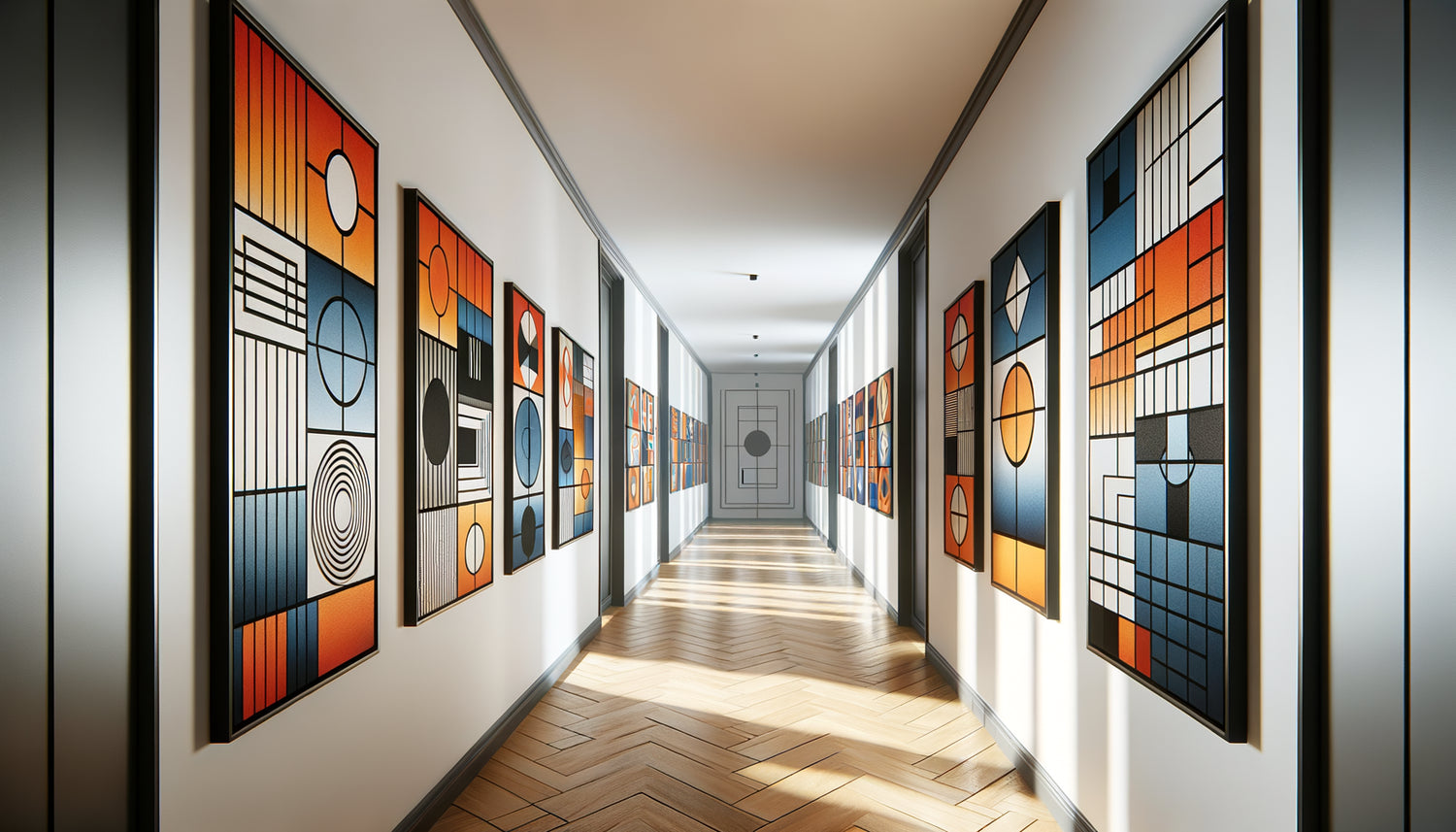
I still remember that endless hallway in a Parisian apartment I transformed three years ago. Three meters long, anonymous white walls, and that strange feeling of crossing a non-place every day. Then we installed five geometric abstract artworks in rhythmic progression. The change was instantaneous: this forgotten passage became a vibrant gallery where the eye danced from one shape to another.
Yes, geometric abstract artworks create a remarkable dynamic rhythm in a hallway. They transform linear space into a captivating visual journey thanks to three powerful mechanisms: the repetition of shapes that naturally guides movement, chromatic contrasts that accelerate or slow down perception, and games of scale that create unexpected depth. Do you know that frustration of walking through a hallway that seems endless and depressing? That feeling of dead space that only serves as passage? Geometric artworks precisely solve this problem by injecting energy and direction. I will show you how to orchestrate this visual ballet so that your hallway becomes one of the most stimulating spaces in your interior.
Geometry as a wall musical score
Imagine your hallway as a musical staff. Geometric abstract artworks play the role of notes: their arrangement creates a visual melody. In my experience as an exhibition designer, I have discovered that the human brain instinctively seeks patterns and sequences. A red circle, followed by a blue square, then a yellow triangle: your eye does not stop, it anticipates the rest.
This anticipation precisely generates that dynamic rhythm you are looking for. Unlike figurative works that capture attention at a fixed point, geometric compositions establish a dialogue between them. I installed in a Brussels gallery hallway a series of seven geometric abstract paintings where each piece took up an element from the previous one: a diagonal line here, a block of color there. The result? Visitors naturally moved forward, carried by this visual continuity.
The power of mastered repetition
Repetition is not monotony when it is orchestrated intelligently. Three geometric abstract artworks sharing the same triangular motif, but in different orientations, create a wavy movement. It's like watching a wave form: your gaze follows the natural progression. I recently applied this principle in an 8-meter hallway where five concentric circle compositions alternated sizes and densities. The rhythm obtained was so fluid that the owners told me they no longer perceived the excessive length of their passage.
Acceleration and deceleration: contrasts that rhythmize space
Here's a secret that few decorators master: dynamic rhythm doesn't mean constant speed. In a hallway, you want to create focal points and moments of respite. Geometric artworks excel at this thanks to their inherent contrasts.
A black-and-white abstract composition with very contrasting vertical lines visually accelerates the passage. It creates tension, an electric energy. Then place a work with rounded shapes in pastel tones: the eye slows down, breathes, before moving on again. I systematically use this technique of rhythmic modulation. In a boutique hotel hallway in Antwerp, we alternated angular geometric pieces in bright red with soft compositions in beige curves. Customers spontaneously described their journey to the rooms as an experience in itself.
Chromatic temperature as a metronome
Colors inherently carry a tempo. Warm hues (red, orange, yellow) in your geometric abstract artworks accelerate the perceived rhythm. They create urgency, excitement. Cool tones (blue, green, violet) soothe and slow down movement. By playing with this chromatic alternation along your hallway, you compose a true visual symphony where each painting is an instrument with its own timbre.

The hidden architecture: how geometry sculpts spatial perception
Hallways suffer from a structural flaw: their one-dimensionality. Length without width, they can feel oppressive. Geometric abstract artworks overcome this limitation by creating illusory architecture. A perfect square on your right wall draws the eye laterally, visually widening the space. Ascending diagonal lines give the impression of greater ceiling height.
I transformed a narrow 90 cm wide hallway by installing a series of horizontally striped geometric compositions on one wall and vertical shapes on the other. The directional contrast created spatial tension that made people forget the actual narrowness. The dynamic rhythm was born from this perpetual dialogue between the two walls, like a visual conversation that accompanies your movement.
Play with scales to create depth
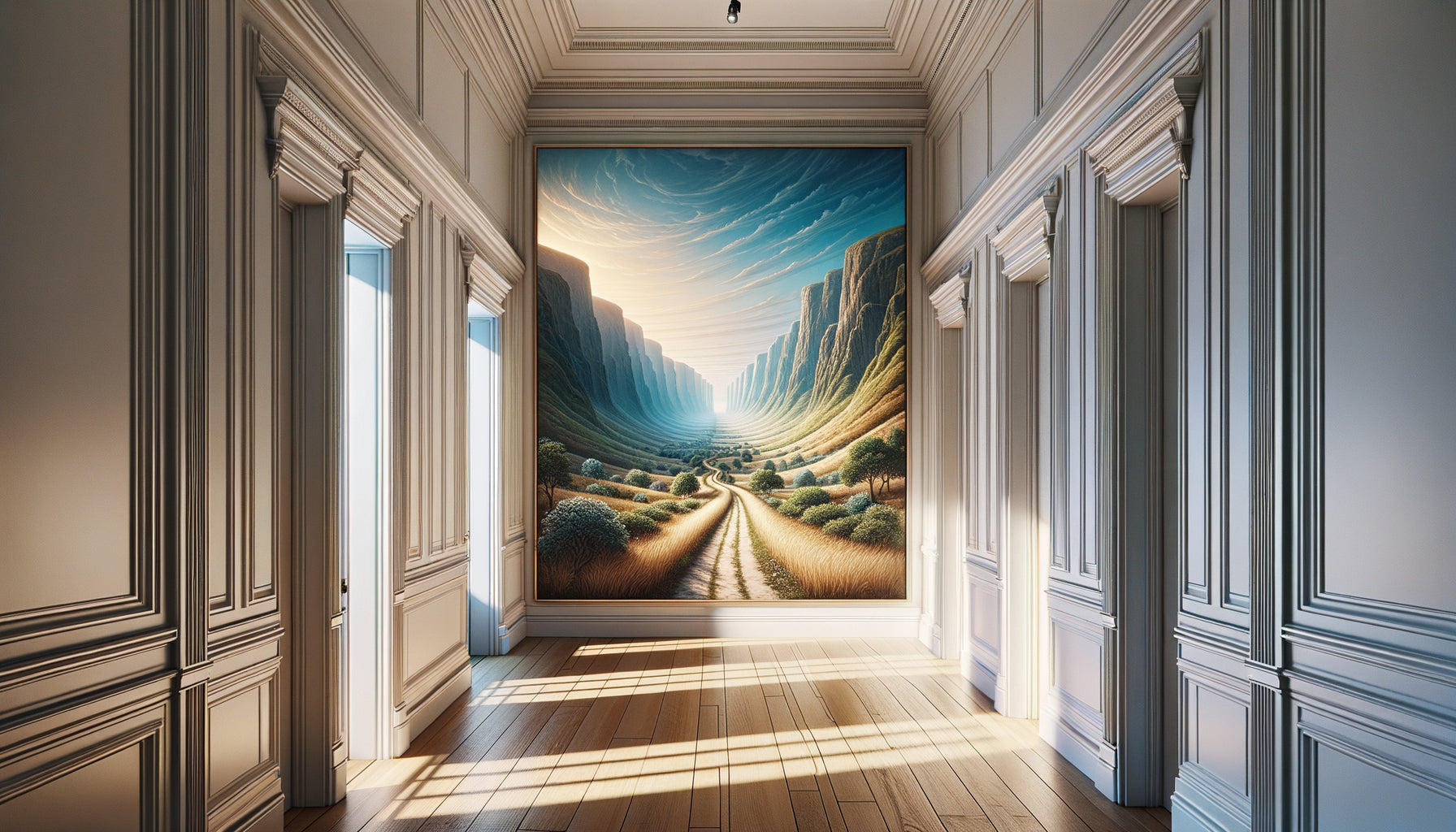
Here's a particularly effective technique: start your hallway with a large geometric abstract artwork with imposing shapes, then gradually reduce the size of the elements in the following artworks. This forced perspective visually lengthens the space while maintaining a captivating progression rhythm. The eye naturally follows this reduction, creating an irresistible forward movement.
The mistakes that break the rhythm (and how to avoid them)
After fifteen years of designing installations for transitional spaces, I have identified three recurring errors that sabotage the potential dynamic rhythm of geometric artworks in a hallway.
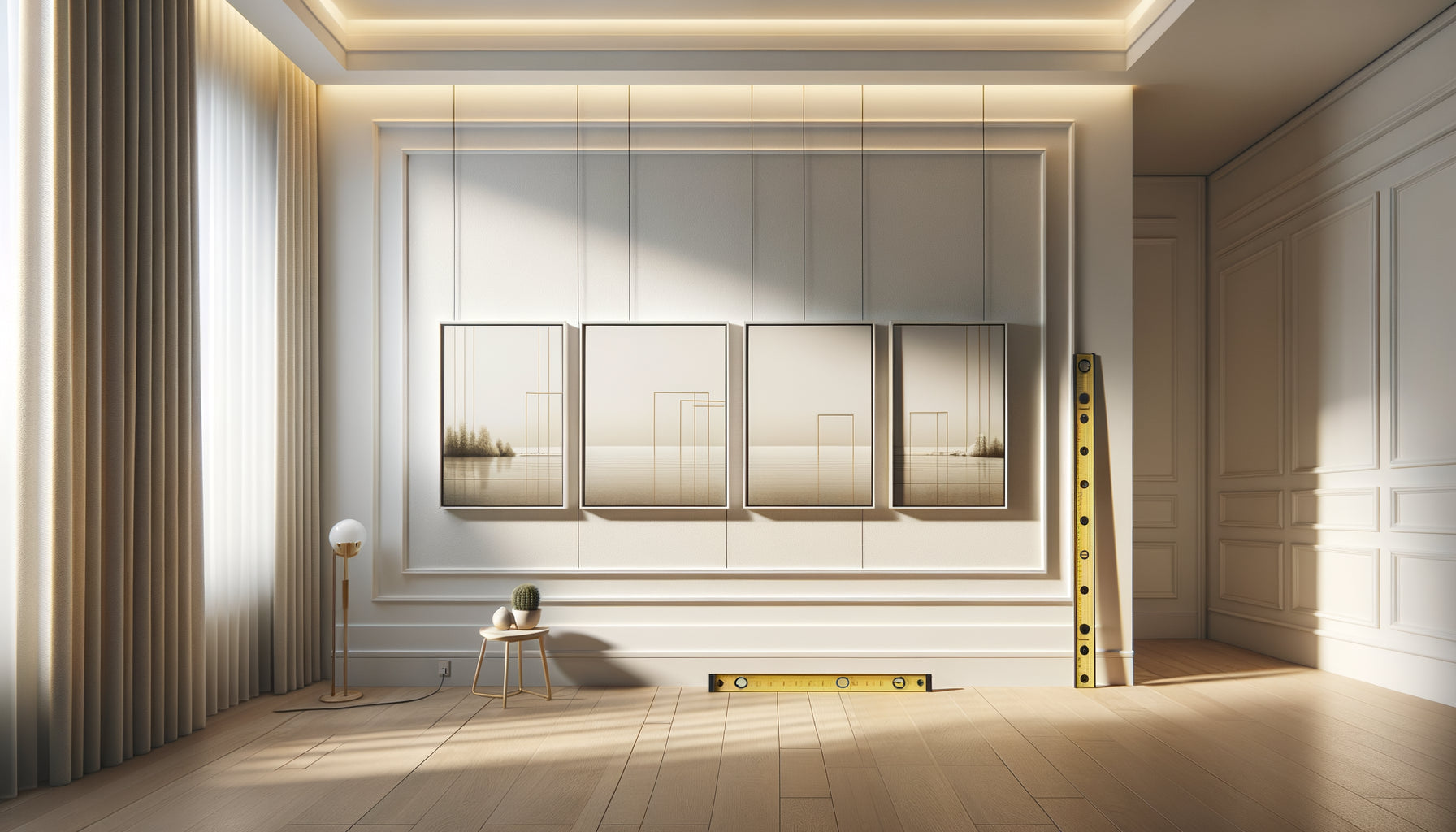
First mistake: anarchic spacing. Installing your artworks at irregular intervals without intention breaks the visual musicality. Rhythm requires logic: equal spacing for a regular tempo, measured alternation for intentional syncopation. But spatial chaos simply creates... chaos. I recently corrected a hallway where seven abstract artworks were randomly arranged: by reorganizing them according to a mathematical progression (100 cm, 90 cm, 80 cm between each), the rhythm appeared instantly.
Second mistake: stylistic cacophony. Mixing too disparate geometric styles dilutes the rhythmic impact. You can vary patterns, certainly, but maintain consistency: same color palette, same degree of abstraction, or even compositional approach. Think of an orchestra: different instruments, but playing the same score.
The crucial importance of hanging height
Third mistake: neglecting vertical alignment. In a hallway, you move, your line of sight evolves. Aligning all your geometric artworks on the same horizontal line (usually at eye level, or 160 cm for the center) creates a stable base upon which rhythm can be built. Intentionally varying this height can also create an interesting vertical rhythm, but that requires technical mastery that I only recommend to the most daring.

Composing your sequence: from slow movement to final acceleration
Now that you understand the principles, let's orchestrate your hallway concretely. I propose a proven five-step method to create an dynamic rhythm optimal with your geometric abstract artworks.
Time 1: Gentle opening. Begin the entrance to your hallway with a work featuring rounded shapes, moderately contrasting colors. It establishes the theme without harshness, inviting you into the visual sequence. Think of the opening of a piece of music: it announces what is to come without revealing everything.
Time 2: Gradual acceleration. The following works introduce more angles, sharper lines, and slightly intensified contrasts. If your first piece mainly featured circles in light blue and green, the second could introduce some triangles and a more saturated blue. The rhythm accelerates subtly.
Time 3: Central climax. Midway through your hallway, place the most dynamic geometric work: maximum contrasts, sharp angles, vibrant colors. This is the culmination of your composition, the moment when energy is at its peak. In a 6-meter hallway, this centerpiece becomes a magnetic focal point.
Time 4: Resolution. After the climax, gradually calm down. Geometric shapes that are still present but less aggressive, colors returning to softer tones. You guide the eye towards the exit of the hallway without harshness.
Time 5: Elegant conclusion. The last geometric abstract work should offer a form of visual resolution, perhaps subtly recalling an element from the first piece, thus creating a satisfying loop. Your hallway then becomes a complete journey with beginning, development and end.
Light and geometry: the alliance that reveals rhythm
An often-neglected but absolutely crucial aspect: the lighting of your geometric abstract works. Light can amplify or completely destroy the dynamic rhythm you have carefully composed.
I learned this lesson during an installation in a private residence hallway in Ghent. The artworks were perfect, the spacing impeccable, but the general ceiling lighting created shadows that fragmented the geometric compositions. We installed individually adjustable spotlights for each painting: immediate transformation. Each piece shone distinctly, the geometric shapes regained their clarity, and the visual rhythm finally became perceptible.
Light temperatures as an ambient modulator
Experiment with different light temperatures. Warm lighting (2700-3000K) softens the rhythm of geometric works, creating an intimate atmosphere. Neutral lighting (4000K) reveals colors accurately and maintains dynamic energy. Cool lighting (5000K+) intensifies the contemporary character and visually accelerates the sequence. In a modern hallway with clean lines, I generally opt for 3500K: the perfect compromise between warmth and dynamism.
Your hallway deserves to become an experience, not just a passage
Discover our exclusive collection of hallway art that will transform your linear space into a rhythmic and captivating gallery.
Your hallway transformed: from dead space to vibrant gallery
Visualize now your hallway in six months. You no longer cross it mechanically, you walk through it with pleasure. Your guests naturally slow down to observe the sequence of geometric abstract artworks that you have orchestrated. This once forgotten passage has become a signature of your interior, a space where dynamic rhythm transforms each movement into an aesthetic micro-event.
Start modestly if you hesitate: three well-chosen and properly spaced geometric works are enough to create a first perceptible rhythm. Observe how your gaze naturally connects them. Then gradually enrich your composition, refine your color sequence, adjust your contrasts. The art of visual rhythm in a hallway is built up layer by layer, like an abstract painting itself. Your hallway awaits only one thing: to become the artistic path that you will cross with a discreet smile each morning.
Frequently Asked Questions
How many geometric abstract artworks do you need to create a dynamic rhythm in a hallway?
The rule I consistently apply: one artwork every 1.5 to 2 meters of hallway length. For a 6-meter passage, aim for 3 to 4 geometric paintings. Fewer than three artworks would create a sequence that is too fragmented to establish a true rhythm, while more than five in a restricted space would risk visual saturation. The goal is for your eye to naturally pass from one piece to the next without effort, creating this sought-after rhythmic fluidity. If your hallway is particularly long (more than 8 meters), you can increase to 5-6 artworks, but then maintain an even stricter stylistic consistency to avoid cacophony. Remember that rhythm is born as much from the empty spaces between the paintings as from the works themselves: these wall breaths are essential to the perception of movement.
Can narrow hallways support imposing geometric abstract artworks?
Absolutely, and it’s often my recommendation! Contrary to intuition, a narrow hallway (less than 1 meter wide) benefits from medium to large-sized artworks rather than multiple small paintings. A geometric composition of 60x80 cm creates an immediate visual impact that diverts attention from the physical narrowness. The secret lies in choosing patterns: prioritize horizontal geometric shapes that visually widen the space, or compositions with perspective that create depth. I equipped a hallway 85 cm wide with three abstract artworks 70 cm high: the result was spectacular, the space paradoxically seemed more generous. Simply avoid frames that are too thick or protruding, which would physically reduce the passage. Opt for thin frames or even frameless canvases to maximize the visual effect without cluttering the real space.
Should geometric artworks with bright or neutral colors be chosen for a dark hallway?
In a naturally dark hallway, geometric abstract artworks in bright colors become virtual sources of light that completely transform the atmosphere. I recently worked on a windowless passage where we installed geometric compositions in luminous yellows, energetic oranges and vibrant whites: the hallway went from oppressive tunnel to luminous gallery. Neutral tones (gray, beige, taupe) work best in hallways that are already well lit, where they bring sophistication and calm. Here's my technical advice: if your hallway receives less than 200 lux of natural light (test with a smartphone app), opt for geometric artworks with at least 60% light or saturated colors. Combine this with targeted artificial lighting on each painting (spots of 3000K minimum), and your dark hallway will become a vibrant space where the dynamic rhythm is all the more perceptible thanks to the contrast with the environment.