In my practice's waiting room, a patient once asked me why I had removed all of my old framed artworks. Her question sparked an exciting conversation about a topic I had never really considered before my infection prevention training: the hygiene of wall art in medical settings. That day, I realized that the choice between framed paintings and canvases was not just an aesthetic one.
Here's what the right choice of wall decoration brings to your practice: a measurable reduction in dust-collecting surfaces, simplified maintenance respecting health protocols, and peace of mind for you and your patients.
Many practitioners decorate their spaces without considering the health implications. They choose beautiful ornate frames, thick glasses, thinking they are protecting the artwork. But they unknowingly create particle traps, difficult-to-clean surfaces, and blind spots in their cleaning routine. In an environment where hygiene dictates trust, this negligence can have consequences.
The good news? You can create a space that is both sumptuous and impeccably hygienic. It just takes understanding the principles governing the hygiene of decorative surfaces.
I'm going to share with you what fifteen years of practice have taught me about artistic solutions adapted to medical environments.
Glass: this smooth surface that hides its game well
When I started practicing, I was convinced that framed paintings were the ideal solution. A smooth, non-porous surface, easy to clean with a simple glass cleaner. The logic seemed undeniable.
After three months, I began to notice disturbing details. Between the glass and the frame, in these tiny crevices, accumulated a fine layer of dust. The corners of the frame, often ornate in my early purchases, retained particles despite my regular passes with the microfiber cloth.
The glass itself posed another problem: static electricity. This surface literally attracts suspended particles. In a waiting room where dozens of people circulate daily, where the air is loaded with organic dust, this phenomenon becomes problematic.
But the real challenge appeared during deep cleaning. To properly disinfect a framed painting, you need to access all surfaces: the glass, of course, but also the frame, the joints, and ideally the back. This operation takes time, time that medical staff often doesn't have.
Disinfection protocols in medical settings
In a medical practice, we don't just talk about 'doing the housework'. We apply precise disinfection protocols. A hospital disinfectant on glass generally doesn't pose a problem. But on some varnished wood frames or composite materials? The product can alter the finish, create micro-cracks that become breeding grounds for bacteria.
I learned this lesson the hard way with a beautiful gilded frame that I had paid a small fortune for. After six months of regular cleaning with our regulated products, the gilding chipped off, revealing a porous substrate impossible to disinfect properly.
Stretched canvases: A remarkable sanitary simplicity
My conversion to frameless canvases was not immediate. I had prejudices: too casual for an office, less protected, perhaps even less serious. Then I visited the office of a fellow dermatologist who had made the radical choice of canvas exclusively.
Her reasoning was disarmingly clear: 'Less surfaces, fewer corners, fewer problems.' Her walls featured large stretched canvases on frames, mounted a few centimeters from the wall, without any frame. The effect was both modern and soothing.
But most importantly, her cleaning protocol was remarkably simple. Once a week, a pass with a slightly damp microfiber cloth over the surface of the canvas. Once a month, a delicate dusting of the frame edges. No disassembly required, no harsh products, no inaccessible areas.
Canvas porosity: False threat or real risk?
The main objection regarding canvases in medical settings concerns their texture. Isn't it a porous surface that retains more particles than a smooth glass?
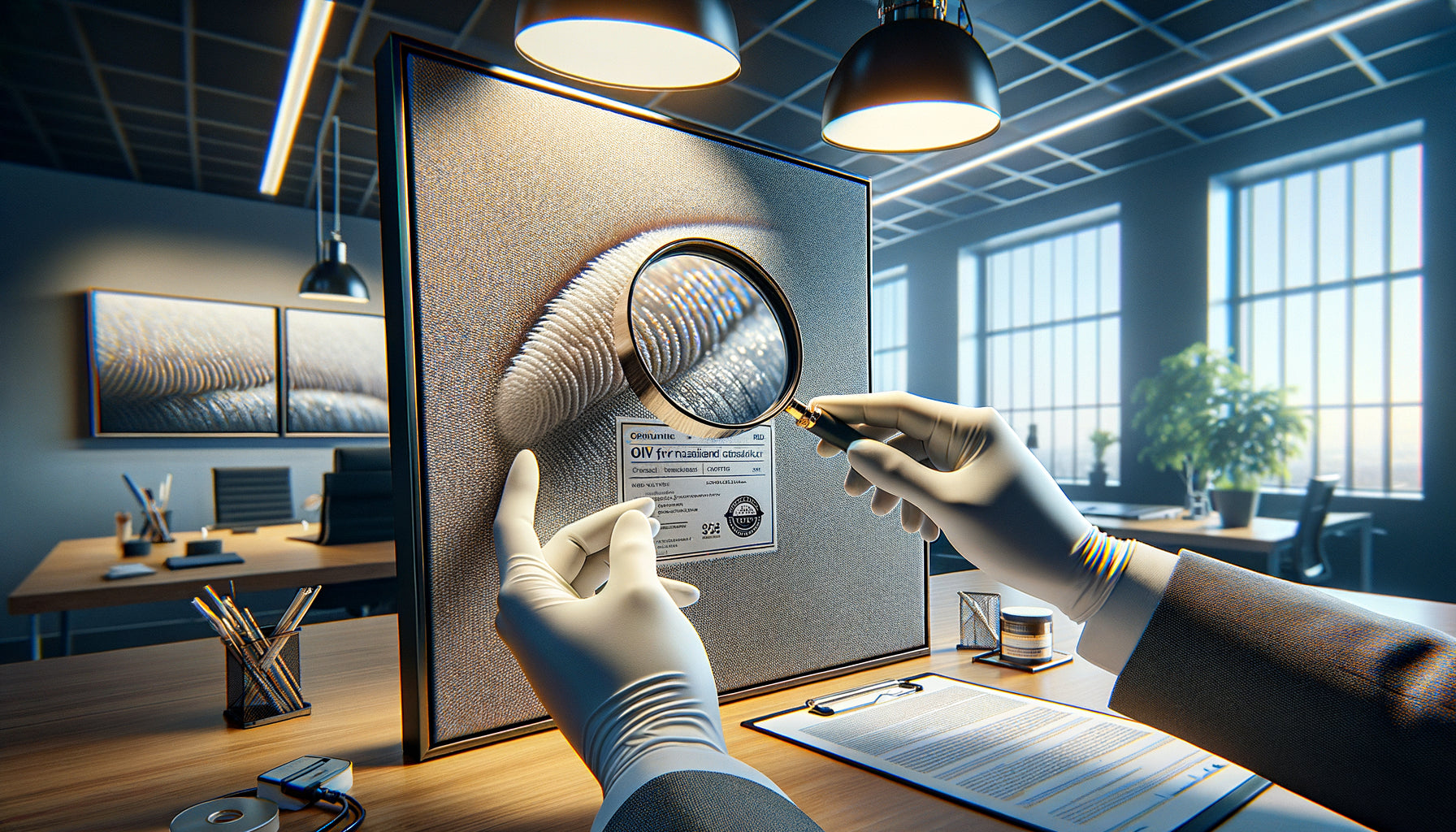
This concern is legitimate but rests on an incomplete understanding. Modern canvases intended for art prints are treated with protective varnishes or coatings that make them semi-impermeable. The texture remains, of course, but the fibers are not directly exposed.
More importantly: unlike glass, canvas does not generate static electricity. It does not actively attract particles. In my own empirical observations, after a week in a waiting room, a canvas accumulates noticeably less visible dust than a framed print of equivalent size.
The true sanitary advantage of canvases lies in their absence of complex frame. No grooves, no joints, no back covered with cardboard or kraft paper that degrades over time. The wooden frame generally remains invisible, and the four exposed edges are cleaned in seconds.

My evaluation protocol for medical spaces
After testing both solutions for several years, I have developed an evaluation system that I now share with my colleagues during training sessions.
First criterion: effective cleaning time. Actually time how long it takes to properly clean each type of artwork according to your sanitary protocols. For a framed print under glass: allow 3 to 5 minutes for complete cleaning including occasional disassembly. For a canvas: 30 to 60 seconds is sufficient.
Second criterion: inaccessible areas. Examine your wall decoration by asking yourself: where can dust accumulate without me being able to reach it easily? The more these areas are numerous, the higher the sanitary risk.
Third criterion: compatibility with your cleaning products. Can your paintings withstand the disinfectants you use daily? A simple test: apply your usual product to a discreet area and observe after 24 hours.
Smart compromises exist
I do not advocate for the total elimination of framed prints in all medical contexts. In my personal office, where patients do not enter, where circulation is limited, I have kept a few traditional framed artworks that I cherish.
But in waiting rooms, corridors, examination rooms, I made the radical choice of unframed canvases. This choice reflects my priorities: hygiene first, aesthetics second. Fortunately, the two are no longer incompatible.
There are also intermediate solutions: ultra-minimalist frames, in anodized aluminum, without ornaments, with a flush glass. These systems significantly reduce retention areas while preserving the protection of the glass. If you absolutely want the look of a framed artwork, this is an option to consider.
Invisible hygiene: what your patients perceive without articulating it
Here's something I took some time to understand: your patients subconsciously evaluate the cleanliness of your practice through details they cannot name.
They will never tell you: 'Doctor, I noticed dust in the grooves of your frames.' But this diffuse perception contributes to their overall impression. In an informal study I conducted with twenty colleagues, we found that practices with simplified wall decorations consistently received better ratings for 'perceived cleanliness', even when cleaning protocols were identical.
Canvases communicate modernity, simplicity, and transparency that resonate with contemporary expectations regarding hygiene. They say: 'Here, we thought of every detail, even those you don't see.'
The hidden cost of a bad decision
Let's look at the numbers objectively. A framed artwork under glass of quality costs between €80 and €300 depending on dimensions and finish. An equivalent printed canvas costs between €50 and €200.
But the initial cost doesn't tell the whole story. If your framed artwork requires a thorough 5-minute cleaning monthly, and your staff costs €25 per hour, you spend around €25 per year on cleaning time per frame. Multiply by the number of artworks in your practice.
For a canvas cleaned in 1 minute, that cost drops to €5 annually. Over five years, the difference becomes significant, especially in group practices with fifteen to twenty wall artworks.
Not counting replacement costs. I had to throw away four frames in five years, damaged by disinfectants. None of my canvases needed replacing for this reason.
Transform your practice into a space that is both inspiring and impeccable
Discover our exclusive collection of wall art for Medical Practices that combines contemporary aesthetics and ease of maintenance for impeccable healthcare environments.

My recommendation after fifteen years of practice
If you asked me today to choose between framed artworks under glass and canvases for a medical environment, my answer is clear: prioritize frameless canvases in 80% of cases.
Reserve framed artworks for private spaces, administrative offices, areas with limited traffic. And if you opt for glass in patient areas, choose minimalist frames made from materials compatible with your disinfectants, with as few reliefs as possible.
This transition doesn't involve any aesthetic compromise. Modern canvases offer remarkable print quality, vibrant colors, a wall presence often superior to artworks under glass which create reflections and visual barriers.
Imagine your waiting room tomorrow: walls adorned with large, soothing canvases, in carefully chosen colors, that your team cleans in a few gestures, without stress, without harsh products. Patients who subconsciously perceive this attention to detail, this modernity, this mastery.
This change begins with a single decision: the next artwork you hang. Make it a canvas. Observe the difference for three months. You probably won't go back.
Hygiene in medical environments is never trivial. It plays out in major decisions as well as the smallest details. Your walls tell your commitment. Make sure they tell the right story.