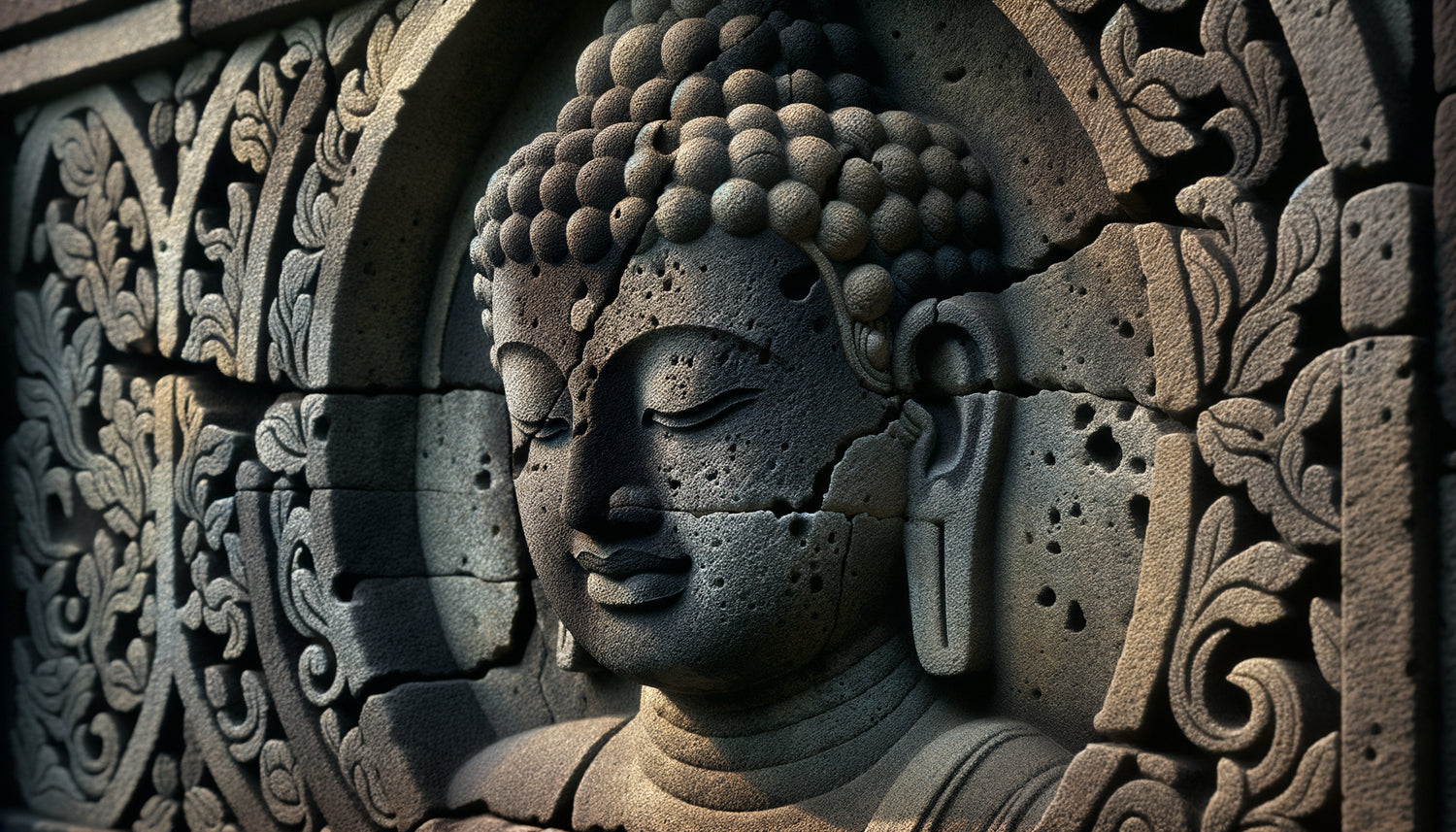
When I first placed my hands on the volcanic stones of Borobudur, under the scorching sun of Java, I felt something strange. These monumental reliefs, known throughout the world in their majestic anthracite grey, held invisible secrets from the hurried eyes of tourists. Infinitesimal traces, pigments fossilized within the pores of the andesite, told a forgotten story: the story of a temple that once exploded with color. After twelve years restoring Buddhist sites in Southeast Asia and three specific missions to Borobudur, I realized we were looking at this 9th-century masterpiece with eyes distorted by time.
Here's what the partial polychromy of Borobudur reveals: a radically new understanding of Javanese art, an experience once multisensory spiritual, and a crucial lesson about our modern perception of ancient monuments. These traces of black are not mere conservation accidents – they are the vestiges of a sophisticated visual language that guided pilgrims towards enlightenment.
The problem? We have been conditioned to imagine these temples in their mineral nudity. Iconic photographs, documentaries, even digital reconstructions perpetuate this monochrome vision. When I mention the possibility of reliefs once enhanced with black, red and gold pigments, I often see disbelief in people's eyes.
Yet, the evidence is accumulating. Spectrometric analyses conducted on the reliefs of Borobudur reveal abnormal concentrations of carbon and metal oxides in specific areas – the folds of clothing, the contours of faces, architectural details. This is not random contamination. It is artistic intention.
The mysterious black traces: when stone speaks
On the 2,672 sculpted panels of Borobudur, some exhibit fascinating anomalies. In the lower galleries, partially protected from tropical rains, I documented dozens of reliefs where black concentrates unevenly.
This black is not dirt. Analyses reveal a carbon of organic origin, probably derived from soot mixed with plant binders – a pigmentation technique known in ancient Asia as lampblack. Javanese artisans would have applied these pigments to create dramatic contrasts, guiding the pilgrim's eye through the sculpted narratives.
Even more revealing: these black traces appear systematically on key narrative elements. The faces of the bodhisattvas, religious symbols, crucial moments in Buddhist stories. It was not a general decoration but a selective highlighting, a kind of spiritual underlining that prioritized visual information.
The highlighting technique: the art of sculpting light
The builders of Borobudur did not work in an isolated tradition. They inherited centuries of Indian craftsmanship where the polychromy of temples was the absolute norm. At Ajanta, Ellora, Sanchi, all reliefs were painted. Why would Borobudur have been different?
The technique of highlighting consists of applying pigments only to certain parts of a sculpture, leaving other areas in their raw material. This created an extraordinary visual depth, making the reliefs readable even under the flickering light of oil lamps carried by nocturnal pilgrims.
Partial polychromy: the silent revolution of our understanding
The expression partial polychromy changes everything. It means that Borobudur was neither entirely gray as we see it today, nor completely painted like a baroque Hindu temple. It was a subtle balance between bare stone and colored accents.
Imagine climbing the circular terraces at sunrise. The volcanic stone, naturally dark, absorbs the first orange rays. Suddenly, a detail emerges: the deep black highlighting the eyes of a bodhisattva, the cinnabar red emphasizing the lips of the infant Buddha, touches of gold on royal ornaments. These chromatic punctuations created a visual rhythm, a breath in the mineral mass.
Research conducted by the Indonesian conservation team has identified at least four pigments used at Borobudur: carbon black, red ochre (hematite), cinnabar (mercury sulfide) and probably gold leaf applied to plant adhesive. These materials were expensive, sometimes imported from very far away. Their use was therefore strategic and symbolic.
Reliefs like illuminated manuscripts
This approach to partial polychromy is surprisingly similar to that of medieval manuscripts. Think of illuminations: the text remains black on parchment, but the initials explode in lapis lazuli blue and gold. The sculptors of Borobudur applied the same philosophy in three dimensions.
The pigmented areas created a narrative hierarchy. An illiterate pilgrim could follow the story of the Buddha simply by following the colored accents from relief to relief. Black often marked dramatic transitions, moments of suffering or renunciation. Red and gold celebrated enlightenment and spiritual royalty.

Why did these colors disappear?
Java is an island of torrential rains, volcanic eruptions and aggressive vegetation. Borobudur was abandoned in the 14th century and engulfed by jungle for centuries. Organic pigments – those based on carbon, plant binders – were literally washed away by time.
Carbon black, however, resists better than other colors. It penetrates deeply into the pores of porous andesite. That is why traces are still detectable today, while reds and golds have almost completely disappeared. These black vestiges are like chromatic ghosts, the last witnesses to a lost splendor.
The rediscovery of the temple in 1814 by Stamford Raffles marked the beginning of restorations – but also of errors. The first teams cleaned the stones with aggressive methods, unknowingly eliminating valuable pigment residues. It was only in the 1980s, with modern analysis techniques, that we began to understand what we had lost.
The tropical climate: an enemy of conservation
Unlike Egyptian temples preserved by the desert, Borobudur is subject to extreme humidity cycles. The Javanese monsoon brings up to 3000 mm of rainfall annually. Organic pigments degrade through hydrolysis, binders dissolve, colors migrate into the stone and then disappear.
The traces of black that survive today are mainly found in protected micro-cavities: behind relief elements, in the corners of sculptures, under overhangs. It is these refuge areas that have allowed scientists to reconstruct the original palette.
The spiritual experience in technicolor
Understanding the partial polychromy of Borobudur transforms our reading of this monument. It was not a simple stone-mountain temple, austere and meditative. It was a orchestrated visual spectacle, designed to both amaze and teach simultaneously.
The pilgrim's journey began on the lower level, immersed in the scenes of the Kamadhatu (world of desire), probably the most richly colored to represent the seduction of the senses. As you go up, the pigments become rarer, the stone becomes more bare, symbolizing the progressive detachment. At the top, facing the open stupas and the large central stupa, the pilgrim reached the formless world – and indeed, without color.
This chromatic gradation was not accidental. It materialized the path to enlightenment, from the colorful multiplicity of illusions to the luminous simplicity of truth. The traces of black in the lower reliefs are therefore not insignificant details: they are the markers of a deeply thought visual teaching.

What Borobudur Teaches Us About Contrast
As a restorer, I’ve learned a fundamental lesson at Borobudur: the power of targeted contrast. Javanese artisans didn't seek to color everything uniformly. They understood that a touch of black on a natural gray background had more impact than an excess of colors.
This philosophy strangely resonates with current interior design trends. The use of strategic black accents in clean spaces creates exactly the same effect: it guides the eye, structures the space, creates depth. A black frame on a white wall, a dark frieze highlighting clear architecture – it’s the same visual intelligence, separated by twelve centuries.
The reliefs of Borobudur remind us that before Mondrian, before the Bauhaus, even before the Renaissance, Asian artists already mastered the art of accentuated minimalism. Their lesson? Contrast doesn't need to be total to be powerful. A few grams of black pigment in the right place are better than kilograms applied without discernment.
Capture the Timeless Power of Contrast
Discover our exclusive collection of black and white artworks that capture the same philosophy of mastered contrast – where each dark touch reveals the surrounding light.
Your Gaze Will Never Be the Same
Next time you contemplate a photograph of Borobudur – or better, if you are lucky enough to walk on its stone terraces – look differently. Look for these suspicious shadow zones in the folds of sculpted clothing. Imagine the disappeared colored accents. Visualize the temple not as a gray and solemn monument, but as a giant picture book, punctuated with colors guiding the faithful to wisdom.
These traces of black are messages in bottles launched across the centuries. They tell us: We were alive. We vibrated. We spoke a language of stone and pigments that you have forgotten. The restorers and scientists who study them are not just technicians – they are translators, deciphering a lost aesthetic vocabulary.
The history of partial polychromy at Borobudur humbly reminds us that we never see the past as it was. We see its ruins, its ghosts, its faded echoes. But with attention, science and imagination, we can begin to rediscover the lost colors – and with them, a richer understanding of the art and spirituality that built these wonders.
Frequently Asked Questions
Was Borobudur really colorful originally?
Yes, scientific evidence converges on this conclusion. Spectrometric analyses reveal the presence of organic and mineral pigments on many reliefs, including carbon black, red ochre and traces of cinnabar. However, it was probably not a total polychromy like some Hindu temples, but a selective application of colors on key narrative elements. This partial polychromy created visual contrasts guiding pilgrims through the carved Buddhist stories, while respecting the natural beauty of the volcanic andesite stone. The black traces are the most persistent because carbon penetrates deeply into the porous stone and resists tropical rains better than other pigments.
Why did these colors disappear when the stone is intact?
The volcanic andesite stone is extremely durable, but the organic pigments applied on the surface are much more fragile. The tropical climate of Java, with its torrential rains (3000 mm per year) and high humidity, has gradually dissolved the plant-based binders that fixed the colors. The abandonment of the temple in the 14th century and its burial under the jungle for centuries accelerated this degradation. Roots, mosses, lichens and thermal cycles finished the job. Early 19th-century restorations, using aggressive cleaning methods, unfortunately eliminated valuable residues. Only microscopic traces remain today in protected areas – sufficient for modern analyses but invisible to the naked eye.
Could Borobudur be recolored to show its original appearance?
This is a complex ethical question that divides conservation experts. Technically, we could create a digital reconstruction or even partially repaint some reliefs. However, the Venice Charter on heritage preservation prioritizes the readability of the monument's history, including its aging process. Repainting would mask twelve centuries of history and risk further damaging the stone. The current solution is more respectful: digital reconstructions in augmented reality allow visitors to visualize the original polychromy via applications, while preserving the site's physical integrity. This approach offers the best of both worlds – understanding the colorful past without erasing the authentic present.