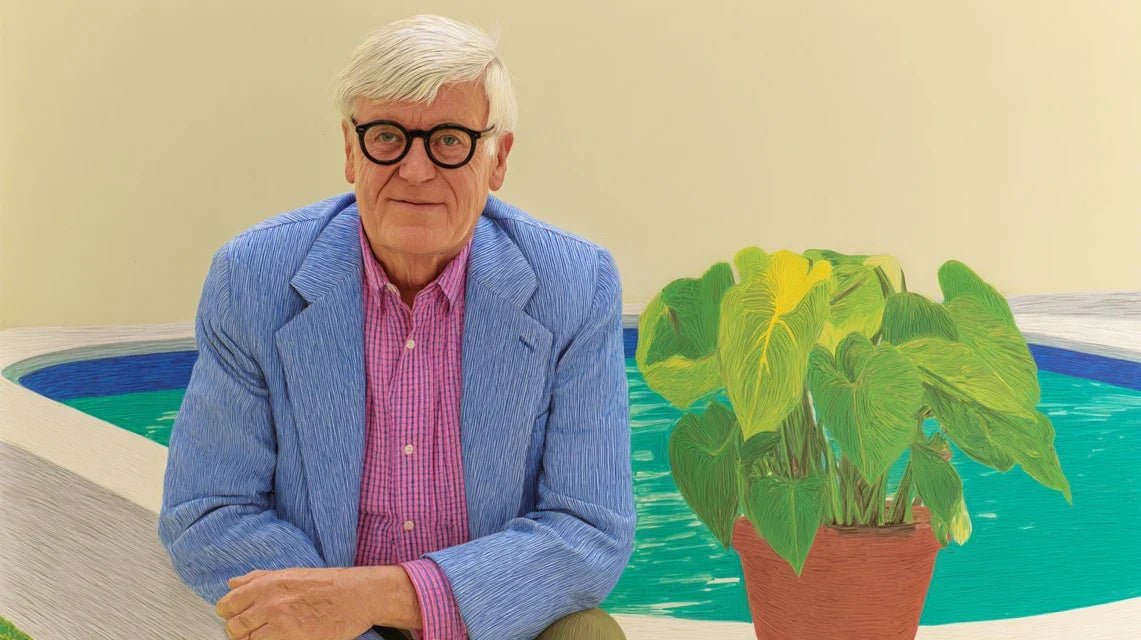
Imagine a painter capable of transforming the chlorinated water of a Californian pool into an eternal masterpiece, capturing the light of Los Angeles with the precision of a photographer and the soul of a poet. 🎨
This artistic genius is David Hockney, the man who revolutionized our perception of contemporary art by blending British tradition and American modernity, photographic realism and color abstraction.
Discovering Hockney means understanding how a young man from industrial Yorkshire became one of the most highly valued living painters in the world, selling his canvases for more than 90 million dollars and influencing generations of artists.
This biography reveals the man behind the iconic pools, his revolutionary technical innovations, and why his art continues to fascinate the world - a dive into the universe of an essential master.
David Hockney : Portrait of a Revolutionary Colorist in Contemporary Art
Knowing the true story of David Hockney allows us to understand how an artist can transform everyday scenes into universal artistic icons, revolutionizing our relationship with modern painting.
| Biographical Highlights | Artistic Legacy |
|---|---|
|
Full name : David Hockney Birth date : July 9, 1937, Bradford, Yorkshire Nationality : British Residence : Los Angeles, California |
Movement : British Pop Art Style : Colorful photographic realism Key work : "Portrait of an Artist (Pool with Two Figures)" Innovation : Photo-collage technique |
But behind these factual highlights lies an extraordinary artistic adventure that takes us from the industrial suburbs of England to the golden hills of Hollywood...
David Hockney : The Yorkshire Roots of a Future Master of Color
Born in a modest family in Bradford, an industrial city in Yorkshire, David grew up in a universe of red bricks and gray skies that violently contrasts with the bright blues that will bring him fame.
Early artistic spark : At the age of 11, David discovered his vocation during a drawing lesson where he reproduced a still life with a precision that amazed his teacher. This revelation pushed him to draw obsessively, transforming every available surface into a creative medium.
His training at the Bradford College of Art and then at the prestigious Royal College of Art in London reveals an early talent for combining classical technique with a modern vision. He develops his unique style there, influenced by Picasso, Matisse and the masters of the Renaissance.
Hockney's founding principle: "Art must be accessible to all without losing its depth" - a philosophy that will guide his entire career and explains the popular success of his most sophisticated works.
This rigorous training, combined with his insatiable curiosity for new techniques, already shapes the future innovator who will revolutionize contemporary art...
David Hockney and the 1960s: The Explosion of British Pop Art
The 1960s saw the birth of a major artistic revolution: Pop Art exploded simultaneously in New York with Andy Warhol and in London with a new generation of British artists, among whom Hockney quickly became an emblematic figure.
This era of cultural effervescence, marked by the Beatles, sexual liberation and the explosion of mass culture, offers Hockney the perfect context to develop his accessible and colorful art.
Unlike his contemporaries such as Peter Blake or Richard Hamilton who draw inspiration directly from advertising imagery, Hockney chooses a more personal path: transforming intimate scenes into universal artistic statements.
The emergence of new materials like acrylic paints and the increasing accessibility of color photography profoundly influence his technique, allowing him to achieve these vibrant blues impossible with traditional techniques.
Hockney's uniqueness in his time: While his contemporaries criticize consumer society, he chooses to celebrate the beauty of modern everyday life, creating an optimistic art that transcends artistic trends.
This unique approach will soon lead him to his greatest revolution: the discovery of California...
David Hockney: The London Hardship Years (1959-1963)
Despite his obvious talent, Hockney's early professional years were marked by financial hardship and the conservative London art scene's incomprehension of his innovative style.
Living in a tiny studio in Notting Hill, he survives by selling drawings on the street and accepting portrait commissions that he finds "commercial" but necessary to pay his rent of 3 pounds a week.
The decisive meeting with dealer John Kasmin in 1963 changes everything: the latter, convinced by Hockney's originality, offers him his first solo exhibition and an exclusive contract that finally ensures him financial stability.
These difficult years forge his legendary determination and ability to transform constraints into creative opportunities, such as when he invents his "domestic scenes" technique due to a lack of professional models.
This period of rigorous training prepares for the creative explosion that will follow his installation in California...
David Hockney: Scandals and Controversies of the Iconoclastic Painter
Hockney's openly assumed homosexuality in the 1960s - a time when it is still illegal in Great Britain - provokes scandals and controversies within the conservative British art scene.
His early explicitly homoerotic works such as "We Two Boys Together Clinging" (1961) create an uproar in the press, with some critics going so far as to call his art "immoral propaganda" and demanding censorship of his exhibitions.
Refusing any compromise, Hockney fully embraces his artistic vision and develops a revolutionary philosophy for the time: "Art must tell the truth about life, even if that truth is disturbing."
The statement that caused scandal: During an interview on BBC in 1964, Hockney stated: "I paint love in all its forms because it's the most beautiful human emotion. If that bothers people, it’s society that has a problem, not my art."
These controversies, far from harming his career, strengthen his notoriety and attract the attention of progressive American collectors, preparing for his imminent Californian success.
This artistic courage becomes his signature: an art that embraces its aesthetic choices without ever seeking to please those who think they are right...
David Hockney and the Art of Swimming Pools: The Californian Revolution
Hockney's installation in Los Angeles in 1964 marks a major artistic transformation: dazzled by the Californian lightand fascinated by private swimming pools, he develops his most famous style.
The creation of his masterpiece "A Bigger Splash" in 1967 reveals his genius: transforming a simple pool dive into a meditation on movement, time and the beauty of modern everyday life.
"Portrait of an Artist (Pool with Two Figures)": David Hockney's Masterpiece
This work from 1972, sold for 90.3 million dollars in 2018, synthesizes all of Hockney's mastery: photographic composition, classic pictorial technique and Californian modernity blend into perfect harmony.
His signature technique consists of combining direct observation, photographs and memory to create images of impossible realism, truer than life but deeply stylized.
David Hockney's Revolutionary Technical Innovations
Pioneer of photo-collages from the 1980s, Hockney invented a unique technique: assembling hundreds of photographs to create multiple perspectives, anticipating digital art by decades.
David Hockney facing his Pop Art Contemporaries
Unlike Andy Warhol who mechanizes art or Roy Lichtenstein who copies comic strips, Hockney humanizes Pop Art by injecting personal emotion and refined pictorial technique.
A revealing anecdote: during a meeting with Warhol in 1963, the latter advised him to abandon painting for silkscreen printing. Hockney replied: "Never, my hands are my best tools."
OUR RECOMMENDED PRODUCTS
This fidelity to traditional painting, enriched by constant innovations, explains the exceptional longevity of his artistic success...
David Hockney: Intimate Portrait of a Passionate and Meticulous Artist
Hockney's personality shines through in every work: perfectionist, meticulous observer and deeply optimistic, he transforms his personal environment into a permanent artistic laboratory.
His tumultuous love affair with Peter Schlesinger in the 1970s inspires some of his most moving works, notably portraits where psychological tension is read in every brushstroke.
A compulsive smoker for decades, Hockney develops a strict work routine: painting in the morning, photography in the afternoon, reading in the evening - a discipline that explains his legendary productivity with more than 5000 works cataloged.
This rigorous organization, combined with his insatiable curiosity for new technologies, leads him to his most surprising innovations...
David Hockney: The Ascent to International Acclaim (1970-2025)
International recognition arrives in the 1970s with his first retrospective at the Whitechapel Gallery in London, definitively establishing his status as a contemporary master at only 33 years old.
The decisive turning point occurs in 1988 with his retrospective at the Metropolitan Museum in New York: the first exhibition of a British living artist, it attracts 500 000 visitors and propels his international value.
David Hockney: Evolution of Value and Sales Records
The evolution of his price perfectly illustrates the growing recognition of his artistic genius and the market's appetite for his constant innovations.
| Period | Average Value | Sales Record |
|---|---|---|
| 1970s-1980s | 50 000 - 200 000 $ | "The Splash" - 340 000 $ (1978) |
| 1990s-2000s | 500 000 - 2 million $ | "Pacific Coast Highway" - 7.9 million $ (2006) |
| Current Market (2020-2025) | 2 - 15 million $ | "Portrait of an Artist" - $90.3 million (2018) |
This meteoric rise reflects not only the exceptional quality of his work but also his unique ability to remain contemporary across decades...
David Hockney: Digital Art and the Legacy of a Master Still Alive
At 87 years old, Hockney continues to revolutionize art by embracing digital technologies: his paintings on iPad since 2010 and his installations in virtual reality prove that innovation knows no age.
His recent series "The Arrival of Spring" (2020-2022), created during lockdown, demonstrates his unique ability to transform contemporary constraints into artistic opportunities, inspiring thousands of artists in confinement.
David Hockney's Influence on International Contemporary Art
His impact on current art is measured by hundreds of artists who adopt his technique of multiple perspectives, his innovative use of digital color and his philosophy of accessible art
Creators like Kerry James Marshall, Peter Halley or Kehinde Wiley explicitly acknowledge Hockney's influence on their approach to contemporary painting and their use of technology.
Recognizing the Hockney legacy today: Look for works combining photographic realism and saturated colors, impossible perspectives and intimacy of everyday life - as many signatures as he has bequeathed to contemporary art.
His major works can be discovered at the Metropolitan Museum and MoMA in New York, the Tate Modern in London, the Centre Pompidou in Paris, and the Getty Center in Los Angeles - veritable pilgrimages for any contemporary art enthusiast. 🏛️
This international museum presence ensures that his influence will continue to inspire future generations of artists and art lovers...
🎁 Special offer for readers
Because you took the time to inform yourself, enjoy 10% discount on your first order:
Frequently Asked Questions about David Hockney's Biography
David Hockney, born in 1937 in Bradford, is one of the most influential British painters of the 20th century. Celebrated for his paintings of California swimming pools and technical innovations, he revolutionized contemporary art by combining photographic realism and vibrant colors. His work "Portrait of an Artist" holds the record for the highest price paid for a living artist at 90.3 million dollars.
Trained at the Bradford College of Art and then at the prestigious Royal College of Art in London, Hockney develops his style by combining classic techniques with modernity. Influenced by Picasso and Matisse, he invented his artistic signature during his installation in California in 1964, where light and swimming pools became his favorite subjects.
Hockney invented in the 1980s a unique technique: assembling hundreds of Polaroid photographs to create multiple perspectives in a single work. This innovation, which he calls "joiners", anticipates digital art and profoundly influences contemporary art by offering a cubist vision of photography.
International recognition came as early as the 1970s with his first retrospective in London. The decisive turning point occurred in 1988 with his exhibition at the Metropolitan Museum of New York, the first retrospective of a British living artist, which attracted 500 000 visitors and definitively cemented his status as a contemporary master.
Hockney's works sell today between $2 and $15 million depending on their period and importance. His absolute record remains "Portrait of an Artist (Pool with Two Figures)" sold $90.3 million in 2018. His recent digital paintings are creating a new market, democratizing access to his art.
Hockney's legacy can be found in hundreds of contemporary artists who adopt his innovations: multiple perspectives, use of technology, and accessibility of art. Creators such as Kerry James Marshall or Kehinde Wiley acknowledge his influence. At 87 years old, he continues to innovate with his iPad paintings and virtual reality installations.
David Hockney: The Eternal Innovator Who Continues to Revolutionize Contemporary Art
Discovering David Hockney today means understanding how an artist can traverse the decades while constantly remaining at the forefront, transforming each technological innovation into a new artistic expression, from acrylic paint to the iPad.
His artistic message - that beauty lies in everyday life and that art should move without intimidating - resonates particularly in our image-saturated era, reminding us that really looking remains a revolutionary act.
Beyond sales records and critical recognition, Hockney offers us a lesson in life: staying curious, experimenting endlessly, and finding poetry in the ordinary are the keys to creativity that is eternally renewed.
The Hockney inspiration for your daily life: Look around with the eyes of this genius artist - every reflection of light, every unexpected color can become a source of wonder and beauty, transforming your perception of the world. 🎨