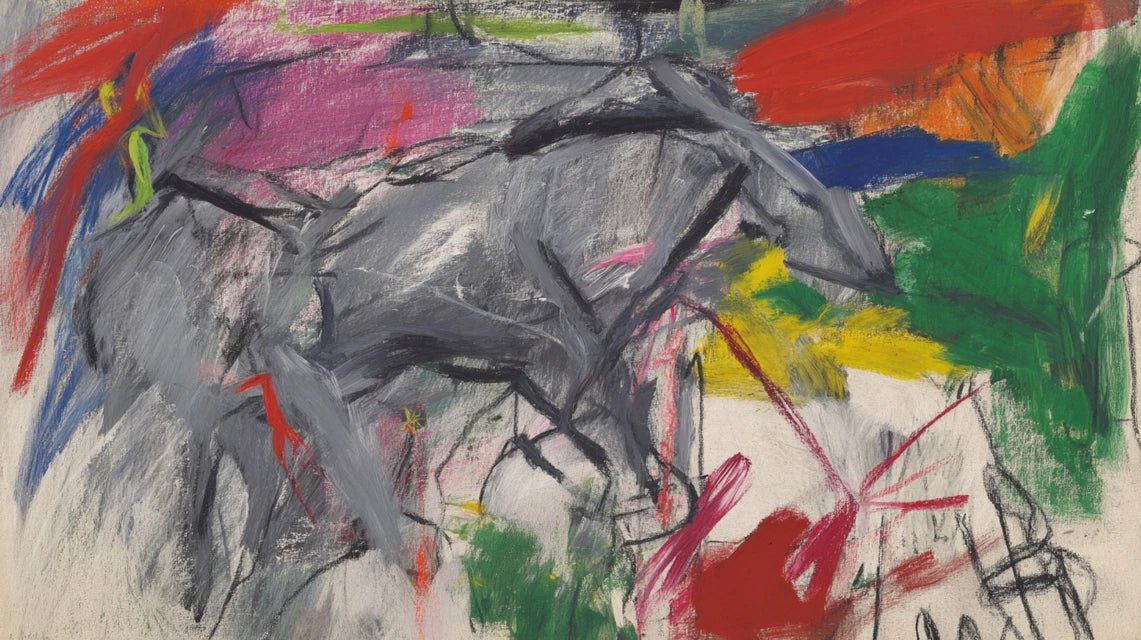
Imagine a man facing his canvas, brush in hand, in his studio in East Hampton, literally tearing the surface of white to unleash tormented forms that seem to dance between reality and abstraction.
The paint splatters, the colors mix in a controlled chaos, and suddenly emerges a female silhouette with impossible curves, sharp teeth, half-goddess half-monster. Willem de Kooning revolutionized American art with brushstrokes.
Who was Willem de Kooning really? How did this son of Rotterdam conquer Manhattan to redefine the boundaries between figuration and abstraction?
Discover the tumultuous saga of the artist who painted modernity with the brutality of a warrior and the sensitivity of a poet - Willem de Kooning, the man who freed painting from its chains.
Willem de Kooning: The revolutionary artist who broke all the codes
Knowing Willem de Kooning means understanding how a single man could radically transform the perception of Western art. Far from sanitized biographies, the true story of this artist reveals a complex, tormented, genius character.
| Biographical highlights | Artistic legacy |
|---|---|
|
Full name: Willem de Kooning Birth: April 24, 1904 in Rotterdam, Netherlands Death: March 19, 1997 in East Hampton, New York Nationality: Dutch then American (naturalized in 1962) |
Movement: American Abstract Expressionism Style: Violent gestural between abstraction and figuration Key work: "Woman I" (1950-1952) Innovation: Revolutionary fusion of Cubism and Expressionism |
de Kooning embodies creative contradiction: European by training but American at heart, abstract by instinct but figurative by passion, violent in gesture but refined in thought. This duality makes him one of the most fascinating artists of the 20th century.
The roots of Willem de Kooning: When Rotterdam forges a genius
In the industrial mists of Rotterdam at the beginning of the 20th century, grew up a child marked by harshness. Willem de Kooning was born into a working-class family torn apart: his father Leendert, wine merchant, and his mother Cornelia, bar owner near the port.
The event that changed everything: At only 3 years, Willem witnesses the brutal divorce of his parents. This family fracture, this early emotional violence will forever mark his vision of the world and permeate every brushstroke of his future tormented works.
Caught between his father and mother, young Willem finds refuge in art. At 12 years old, he leaves school to become an apprentice with a commercial decorator. In the evening, he studies at the Rotterdam Academy of Fine Arts, where he discovers European masters: Rembrandt, Rubens, but also emerging avant-gardes.
The revelation of free gesture: From his first years of apprenticeship, Willem understands that artistic truth does not lie in perfect imitation, but in the raw expression of emotion. This brilliant intuition will guide his entire career.
In 1926, at 22 years old, the young man takes a decisive step: he stows away on a British cargo ship and crosses the Atlantic to America, carrying in his luggage the European artistic heritage that he will revolutionize.
Willem de Kooning and the Roaring Twenties: Art in America between the Wars
De Kooning's arrival in the United States coincides with a period of extraordinary cultural effervescence. The America of the 1920s-1930s is brimming with creativity, New York rivals Paris to become the world’s artistic capital.
The crash of 1929 and the Great Depression profoundly transform American society. The artists, supported by the federal programs of the New Deal, explore new creative avenues, far from traditional European influence.
It is in this context that De Kooning meets the future giants of American art: Jackson Pollock, Mark Rothko, Barnett Newman, Arshile Gorky. Together, they form what will later be called the New York School, revolutionizing Western art.
The Second World War accelerates the exile of many European artists to New York, bringing the latest innovations of Surrealism and abstraction. This cross-fertilization nourishes the emergence of abstract expressionism.
Art as an affirmation of freedom: For De Kooning and his generation, painting becomes a political act, an affirmation of creative freedom in the face of European totalitarianisms. Each canvas proclaims American cultural independence.
This era shapes De Kooning's artistic character: rebellious, independent, refusing any label or defined movement, he perfectly embodies the spirit of American freedom.
Willem de Kooning in the poverty of Manhattan: 1926-1940, the lean years
Arriving penniless in Newport News Virginia, De Kooning does a string of odd jobs: painter, billboard designer, window decorator. These years of precariousness forge his determination and artistic authenticity.
Installed in Greenwich Village in 1927, he shares a spartan workshop with other struggling artists. In this New York bohemianism, he hones his technique and develops his unique style, blending European heritage and raw American energy.
1934 marks a turning point: De Kooning joins the Artist's Union and participates in federal art programs. For the first time, he can devote himself entirely to painting, freed from commercial constraints.
These lean years develop within him a visceral relationship with pictorial matter: lacking money to buy colors, he favors black and white, creating works of striking dramatic intensity.
His meeting with Arshile Gorky in 1935 transforms his trajectory: this brilliant mentor teaches him the art of "keeping a flat form while giving the idea of volume," a fundamental principle of his future art.
Willem de Kooning facing scandal: When "Woman I" divides America
1953: the exhibition of "Woman I" at the Sidney Janis Gallery provokes an unprecedented uproar in the American art scene. This monstrous woman, with sharp teeth and a carnivorous smile, deeply shocks puritanical America.
The critics are divided: some see it as a revolutionary masterpiece, others as an inadmissible misogynistic regression. De Kooning loses supporters, collectors abandon him, but gains international notoriety.
The artist fully embraces his provocative vision: "I don't paint women. I paint with women." For him, the female figure embodies all the tensions of human existence: desire and repulsion, creation and destruction, beauty and ugliness.
The philosophy of transgression: "Art should not be comfortable. It must disturb, question, reveal what we prefer to ignore," De Kooning told his detractors. This conviction guides all his work.
This controversy reveals De Kooning's genius: refusing aesthetic conveniences, he confronts the viewer with their own contradictions, transforming painting into a mirror of the human soul.
Far from being intimidated, he perseveres in his path, creating a series of "Women" that mark the history of contemporary art and definitively establish his global reputation.
Willem de Kooning and creative explosion: The invention of American Abstract Expressionism
The 1940s-1950s mark the creative peak of De Kooning. Freed from financial constraints thanks to the burgeoning success, he can finally give free rein to his revolutionary vision, creating the works that will forever change Western art.
1950: the creation of "Excavation" constitutes an artistic earthquake. This monumental canvas of 2 meters by 2.5 meters reveals the full extent of his genius, blending pure abstraction and figurative suggestions in a masterful controlled chaos.
"Excavation" by Willem de Kooning: The Masterpiece That Revolutionized Modern Art
"Excavation" summarizes Willem de Kooning's entire artistic philosophy: in this labyrinth of intertwined forms, the viewer distinguishes fragments of bodies, distorted faces, impossible geometries. The work constantly oscillates between readability and mystery, revealing the complexity of contemporary existence.
This revolutionary canvas earned De Kooning the Logan Medal from the Art Institute of Chicago and propelled his international career. It was also exhibited at the 25th Venice Biennale, definitively establishing American art on the world stage.
Willem de Kooning's Revolutionary Technique: Gesture and Matter
De Kooning develops a unique approach to painting: his canvases are born from successive layers, additions and deletions, creating surfaces of extraordinary tactile richness. He mixes oil, enamel and charcoal, sometimes using his fingers or found objects as tools.
Willem de Kooning Confronted with Jackson Pollock and His Contemporaries: A Creative Emulation
Unlike Pollock who favors pure automatism, De Kooning maintains a conscious control of his gesture. Faced with Rothko and his contemplative compositions, he chooses expressive violence. This diversity enriches American abstract expressionism.
His tumultuous relationship with Pollock stimulates their mutual creativity: rivals and admirers, they push each other to their respective limits, creating some of the most important works of the 20th century.
OUR RECOMMENDED PRODUCTS
This creative emulation transforms New York into the new world artistic capital, dethroning Paris for the first time since the Renaissance. De Kooning plays a central and decisive role.
Willem de Kooning, the man behind the artist: Passions, torments and creativity
De Kooning's private life sheds new light on his tormented art. His marriage in 1943 to Elaine Fried, herself a talented artist, perfectly illustrates the creative tensions that nourish his work.
Their passionate relationship, marked by alcoholism, mutual infidelities and separations, reflects the dramatic intensity of his canvases. Elaine becomes both muse, critic and rival, constantly stimulating his creativity through their stormy complicity.
The birth of his daughter Lisa in 1956, born from a liaison with Joan Ward during his separation from Elaine, reveals the complexity of his personality: loving father but absolute artist, unable to choose between family life and artistic creation.
These personal upheavals are directly reflected in his art: periods of crisis nourish his most powerful works, as if suffering amplified his creative genius.
Willem de Kooning: From poverty to world records, the meteoric rise
The recognition comes gradually: his first solo exhibition in 1948 at the Charles Egan Gallery marks the beginning of a meteoric ascent. The MoMA immediately acquires "Painting" (1948), officially consecrating his talent.
The 1950s saw an explosion of his notoriety: international exhibitions, prestigious awards, glowing reviews transform the former impoverished immigrant into a contemporary art star. His participation in the Venice Biennale confirms his global status.
Willem de Kooning on the art market: Records that defy understanding
The evolution of his price list perfectly illustrates the growing recognition of his genius. "Interchange" (1955), sold for 300 million dollars in 2015, becomes the third most expensive work in history, testifying to the capital importance of his artistic legacy.
| Period | Average value | Sale record |
|---|---|---|
| 1950-1970 (during his lifetime) | 10 000 - 100 000 dollars500 000 dollars for "Police Gazette" (1969) | |
| 1980-1997 (end of career) | 1-5 million dollars20,6 million for "Interchange" in 1989 | |
| Current market (2000-2024) | 5-50 million dollars300 million for "Interchange" in 2015 |
Willem de Kooning in 1997: The final years of the master and his artistic testament
The last decades of De Kooning, marked by Alzheimer's disease diagnosed in the 1980s, raise troubling questions about artistic creation and creative lucidity. His late canvases, more refined and luminous, question the natural evolution of his style.
His death on March 19, 1997 in East Hampton closes an exceptional career of over 70 years. Honors pour in from around the world, confirming his status as a giant of contemporary art and pioneer of American abstract expressionism.
The influence of Willem de Kooning on contemporary art: A living legacy
His impact on subsequent generations of artists remains considerable: Jean-Michel Basquiat, Julian Schnabel, Anselm Kiefer claim his influence. His free gesture inspires Narrative Figuration, the New Fauves and even contemporary Street Art.
His revolutionary fusion of abstraction and figuration definitively liberates contemporary art from the sterile opposition between these two approaches, opening up infinite creative avenues for today's artists.
Recognizing De Kooning’s legacy today : Observe contemporary works using free gesture, thickness of pictorial matter and constant oscillation between figuration and abstraction - you will find the direct influence of the Dutch master.
Where to discover Willem de Kooning today: Worldwide collections and practical advice
The major works of De Kooning are held at the MoMA in New York, the Metropolitan Museum, the National Gallery in Washington, the Tate Modern in London and the Centre Pompidou in Paris. Plan your visits to experience this artistic revolution firsthand.
This extraordinary legacy confirms that De Kooning was not only an artist of his time, but a visionary whose work continues to nourish and inspire contemporary art worldwide.
🎁 Special offer for readers
Because you took the time to inform yourself, enjoy 10% discount on your first order:
⏰ Valid 72h after reading • Applicable to all our products
Complete FAQ on Willem de Kooning: Everything you need to know about the master of abstract expressionism
Willem de Kooning (1904-1997) was a Dutch-American painter, a central figure of abstract expressionism. Born in Rotterdam into a working-class family, he immigrated to the United States in 1926 and revolutionized American art with his unique gesture blending abstraction and figuration. His fame rests on his revolutionary “Woman” series and masterpieces such as “Excavation”, which redefined the pictorial codes of the 20th century.
De Kooning initially trained as a commercial decorator in Rotterdam, while attending evening classes at the Academy of Fine Arts. In the United States, his decisive encounter with Arshile Gorky in 1935 transformed his artistic approach. He draws inspiration from European masters (Picasso, Matisse, Ingres) but also from the raw American energy, creating a unique style that fuses European tradition and American modernity.
De Kooning develops a unique gestural technique based on layering, adding and removing material. He mixes oil, enamel and charcoal, sometimes using his fingers or found objects. His violent but controlled gesture creates surfaces of extraordinary tactile richness, constantly oscillating between pure abstraction and figurative suggestions, thus revolutionizing Western art.
The "Woman" series (1950-1953) shocks puritanical America with its distorted and aggressive representation of femininity. These women with sharp teeth and tormented bodies question traditional aesthetic norms. De Kooning assumes this provocation, declaring that he paints "with women" rather than "women," using the female figure to express all the tensions of modern human existence.
De Kooning's works reach peaks in the art market. "Interchange" (1955) holds the record at $300 million (2015), making him one of the most highly valued artists in the world. His major paintings sell for between $5 and $50 million, while his drawings range from $50,000 to several million depending on the period and importance. This exceptional valuation confirms his status as a giant of contemporary art.
De Kooning's legacy is immense: he definitively frees art from the sterile opposition between abstraction and figuration, influences artists such as Basquiat, Schnabel or Kiefer, and even inspires contemporary street art. His free gesture and revolutionary fusion of genres open up endless creative paths. His works are held in the world's leading museums (MoMA, Metropolitan, Centre Pompidou), testifying to his lasting impact on contemporary art.
Willem de Kooning today: Why this genius continues to fascinate us
More than 25 years after his death, Willem de Kooning continues to fascinate by the burning relevance of his artistic message. In our era of constant transitions, his rejection of rigid categories, his ability to embrace creative contradiction resonate with a particular force.
His art reveals a universal truth: human existence cannot be confined within any system, any definitive classification. Just as his works oscillate between abstraction and figuration, we constantly navigate between certainties and doubts, tradition and modernity, order and chaos.
Discovering De Kooning today is to allow ourselves to fully embrace our own contradictions, to see in uncertainty a source of creative wealth rather than an obstacle to overcome. His example teaches us that true artistic - and human - freedom is born from the refusal to choose between imposed alternatives.
Art as self-revelation: Let yourself be transformed by the art of De Kooning. His works do not only decorate our walls, they reveal hidden aspects of our humanity and invite us to see the world with new eyes, freed from reassuring but sterilizing conventions.