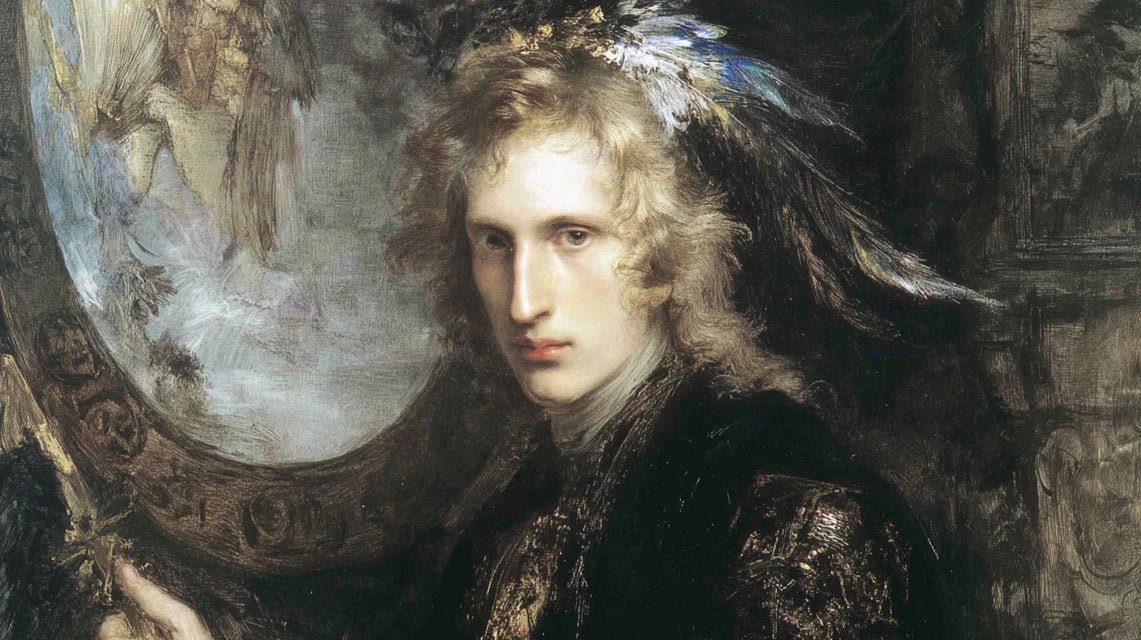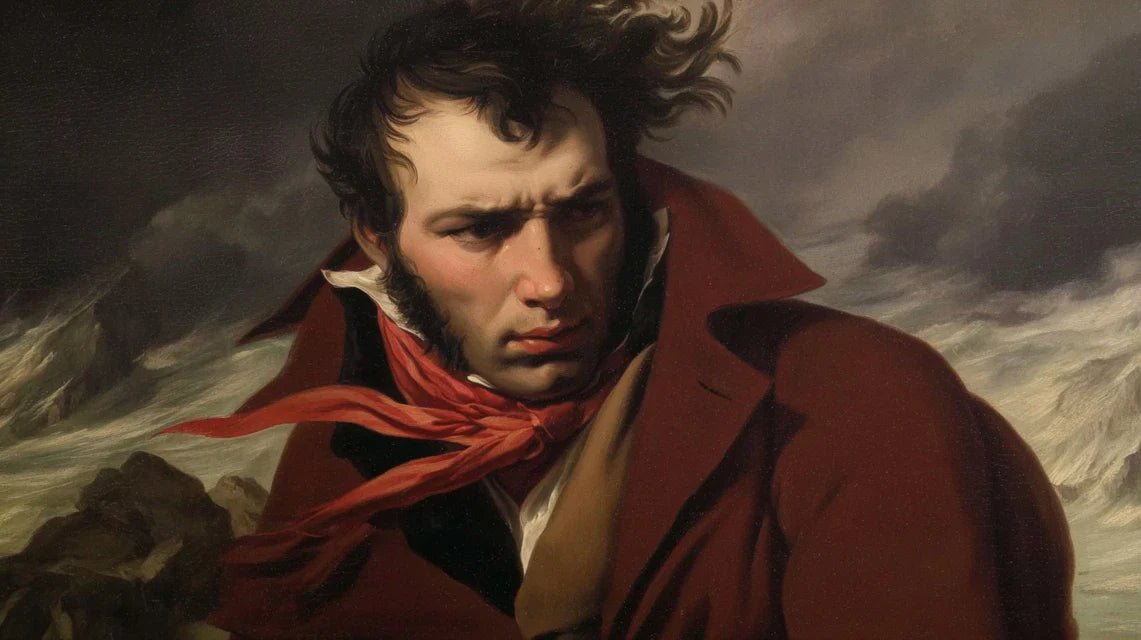
In the feverish atmosphere of Théodore Géricault's Parisian workshop on rue des Martyrs, brushes fly and the smell of turpentine mixes with that of decaying flesh. A young man of 27 years old, his eyes burning with a devouring passion, scrutinizes human corpses with the meticulousness of an anatomist.
🎨 Théodore Géricault has just had a full-size raft built in his workshop to understand the drama he is about to immortalize. Outside, Paris buzzes with rumors about this rebellious painter who dares to defy official art by painting the most scandalous events of 1818.
This scene could seem taken from a gothic novel, but it perfectly illustrates the creative obsession that animated one of the most revolutionary painters of the 19th century. Because Géricault was not only the author of the famous Raft of the Medusa - he embodied in himself all the fervor and contradictions of the nascent Romanticism.
Discover the man behind the genius: his destructive passion for horses, his forbidden loves that caused a scandal, and how he revolutionized French art in just twelve years of creation - a life as intense as it was tragic
Jean-Louis André Théodore Géricault: the fiery pioneer of French Romanticism
Why does Théodore Géricault still fascinate today, two centuries after his disappearance? Because he perfectly embodied the revolutionary spirit of his time: rebellious bourgeois, passionate artist, free man refusing conventions. He made news stories a noble subject, modernity a legitimate source of inspiration.
| Biographical Highlights | Artistic Legacy |
|---|---|
|
Full name: Jean-Louis André Théodore Géricault Birth: September 26, 1791, Rouen Death: January 26, 1824, Paris (32 years old) Nationality: French |
Movement: Romanticism (precursor) Style: Dramatic and expressive realism Flagship work: The Raft of the Medusa (1819) Innovation: Contemporary history painting |
The Norman roots of Théodore Géricault: between bourgeois tradition and artistic rebellion
On September 26, 1791, in the revolutionary fervor shaking France, a child destined to revolutionize painting is born in Rouen. Georges-Nicolas Géricault, a prosperous lawyer, and Louise-Jeanne-Marie Caruel, from a family of Norman procurators, welcome their only son into a privileged environment with monarchist convictions.
The awakening of a devouring passion: Around 1806, young Théodore discovers his vocation at a Saint-Cloud party. A dappled gray horse harnessed to a carriage, foaming and sweating under the effort, fascinates him to the point of transforming his artistic vision. This equestrian revelation will become the guiding thread of all his work.
In 1808, after the death of his mother who leaves him a considerable fortune, Géricault enters the studio of Carle Vernet, specializing in horse scenes. Then in 1810, he joins the academy of Pierre-Narcisse Guérin, master of neoclassicism, who recognizes his talent while disapproving of his impulsive temperament.
The principle of creative independence: At just 19 years old, Géricault abandons traditional teaching to freely copy the masters at the Louvre: Rubens, Titian, Velázquez, Rembrandt. He thus discovers a vitality that neoclassical school did not offer him.
This autodidactic training in contact with masterpieces forges his unique style: the vigor of Rubens mixed with the modernity of his time. A revolutionary approach that already foreshadows his future break with official art.
Géricault and the Napoleonic era: witness and actor of artistic upheavals
Géricault grows up in a constantly changing France: Empire, Restoration, regimes that succeed each other while art hesitates between tradition and modernity. This political instability nourishes his romantic temperament and his thirst for creative freedom.
The neoclassical School of David still dominates the official Salons, advocating ideal beauty and ancient subjects. But a new generation of artists, including Géricault, aspires to paint their time with its passions and contemporary dramas.
His contemporaries? Antoine-Jean Gros for the Napoleonic epic, Ingres for classical refinement, soon Delacroix for romantic expressiveness. But Géricault stands out with his boldness: he dared to paint the most burning political actuality of his time.
The Napoleonic wars deeply mark his artistic sensibility: cuirassiers, horse hunters, battle scenes populate his canvases with a striking truth. He does not glorify war but shows its tragic reality: wounded soldiers, retreat from Russia, human suffering.
Art in the service of historical truth: Géricault revolutionizes history painting by abandoning mythological heroes to focus on ordinary people caught in the torments of their time. A humanist approach that will influence all 19th century art.
This modern vision of art places him at odds with official aesthetics, foreshadowing the great aesthetic upheavals to come.
Géricault’s turbulent beginnings: between early success and artistic disillusionment
Contrary to legend, Géricault did not experience poverty in his early years; his family fortune spared him material worries. His difficulties were more artistic and psychological: how to impose his vision in a conservative environment?
1812 marks his first triumph: his “Officer of horse hunters of the imperial guard charging” creates a sensation at the Salon. At 21, he receives a gold medal for this work of striking modernity: dynamic composition, vibrant colors, spectacular movement.
But 1814 holds a cruel disappointment for him: his “Wounded cuirassier leaving the battlefield” goes unnoticed, or even disappoints critics. This darker work, reflecting the Napoleonic defeat, does not meet the expectations of the public of the Restoration.
Hurt in his artist's pride, Géricault makes a surprising decision: he joins the gray musketeers of King Louis XVIII and accompanies the monarch in his flight to Ghent. A brief but significant military experience that enriches his understanding of the realities of war.
This period of doubts and questioning forges his determination: he understands that true art requires courage and perseverance. Failures do not undermine his faith in his artistic mission.
Géricault’s scandalous loves: forbidden passion and social revolt
1814 marks a dramatic turning point in the life of Géricault: at 23 years old, he passionately falls for Alexandrine-Modeste Caruel de Saint-Martin, the wife of his maternal uncle. A liaison adultery that causes a sensation in the family and reveals his rebellious temperament.
Alexandrine, aged 29 years old, is only six years older than her son-in-law. Married to a man 28 years her senior, this declassed aristocrat finds in Théodore love and passion that her marriage of convenience did not offer her.
Their secret relationship lasts for several years and disrupts the family balance. The Parisian bourgeoisie, already scandalized by his artistic audacity, discovers that Géricault also transgresses the most sacred social conventions.
The birth of a secret: On August 21, 1818, Alexandrine secretly gives birth to a son, Georges-Hippolyte, declared "of unknown father and mother." The child is entrusted to the “grosse Suzanne”, a domestic servant of the family, to quell the scandal.
This hidden paternity obsesses Géricault: how can he reconcile his responsibilities as a man and his freedom as an artist? The weight of the secret nourishes his romantic melancholy and profoundly influences the darkness of some works.
To escape family pressures and reproachful glances, he undertakes an initiatory journey to Italy in 1816: Florence, Rome, Naples. A flight that becomes artistic revelation.
The revealed genius of Géricault: from decorative art to revolutionary painting
The Italian stay (1816-1817) radically transforms the artistic vision of Géricault. In contact with the masters of the Renaissance - Michelangelo, Raphael, Caravaggio - he discovers the expressive power of art and definitively abandons decorative grace.
Returning to Paris in 1817, Géricault embarked on his most ambitious project: immortalizing the scandal of the frigate Méduse. A shipwreck caused by the incompetence of a royalist captain becomes the pretext for a revolutionary work.
The Raft of the Medusa: masterpiece of modern art and political manifesto
1818-1819: Géricault works relentlessly on a monumental canvas measuring 5 meters by 7. He interviews the survivors, has a raft built in his studio, studies cadavers at the morgue to capture the anatomical truth of death.
This revolutionary scientific method transforms historical painting: no more idealized compositions, but a documentary truth served by an expressionist art of unparalleled power.
Géricault's technical innovations: between tradition and revolutionary modernity
Géricault invents a new aesthetic: classic pyramidal composition but revolutionary color treatment, dramatic chiaroscuro of Caravaggio mixed with the fervor of Rubens. He uses earthy tones, pallid flesh tones, a dark palette to express the horror of the drama.
Géricault facing his contemporaries: creative audacity against official art
While Ingres cultivates the pure line and Delacroix expressive color, Géricault reconciles drawing and color in an unprecedented dramatic realism. He influences Delacroix who poses for one of the dying men on the raft.
His artistic courage inspires a whole generation: choosing a contemporary news story rather than a mythological subject, denouncing political incompetence through art, transforming a scandal into an eternal masterpiece.
OUR RECOMMENDED PRODUCTS
This aesthetic revolution marks the birth of French pictorial romanticism and opens the way to modern art.
The man behind the artist: Theodore Gericault's devouring passions
Géricault perfectly embodied the Romantic ideal: handsome, grand, seductive, a skilled horseman, he fascinated with his natural charisma and his devouring passion for life. But this very intensity contained the seeds of his early loss.
His equestrian passion bordered on obsession: he rode daily, studied the anatomy of horses, and collected thoroughbred English horses. This intimate knowledge of the equestrian world nourished his most beautiful pictorial achievements but also caused his premature death.
The Alexandrine affair reveals his passionate nature: capable of the greatest impulses as well as the deepest melancholies, Géricault lived his emotions with an intensity that shines through in every brushstroke.
This psychological complexity enriches his art: his portraits reveal a remarkable psychological depth, his battle scenes a humanity that goes beyond simple technical prowess.
The posthumous success of Géricault: from misunderstanding to artistic consecration
Paradoxically, Géricault knew celebrity during his lifetime while remaining misunderstood by his contemporaries. His The Raft of the Medusa, presented at the Salon of 1819 under the neutral title "Scene of a shipwreck", violently divided critics.
Louis XVIII himself, despite being targeted by implicit political criticism, praised his genius: "Here, Monsieur Géricault, is a shipwreck that will not sink the artist who painted it." But the State refused to acquire the work, forcing the artist to exhibit in England.
The evolution of Géricault's artistic value: from contempt to veneration
The art market reflects this gradual recognition: shunned by collectors of his time, Géricault became one of the most sought-after French painters in the 20th century.
| Period | Average value | Sale record |
|---|---|---|
| 1810-1824 (living) | 500-2000 francs | Gold medal (recognition) |
| 1825-1900 (posthumous) | Growing interest from collectors | Entry to the Louvre (1824) |
| 2000-2024 (current market) | €100,000 - €2,000,000 | Studies for The Medusa: €1.5M |
This reassessment reflects the modernity of his approach: Géricault anticipated contemporary art through his social realism and creative freedom.
The tragic death of Géricault in 1824: the end of a legend, the birth of a myth
On January 26, 1824, Paris learned with shock of the death of Théodore Géricault. At just 32 years old, the painter died from several horse falls that had confined him to bed since 1822. A tragic end which consecrated his legend as a Romantic artist.
His later works reveal a genius in full maturity: the series of "Manics", portraits of mentally ill people with a striking realism, foreshadows modern art through its psychological truthfulness without complaisance.
The lasting influence of Géricault on contemporary art and modern creation
Delacroix, Courbet, Manet: all claim the legacy of Géricault. His lesson? Art must bear witness to its time with courage and sincerity, reject conventions to invent new forms of expression.
Even today, street artists, photojournalists, painters of the social reality draw on his example: how to transform current events into eternal art?
Recognizing Géricault's influence in contemporary art: Look for works that transform current events into art, prioritize truth over conventional beauty, use documentary techniques to serve artistic expression.
Where to discover Géricault today: must-see museums and global collections
🏛️ Louvre Museum (Paris): The Raft of the Medusa, portraits of officers, preparatory studies 🏛️ Musée d'Orsay (Paris): drawings and lithographs 🏛️ Metropolitan Museum (New York): collection of equestrian paintings 🏛️ National Gallery (London): Horse frightened by a storm
These places allow you to understand the evolution of his style and the universality of his artistic message.
🎁 Special offer for readers
Because you took the time to inform yourself, enjoy 10% off on your first order :
⏰ Valid 72h after reading • Applicable on all our products
Frequently asked questions about the life and work of Théodore Géricault
Géricault (1791-1824) was a French painter from the Norman bourgeoisie who revolutionized art by painting contemporary events. Famous for The Raft of the Medusa, he was the precursor of French pictorial romanticism and influenced Delacroix and all modern art.
Trained in the workshop of Carle Vernet (specialist in horses) then with Pierre-Narcisse Guérin (neoclassical master), Géricault was mostly self-taught : he copied the masters at the Louvre (Rubens, Titian, Velázquez) and traveled to Italy to study Michel-Ange and the Renaissance.
Géricault invented an unprecedented dramatic realism : in-depth documentary research, anatomical studies from life, a dark and expressive palette, a dynamic composition mixing classical tradition and romantic modernity. He favored truth over idealized beauty.
The work scandalized by its contemporary subject (a political news story), its implicit criticism of the royal regime, its revolutionary technique and its raw realism. Géricault dared to treat a current scandal with the grandeur traditionally reserved for mythological subjects.
Géricault inspired Romanticism (Delacroix), Realism (Courbet), modern art (Manet) and still influences contemporary art: social art, reportage photography, street art. His message? Transform current events into eternal art through courage and sincerity.
Géricault today: the eternal relevance of a visionary genius of modern art
Two centuries after his death, Théodore Géricault remains strikingly modern. In a world saturated with images and information, his lesson still resonates: how to transform the ephemeral into the eternal, the news item into an artwork?
His artistic courage - painting political events despite the risks, prioritizing truth over complacency, inventing new forms of expression - inspires all those who reject decorative art for an engaged creation.
Géricault teaches us that true art is born from the encounter between mastered technique and sincere passion, between respected tradition and bold innovation. A modernity that never ages.
Art as self-revelation: Discovering Géricault means understanding that art can transform our view of the world, reveal beauty in drama, grandeur in the ordinary. An experience that permanently enriches our aesthetic sensibility.