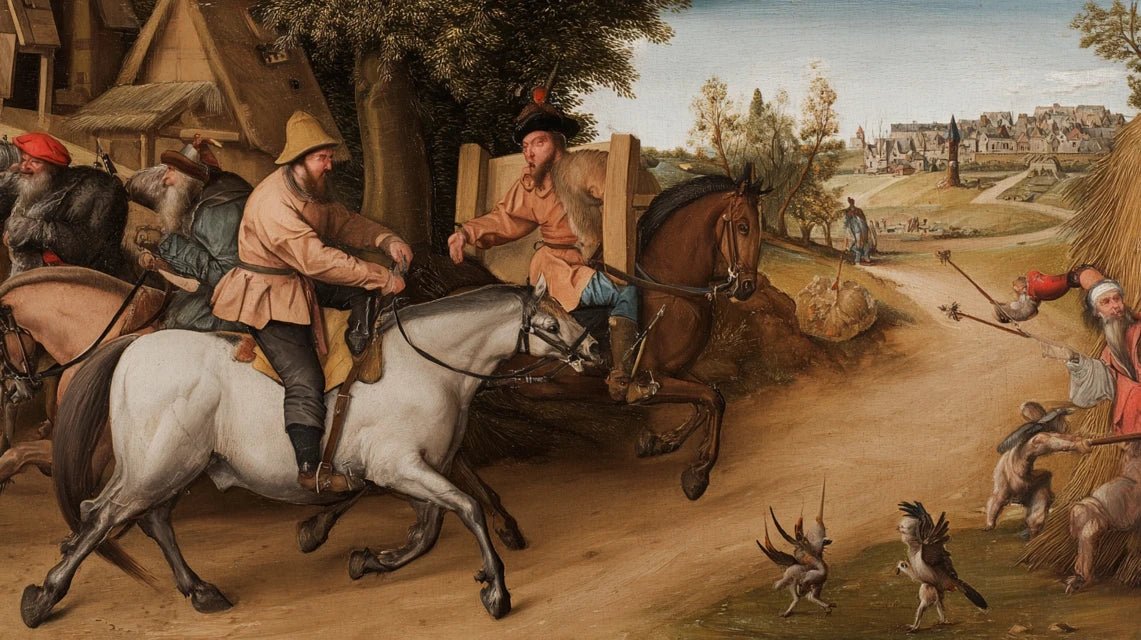
Imagine a man discreetly slipping into a Flemish village wedding, observing the rustic dances, feasts, and quarrels with a mischievous eye. This is Pieter Brueghel the Elder, who will transform these stolen moments into timeless masterpieces.
In the smoky atmosphere of 16th-century Flemish taverns, between the scents of blonde beer and the laughter of peasants, an artistic revolution is born. A painter dares to break the codes, abandoning the nobility to be interested in the humble, preferring muddy fields to golden palaces.
Nicknamed "Bruegel the Funny" by his contemporaries, this visionary artist knew how to capture the soul of a troubled era with a biting humor and profound humanity. Behind his bustling canvases lies a vision of the world of striking modernity.
Discover how Pieter Brueghel the Elder revolutionized Western art by giving nobility to genre painting and creating the most beautiful winter landscapes in the history of art - a dive into the universe of the Flemish master who knew how to make the beauty of everyday life eternal.
Pieter Brueghel the Elder: The Revolutionary of Flemish Popular Painting
Understanding Pieter Brueghel the Elder is to plunge into the soul of 16th-century Flanders, a pivotal period when Western art was shifting towards modernity. This man dared what no one had attempted before: to make the people his main hero.
| Biographical Highlights | Artistic Legacy |
|---|---|
|
Full name: Pieter Brueghel the Elder Birth: around 1525-1530, near Breda Death: September 9, 1569, Brussels Nationality: Flemish (Spanish Netherlands) |
Movement: Flemish Renaissance Style: Genre painting and panoramic landscapes Flagship work: The Hunters in the Snow (1565) Innovation: Dignification of peasant life |
The Mysterious Origins of Pieter Brueghel: Between Legend and Historical Reality
The exact place of birth of Pieter Brueghel remains one of the most fascinating enigmas in art history. Was it near Breda in Brabant or rather to Bree in Limbourg? This geographical uncertainty already reveals the elusive character of a man who preferred the shadows to the light.
The encounter that changed everything: Around 1545, the young Pieter enters the workshop of Pieter Coecke van Aelst, master painter of Antwerp and renowned architect. In this place brimming with creativity, he discovers the secrets of Flemish art but also... little Mayken Coecke, whom he will often hold in his arms and marry twenty years later.
The awakening of a unique gaze: From his beginnings, Brueghel demonstrates an exceptional talent for capturing humanity in its raw truth. Where others see vulgarity, he perceives authentic and universal beauty.
Pieter Brueghel and the troubled era of the Flemish Renaissance
Pieter Brueghel is born and grows up under the reign of Charles Quint, then Philippe II d'Espagne. The Spanish Netherlands are experiencing a period of increasing religious tensions, a prelude to future revolts against Spanish authority.
The 16th century Flemish sees the flourishing of a prosperous bourgeoisie thanks to maritime trade. Antwerp becomes one of the most important financial centers in Europe, attracting artists, merchants and humanist intellectuals from all over the continent.
His contemporaries include major figures such as Jérôme Bosch (his spiritual inspiration), Pieter Aertsen (a pioneer of genre scenes) or even the cartographer Abraham Ortelius who will become one of his most faithful friends and collectors.
Paradoxically, this period of economic prosperity coincides with the beginning of the "Little Ice Age", a period of climate cooling that will profoundly mark Brueghel's artistic imagination, particularly in his famous winter landscapes.
The genius of creative adaptation: Brueghel transforms the constraints of his time - political tensions, climatic rigor, religious upheavals - into sources of inspiration to create an art that is both timeless and deeply rooted in its time.
Pieter Brueghel's apprenticeship years: an initiation journey in Italy
In 1552, the young master Brueghel undertakes the almost-obligatory journey to Italy for any Flemish artist of his time. But unlike his colleagues seeking idealization in the manner of Raphael or Michelangelo, he is more interested in the Alpine landscapes.
In Rome, he meets the Croatian miniaturist Giulio Clovio and moves within the artistic circles of the Eternal City. However, this Italian stay will never convert him to Renaissance aesthetics. On the contrary, it reinforces his conviction that art must draw from local reality.
The real turning point occurs during his return in 1554: Brueghel partners with print publisher Jérôme Cock in Antwerp. This collaboration will be decisive, allowing him to develop his drawing talent and reach a wider audience through the distribution of engravings.
For nearly ten years, from 1554 to 1563, Brueghel mainly works as a engraver. This period of technical training forges a graphic style of remarkable precision, the foundation of his future pictorial masterpieces.
These laborious years, far from the pomp and circumstance of historical painting, teach him discipline and rigor. Above all, they allow him to refine his eye of an ethnologist of everyday Flemish life.
Pieter Brueghel facing controversies: the art of subtle subversion
From his first painted works around 1557, Brueghel develops an art of subtle subversion that is as disturbing as it is fascinating. His canvases teeming with details often hide acerbic criticisms of the society of his time.
"The Fight Between Carnival and Lent" (1559) perfectly illustrates this approach. Beneath the appearance of an amusing genre scene lies a scathing satire of religious excesses, both Catholic and Protestant.
The times are delicate: the Spanish Inquisition is rampant in the Netherlands, and the slightest religious criticism can lead to the stake. Brueghel therefore develops a coded language, using popular proverbs and allegories to express his opinions.
The legend of the painter-spy: Carel van Mander reports that Brueghel, on his deathbed, asked his wife to burn some "too biting and too satirical" drawings, fearing they would cause him posthumous trouble. True precaution or golden legend? The mystery remains.
This caution does not prevent him from benefiting from high-level protection. Cardinal Antoine Perrenot de Granvelle, Philip II's minister in the Netherlands, collects his works, proof that the elite appreciates his talent despite his boldness.
Brueghel’s art thus reveals a remarkable political intelligence: to criticize without offending, to denounce while entertaining, to reveal by hiding. This creative strategy allows him to survive in an era of censorship while leaving behind a striking testimony about his time.
Pieter Brueghel's artistic revolution: inventor of modern genre painting
From 1559, Brueghel undergoes a major artistic transformation. He gradually abandons engraving to devote himself entirely to painting, creating in a decade the masterpieces that will secure his posterity.
This period coincides with a symbolic change: he simplifies the spelling of his name, from "Brueghel" to "Bruegel". This detail reveals a desire for personal affirmation and creative independence.
The Tower of Babel (1563): metaphor of human ambition
"The Tower of Babel" marks the peak of his first manner. This monumental work combines the precision of a miniaturist with the panoramic vision of a landscapist. Brueghel subtly denounces the megalomania of his time in this work, from King Nimrod to Emperor Charles Quint.
The artist reveals here his genius for architectural observation. Every detail of the construction - cranes, scaffolding, lifting systems - bears witness to his intimate knowledge of building sites of his time. The voluntary anachronism (techniques of the 16th century applied to a biblical myth) reinforces the political message.
Brueghel's technical innovations: master of the "world landscape"
Brueghel invents what one could call the "world landscape": panoramic compositions that embrace vast expanses, populated by hundreds of characters. This revolutionary technique requires perfect mastery of aerial perspective and color gradation.
Brueghel facing his contemporaries: absolute originality
When Giuseppe Arcimboldo composes his fantastic portraits in Prague, when Tintoretto ignites Venice with his baroque compositions, Brueghel chooses a radically different path: that of popular realism tempered by humor.
This originality leads him to be misunderstood by many contemporaries. It will take the Dutch Golden Age for his influence to be fully recognized and imitated.
OUR RECOMMENDED PRODUCTS
The turning point of 1565 with the series of "Months" will mark the culmination of this artistic revolution, establishing Brueghel as the greatest landscapist of his time.
The man Pieter Brueghel: between personal mystery and profound humanity
Behind the artist lies a man of remarkable discretion. Carel van Mander describes him as "tranquil, wise and discreet, but amusing in company". This duality between public reserve and private joviality illuminates his complex personality.
In 1562, at the request of his future mother-in-law, Brueghel leaves Antwerp to settle in Brussels, in the popular district of Marolles. This move reveals his attachment to modest backgrounds, far from the splendor of the court.
His marriage in 1563 to Mayken Coecke, daughter of his former master, confirms his integration into the Anversoise artistic bourgeoisie. Van Mander amusingly reports that he had "carried his future wife in his arms when she was a child".
Pater to two future painters - Pieter the Younger (1564) and Jan dit "de Velours" (1568) - Brueghel will not have time to train his sons. His premature death in 1569 leaves them orphans, but they will brilliantly perpetuate the family tradition.
This personal tragedy undoubtedly deprives us of masterpieces: the artist, who died "in the prime of life
His latest works - "The Parable of the Blind" (1568), "The Beggars" (1568) - reveal a growing pessimism, perhaps linked to the increasing political unrest in the Netherlands or declining health.
The influence of Brueghel on contemporary art: an eternal modernity
The legacy of Brueghel extends far beyond his time. His approach to landscape as a theater of humanity directly foreshadows the 'Dutch School of the 17th century'. Painters like Jacob van Ruisdael or Hendrik Avercamp perpetuate his vision of winter landscapes.
In the 20th century, his influence resurges with filmmakers such as Andrei Tarkovsky who uses "The Hunters in the Snow" in "Solaris" (1972), or Lars von Trier in "Melancholia" (2011).
Recognizing the Bruegelian heritage today: Observe the films of Ken Loach or the Dardenne brothers: their attention to working classes, their uncomplaining but empathetic look at the human condition perpetuates the spirit of Brueghel.
Where to discover Pieter Brueghel today: guide to essential collections
🏛️ Vienna (Kunsthistorisches Museum): The largest collection in the world with 12 paintings, including "The Hunters in the Snow" and "The Tower of Babel". 🏛️ Brussels (Royal Museums of Fine Arts): "The Fall of the Rebel Angels" and "The Drowning of Bethléem". 🏛️ Madrid (Prado Museum): "The Triumph of Death", a testamentary work from his dark period. 🏛️ New York (Metropolitan Museum): "The Harvesters", a jewel in the series of Months.
These institutions offer digital tours allowing you to explore every detail of the works with unparalleled precision, revealing subtleties invisible to the naked eye.
🎁 Special reader offer
Because you took the time to inform yourself, enjoy 10% discount on your first order:
⏰ Valid 72h after reading • Applicable to all our products
Frequently asked questions about Pieter Brueghel the Elder
Pieter Brueghel was born around 1525-1530 in a village near Breda, probably called "Brueghel" (hence his name). The exact location remains uncertain, some historians leaning towards the Northern Brabant, others to the Belgian Limbourg. This modest origin perhaps explains his attachment to popular scenes that will make his fame.
Brueghel was trained by Pieter Coecke van Aelst, a master painter and architect from Antwerp, whose daughter Mayken he later married. Becoming a master in the Saint-Luc guild in 1551, he then traveled to Italy (1552-1553) before developing his unique style by collaborating with the printmaker Jérôme Cock of Antwerp.
Brueghel revolutionized Western art by creating modern genre painting: he elevated scenes of everyday life, particularly peasant life, to a new level. His technique of the "world landscape" - vast panoramas populated with hundreds of characters - profoundly influences European art, notably the Dutch School of the 17th century.
His contemporaries called him "Bruegel the Funny One" (Pieter de grappige) for his biting humor and social satires. A master of visual irony, he subtly criticized society, religious customs, and political power in his works. This approach allowed him to denounce while entertaining, an essential strategy in the troubled era of Spanish Inquisition.
The 47 authenticated paintings by Brueghel are now inestimable and almost exclusively preserved in the world's leading museums. None appear on the private art market. The rare drawings attributed to him reach several million euros at public auctions. This absolute scarcity makes each work a national treasure for the countries that possess them.
Brueghel's influence transcends centuries: he inspires the Dutch School (Avercamp, Ruisdael), influences modern cinema (Tarkovski, von Trier), and nourishes contemporary art through his social perspective. His approach to popular realism resonates in the work of filmmakers such as Ken Loach or the Dardenne brothers, perpetuating his humanist vision of art.