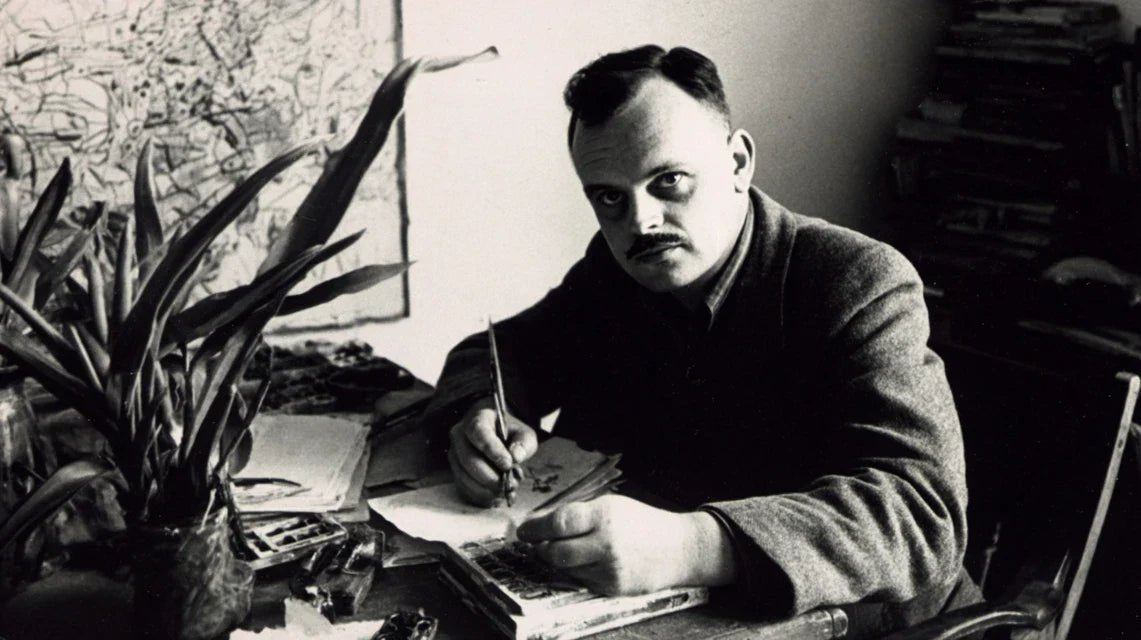
🎨 Imagine a man sitting in front of his easel, a violin bow in one hand and a paintbrush in the other. Paul Klee never chose between these two passions: he fuses them into a unique visual symphony that revolutionizes 20th century art.
In his workshop in Weimar, Bach's scores mingle with canvases of impossible colors. Every morning, before painting, Klee plays the violin for an hour. This daily routine nourishes an artistic approach where musical rhythm and chromatic harmony respond to each other in a unique dialogue.
Why does a virtuoso violinist abandon a promising musical career to become one of the most influential painters of his time? How does this discreet man from Bern revolutionize the perception of modern art by creating a completely new pictorial language?
Discover the fascinating story of Paul Klee, this silent genius who transforms musical theories into a pictorial revolution - a journey to the heart of pure creation.
Paul Klee: The Painter-Musician Who Revolutionized Modern Art
Understanding Paul Klee means grasping the essence of an era when art shifts towards abstraction. Far from conventional biographies, the story of this Swiss-German master reveals how a musician becomes one of the most respected art theorists in the world.
| Biographical Highlights | Artistic Legacy |
|---|---|
| Full name: Paul Ernst Klee Born: December 18, 1879, Münchenbuchsee (Switzerland) Died: June 29, 1940, Muralto (Switzerland) Nationality: Swiss-German |
Movement: Expressionism, Bauhaus, Surrealism Style: Lyrical and geometric abstraction Key work: "Angelus Novus" (1920) Innovation: Fusion of music-painting, color theory |
This unique biography reveals how Klee transcends the boundaries between arts, creating a universe where each color sings and each form dances according to rules he invents through his discoveries.
Paul Klee as a Child: When Music Leads to Painting
In the cultured bourgeoisie of Bern, young Paul grew up in an environment where Mozart's sonatas and Bach's fugues constantly resonate. His father, Hans Klee, a music teacher, and his mother, Ida Frick, a lyric singer, were not surprised to see their son handle the bow with precocious dexterity.
The moment of artistic revelation: At seven years old, Paul discovers in his family's attic a box of forgotten pastels. Instinctively, he draws the melodies he hears: curved lines for the violins, angular shapes for the percussion. This synesthetic experience marks the birth of a genius who will always perceive colors as notes.
The personal revolution: From his earliest works, Klee rejects imitation of nature to favor expression of pure emotion. He intuitively understands that art must not reproduce the visible, but "make visible the invisible".
Paul Klee and his time: European art in transition (1900-1920)
When Klee begins his career, Europe's artistic scene is bubbling with revolutionary innovations. Picasso invents Cubism, Kandinsky theorizes abstraction, while the Fauves free color from all naturalist constraints.
In this effervescent context, Munich becomes the laboratory of modern German art. The city attracts avant-garde artists from around the world, creating a stimulating intellectual climate where aesthetic theories confront each other in cafes and workshops.
Unlike his flamboyant contemporaries, Klee cultivates discretion and reflection. While Kandinsky proclaims his theories with passion and Franz Marc paints his blue horses expressionistically, Klee observes, analyzes, and patiently builds his own vision.
The First World War deeply traumatizes the artist. Mobilized in 1916, he sees his friends Franz Marc and August Macke die. This tragedy reinforces his conviction that art must transcend the horrors of the world to reveal the eternal beauty hidden in the universe.
Klee's originality: While his contemporaries seek to shock or brutally revolutionize, Klee develops a contemplative and spiritual approach to modern art. He does not reject the past but transforms it into contemporary language.
Paul Klee facing failures: the slow construction of a genius (1901-1914)
Klee’s early professional years were marked by repeated commercial failures. His etchings (1903-1905) found no buyers. Critics did not understand these fantastic creatures that seemed to emerge from an incomprehensible dreamlike world.
In 1906, he married the pianist Lily Stumpf and settled in Munich. To survive, he gave violin lessons and painted illustrations to make ends meet. This period of humility shaped his character: Klee learned the patience and perseverance that would characterize his entire artistic approach.
His meeting with Wassily Kandinsky in 1911 marked a decisive turning point. The Russian master immediately recognized Klee’s talent and invited him to join the group "Der Blaue Reiter". This recognition by a confirmed genius gave confidence back to the young Swiss artist.
Paradoxically, these years of hardship greatly enriched Klee’s creative universe. Having nothing to lose, he dared to experiment freely, developing this controlled audacity that characterizes his future masterpieces.
The "Der Blaue Reiter" exhibition of 1912 finally revealed his talent to the Munich public. His abstract watercolors intrigued with their mysterious poetry and perfect technical mastery.
Paul Klee and his controversies: the "degenerate" art according to the Nazis
Contrary to his discreet personality, Klee’s art sparked passionate controversies. His detractors accused him of producing "children's scribbles" without understanding the sophistication of his approach. Conservative critics denounced his abandonment of traditional figuration.
The most violent controversy erupted with the arrival of the Nazis in power. In 1933, Klee was dismissed from his position as professor at the Bauhaus. His works were declared "degenerate art" and removed from German museums. This persecution forced him into exile to his native Switzerland.
Klee fully embraced his revolutionary artistic vision. For him, art should not please immediately but elevate the soul and reveal hidden truths. He defended a spiritual conception of creation that transcends trends and commercial pressures.
His artistic philosophy summarized: "Art does not reproduce the visible, it makes visible." This famous sentence perfectly summarizes the mission Klee set for himself: to reveal the secret harmonies of the universe through his abstract compositions.
These attacks paradoxically reinforce the artist's determination. He intensifies his research on pure color and develops an even more personal technique, preparing his most accomplished works.
Today, this Nazi persecution appears as proof of the subversive power of Klee’s art, capable of disturbing totalitarian regimes through its mere creative freedom.
Paul Klee and abstraction: the birth of a revolutionary pictorial language
The true artistic revolution of Klee begins with his trip to Tunisia in 1914. Dazzled by the Mediterranean light and the desert colors, he writes in his journal: "Color possesses me. I no longer need to pursue it." This revelation marks his definitive transformation into a master colorist.
Back in Europe, Klee develops a unique technique combining watercolor, oil and drawing in compositions of fascinating complexity. Each work becomes a laboratory where he tests new chromatic harmonies according to almost scientific principles.
"Angelus Novus" (1920): the masterpiece that summarizes Paul Klee’s art
This watercolor on paper of modest dimensions (31.8 × 24.2 cm) perfectly illustrates Klee's genius. The "New Angel" combines figurative and abstract in a perfect synthesis. The expressive lines of the face contrast with the geometric forms of the body, creating a striking visual tension.
Walter Benjamin, who owned this work, saw it as a metaphor for modern history: an angel contemplating the ruins of the past while being carried away towards the future. This philosophical interpretation illustrates the conceptual depth of Klee’s art.
Paul Klee's revolutionary technique: between science and poetry
Professor at the Bauhaus (1921-1931), Klee theorizes his artistic practice. He develops a revolutionary pedagogy based on the analysis of dynamic forms and colored rhythms. His courses, later published under the title "Theory of Modern Art", still influence contemporary art education.
Paul Klee facing Kandinsky and Mondrian: three visions of abstraction
Unlike Kandinsky who favors gestural expressiveness, Klee cultivates constructive precision. Faced with Mondrian and his pure geometric abstraction, he maintains references to the natural world in his most abstract compositions.
This intermediate position makes Klee a brilliant synthesizer capable of uniting emotion and construction, spontaneity and reflection in a unique balance.
OUR RECOMMENDED PRODUCTS
This exceptional technical mastery allows Klee to create a novel pictorial language that profoundly influences the evolution of modern art.
Paul Klee intimate: the sensitivity of an artist between family and creation
Behind the image of a stern theorist, Klee reveals a personality of extreme sensitivity. Devoted father to Felix (born in 1907), he creates fantastic albums for his son filled with tender and mischievous creatures. These family drawings illuminate the playful dimension of his art.
His correspondence with his wife Lily unveils a deeply romantic and attentive man. Their letters reveal how his artistic travels (Italy, Tunisia, France) nourish his creation while strengthening his family attachment. This emotional stability forms the foundation of his creative balance.
Klee cultivates secret passions that enrich his art: a collector of minerals, a passionate observer of natural phenomena, and an avid reader of contemporary poetry. This universal curiosity transpires in the symbolic richness of his compositions.
His degenerative disease (scleroderma), diagnosed in 1935, paradoxically transforms his creation. Aware of the time he has left, he simplifies his style and achieves a striking expressive purity in his later works.
Paul Klee and celebrity: from incomprehension to worldwide consecration
The recognition of Klee follows a remarkable upward curve. Ignored by the general public before 1920, he gradually becomes one of the most sought-after artists on the international market. His first personal exhibition in Paris (1925) marks the beginning of his French notoriety.
The decisive turning point occurs with the MoMA retrospective in New York in 1941, a year after his death. This exhibition reveals to the American public the extraordinary coherence of his work and definitively establishes his international reputation.
Paul Klee on the art market: a safe haven asset in constant progression
The evolution of Klee's price illustrates perfectly the progressive recognition of artistic genius. From a few marks in the 1910s, his works today reach vertiginous peaks that confirm their status as a leading artistic investment.
| Period | Average value | Record sale |
|---|---|---|
| 1920-1940 (living) | 100-1000 Reichsmarks | 5000 Reichsmarks ("Ad Parnassum", 1932) |
| 1950-1980 (posthumous) | 10,000-100,000 $ | 2.5 million $ ("Blick in das Fruchtland", 1976) |
| 2000-2024 (current market) | 500,000 - 5 million $ | 23.1 million $ ("Hugel und Sonne", 2021) |
This exceptional progression is explained by the rarity of artworks available on the market and the constant international demand from the most discerning collectors.
Paul Klee in 1940: Artistic Testament and Eternal Influence
The last years of Klee (1935-1940) constitute an extraordinary creative period. Despite the illness that weakened him, he produced more than 1200 works in five years, exploring new expressive territories with a total freedom. His "Angels" of this period reach a striking spiritual dimension.
His death on June 29, 1940 in Muralto deprives the art world of an irreplaceable master. His last paintings, with a brilliant simplicity, show an artist who has achieved full mastery of his unique pictorial language.
Paul Klee's influence on contemporary art: An inexhaustible inspiration
Klee’s legacy still permeates today’s creation. From street artists like Banksy to digital artists exploring synesthesia, his influence crosses generations and mediums. His conception of art as spiritual quest particularly inspires current creators.
Art schools worldwide still teach his theories on color and form. His pedagogical notebooks from the Bauhaus are essential references for understanding the mechanisms of modern artistic creation.
Recognizing Klee’s legacy today: Observe contemporary interactive installations, digital artworks playing on correspondences between color and sound, or even performances combining visual arts and music - you will find the pioneering spirit of Paul Klee.
Paul Klee in world collections: Where to discover his masterpieces
The Paul Klee Center in Bern (designed by Renzo Piano) houses the most important collection in the world with more than 4000 works. The MoMA in New York, the Tate Modern in London and the Centre Pompidou in Paris also possess exceptional ensembles allowing to grasp the complete evolution of his art.
These institutions regularly organize thematic exhibitions that reveal new aspects of his genius, confirming that Klee’s work continues to deliver its secrets to new generations of researchers and art lovers.
🎁 Special offer for readers
Because you took the time to inform yourself, enjoy 10% discount on your first order :
⏰ Valid 72h after reading • Applicable on all our products
Frequently asked questions about Paul Klee: everything you need to know about the Swiss-German master
Paul Klee (1879-1940) was a revolutionary Swiss-German painter who transformed modern art by merging music and painting. Son of a music teacher and a singer, he grew up in a refined artistic environment in Bern. His fame comes from inventing a unique pictorial language combining geometric abstraction, visual poetry and scientific theories of color.
Klee trained at the Academy of Fine Arts in Munich (1898-1901), but quickly rejected traditional academic teaching. He developed his unique technique by studying the old masters (Dürer, Flemish primitives) and experimenting personally. His real training came through contact with the Munich avant-garde, including Wassily Kandinsky and the group "Der Blaue Reiter".
Klee invented a revolutionary mixed technique combining watercolor, oil, pastel and drawing on paper or canvas. His specificity: he applies musical theories to painting, creating "compositions" where each color corresponds to a note. He also developed a scientific pedagogical method based on the analysis of dynamic forms and chromatic rhythms, taught at the Bauhaus.
Klee's recognition spans several decades. His first notoriety came with the "Der Blaue Reiter" exhibition (1912), followed by his European consecration with his first Parisian exhibition (1925). Definitive international recognition occurs with the MoMA retrospective in 1941, a year after his death. Ironically, it took until the 1960s for the general public to fully appreciate his genius.