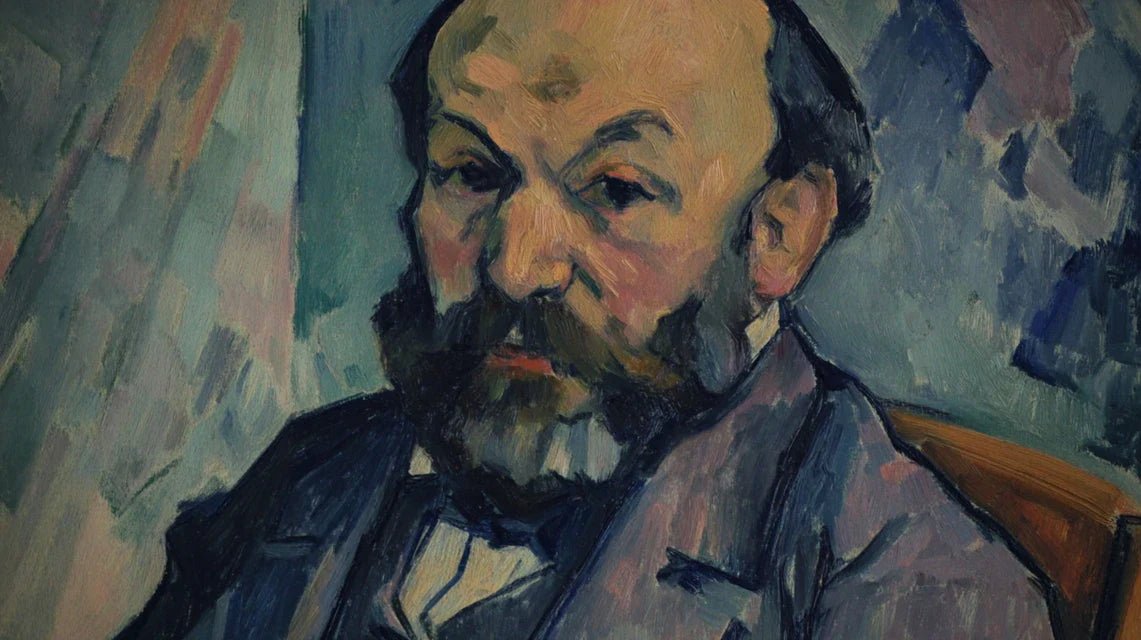
Imagine a solitary man, setting up his easel under the Provençal sun, stubbornly observing Mont Sainte-Victoire for the hundredth time. This misunderstood painter of his lifetime would revolutionize Western art and lay, brushstroke by brushstroke, the secret foundations of modernity.
In the shadow of his native Provence, far from the Parisian salons that rejected him, Paul Cézanne developed an artistic vision so radical that it would shake academic conventions. His geometric apples, fragmented landscapes and architectured portraits quietly prepared for the birth of Cubism and contemporary art.
This biography reveals how a shy bourgeois from Aix-en-Provence became the "father of modern art", influencing Picasso, Matisse and generations of artists who had not yet been born. A story of perseverance, innovation and misunderstood genius.
Discover the man behind the myth, his deep doubts, his revolutionary innovations and the colossal artistic legacy he left to the world - a journey into the heart of modern creation
Paul Cézanne : The Secret Architect of Modern Painting
Understanding Paul Cézanne means grasping the precise moment when Western art shifted towards modernity. This reserved man transformed our way of seeing and painting the world, creating a bold bridge between traditional art and the artistic revolutions of the 20th century.
| Biographical Highlights | Artistic Legacy |
|---|---|
|
Full name : Paul Cézanne Birth date : January 19, 1839 in Aix-en-Provence Death date : October 22, 1906 in Aix-en-Provence Nationality : French |
Movement : Post-Impressionism Style : Geometrization of forms Key work : The Bathers Innovation : Modern form-color synthesis |
His artistic journey reveals a fascinating progression: from a bourgeois young man with legal ambitions to a pictorial revolutionary who would inspire Picasso, Matisse and Kandinsky. This transformation was not without pain or perseverance.
The Provençal Roots of Paul Cézanne : Between Bourgeoisie and Artistic Vocation
Aix-en-Provence, 1839. Paul was born into a family on the rise. His father Louis-Auguste Cézanne, former hat maker turned prosperous banker, and his mother Anne-Élisabeth Aubert, mill worker, offer their son a rare financial security for a future artist. This family wealth will be providentially useful for his artistic experiments.
The founding anecdote of the apple basket: At Bourbon College, young Paul defends Émile Zola against bullying. In thanks, Zola gives him a basket of apples. These simple fruits will become Cézanne’s pictorial obsession, symbols of his eternal quest for perfect form in his legendary still lifes.
The original conflict between vocation and filial duty: From this time on, Cézanne reveals his fundamental creative principle - the tension between academic structure and personal expression, which will become the signature of his revolutionary art.
Cézanne and the Artistic Effervescence of the Second Empire
The years 1860-1870 mark a cultural revolution in France. Cézanne arrives in Paris at a pivotal moment: Manet scandalizes the salons, Impressionism is born, and academic art falters. This era of artistic effervescence shapes his personality as a painter.
The École des Beaux-Arts rejects his application in 1861, judging his vibrant colors too far from official academism. This first professional rejection pushes him towards the Swiss Academy, a meeting place for future Impressionists.
He meets Camille Pissarro, Claude Monet, Auguste Renoir and Alfred Sisley. These friendships determine his artistic evolution, but Cézanne quickly develops his own path, which is more structured than that of his fellow Impressionists.
The Franco-Prussian War of 1870 and the Paris Commune deeply mark his generation. Cézanne takes refuge in Provence with his companion Hortense Fiquet, an event that strengthens his attachment to his native land and influences his Mediterranean palette.
Cézanne’s French exception: Unlike his contemporaries influenced by Japanese art or exotic travels, Cézanne draws inspiration from French classicism and Provençal light, creating a modernity deeply rooted in the terroir.
Years of Misunderstanding: Cézanne Facing Rejections from the Official Salon
From 1863 to 1882, Cézanne faced rejection after rejection at the official Salon in Paris. His canvases with thick impasto and pure colors clashed with the tastes of the time. This period of systematic rejections forged his independent artist's character and creative determination.
His early works like "The Murder" (1868) reveal a dark and passionate romantic inspiration. This pictorial violence, inherited from Delacroix and Courbet, frightens critics but already foreshadows his future expressive power.
In 1869, he meets Hortense Fiquet, model and future wife, whom he hides from his family for fear of displeasing his father. This clandestine relationship, complicated by the birth of their son Paul in 1872, reveals his secret personality and relational difficulties.
Despite financial support from his father, Cézanne lived this period with creative anguish. His impressionist friends began to be recognized while he remained in the shadows, developing a solitary and obstinate working method that would become his strength.
The installation at Auvers-sur-Oise in 1872 marks a turning point. Guided by Pissarro, he discovers plein air painting and develops his technique of "colored modulations" which will revolutionize modern painting.
The Cézanne Scandal: When Modern Art is Born in Incomprehension
The 1874 impressionist exhibition reveals Cézanne to the Parisian public... who violently rejects him. His three canvases - "A modern Olympia", "The House of the Hanged Man" and "Study, landscape of Auvers" - provoke laughter and indignation. The critic Louis Leroy speaks of "painting for fools".
This hostile reception deeply traumatizes the sensitive artist. He now avoids collective exhibitions and retreats to Aix-en-Provence, developing in isolation his revolutionary pictorial language. This forced marginalization paradoxically becomes his creative freedom.
His artistic philosophy crystallizes around a titanic ambition: "to redo Poussin on nature". He wants to reconcile French classical tradition with direct observation of the subject, creating an unprecedented synthesis between permanence and modernity.
The break with Zola, a drama in his life : In 1886, Émile Zola publishes "L'Œuvre", a novel where the painter Claude Lantier (inspired by Cézanne) fails and commits suicide. Cézanne, hurt by this vision of his childhood friend, definitively breaks off their relationships. This literary betrayal reinforces him in his solitary path.
Paradoxically, these years of rejection shape his genius. Freed from commercial constraints thanks to the paternal inheritance received in 1886, he can experiment without limits and lay the foundations of contemporary art.
The Cézanne Revolution: The Invention of Modern Plastic Language
The years 1880-1900 mark the creative peak of Cézanne. Settled definitively in Provence, he develops his revolutionary method: "treating nature by the cylinder, the sphere, the cone". This geometrization of forms directly announces Picasso and Braque's cubism.
He obsessively paints Mont Sainte-Victoire - more than 80 versions! This series reveals his philosophy: to grasp the permanent essence of things through their luminous and temporal variations. Each canvas explores a new aspect of this quest for pictorial absoluteness.
The Bathers: A Testament to Paul Cézanne's Art
"The Bathers" (1895-1906) represent the fulfillment of his art. These three monumental versions synthesize all his research: geometric construction, harmonious color, synthesis between figuration and abstraction. The Philadelphia work (210 x 250 cm) directly influences Picasso's "Les Demoiselles d'Avignon".
In these compositions, Cézanne revolutionizes the classical nude. His bathers with architectural volumes, integrated into a geometrized landscape, create a monumental and timeless art that inspires Matisse and the Fauves as much as the Cubists.
The Cézanne Technique: Innovation of Colored Modulations
Cézanne invents "colored modulations": to construct volumes by color alone, without resorting to traditional modeling. His calculated impastos, directional touches and juxtaposed pure tones create a new pictorial grammar that all modernists will adopt.
Cézanne and his Contemporaries: The Creative Isolation Facing the Impressionists
While Monet dissolves forms in impressionistic light, Cézanne solidifies them with structural color. Faced with the spontaneity of Renoir, he opposes methodical construction. This fundamental difference makes him the precursor of modern conceptual art.
His friendship with Camille Pissarro remains the most artistically fruitful. The master impressionist guides his first steps in plein air, but Cézanne quickly surpasses his mentor through his research for structural synthesis, announcing the aesthetic revolutions of the following century.
OUR RECOMMENDED PRODUCTS
This founding period establishes Cézanne as the "primitive of a new art", in his own words. His Provençal laboratory forges the conceptual tools of artistic modernity.
The Man Cézanne: Portrait of a Tormented and Solitary Genius
Behind the innovator lies a complex man, torn between pathological shyness and boundless artistic ambition. Cézanne suffers from a fear of physical contact, a childhood trauma that explains his relational solitude and distrust of critics and collectors.
His marriage to Hortense Fiquet in 1886 is not based on passion but on paternal duty. Their difficult relationship is reflected in his portraits of his wife - 29 versions! - where a disturbing emotional distance transpires despite the technical perfection.
His later years reveal a man imbued with rediscovered faith. A devout Catholic, he attends daily mass at the Aix Cathedral Saint-Sauveur before joining his Lauves studio, built in 1901. This spirituality nourishes his artistic quest for the absolute.
His correspondence with young painters Émile Bernard and Henri Gasquet reveals a generous master, transmitting his technical discoveries while jealously guarding his creative secrets. This ambivalence characterizes his personality as a solitary but influential artist.
The Late Recognition: When Cézanne Becomes the Master of Modern Art
1895 marks a turning point in his career. The first personal exhibition organized by Ambroise Vollard reveals 150 works in Paris. While the public remains perplexed, avant-garde artists discover a master. This recognition by peers gradually transforms his reputation.
The Salon d'Automne of 1904 dedicates an entire room to him. At 65 years old, Cézanne finally sees his genius recognized. Young painters such as Maurice Denis and Émile Bernard come on pilgrimage to Aix to study his revolutionary method.
The Spectacular Evolution of the Cézanne Price in the Art Market
His price evolves dramatically: from a few hundred francs during his lifetime to millions of euros today. This progression testifies to the progressive recognition of his revolutionary contribution to Western art.
| Period | Average Value | Record Sale |
|---|---|---|
| 1880-1906 (artist's life) | 100-500 francs | 6,000 francs ("Still Life" 1899) |
| 1907-1950 (posthumous recognition) | 50,000-200,000 francs | 9.2 million francs ("Apples" 1928) |
| Contemporary market | 5-50 million euros | 300 million dollars ("Card Players" 2011) |
This explosion of prices reflects the increasing historical importance given to Cézanne. His works are now considered essential milestones in Western art, explaining their status as a leading cultural and financial investment.
The Master's Death: Cézanne Paints Until his Last Breath in 1906
October 15, 1906. Aged 67, Cézanne paints outdoors on the slopes of Mount Sainte-Victoire when a violent storm breaks out. Soaked and weakened by diabetes, he collapses but refuses to abandon his canvas. This creative tenacity until death illustrates his absolute artistic passion.
He dies on October 22, 1906 from pneumonia in his Aix apartment, surrounded by his unfinished masterpieces. His disappearance immediately triggers a retrospective at the Salon d'Automne of 1907 which definitively reveals his genius to the art world.
The Revolutionary Influence of Cézanne on Contemporary Art
Pablo Picasso and Henri Matisse unanimously declare: "Cézanne is the father of us all". This claimed lineage testifies to the fundamental impact of his innovations on all modern creation. From Cubism to Constructivism, from abstraction to pop art, each movement draws on his legacy.
Kandinsky discovers non-figurative art while contemplating a Cézanne canvas turned upside down. Mondrian abandons the figurative after studying his geometrised landscapes. These anecdotes reveal the concrete influence of his revolutionary vision on the pioneers of abstraction.
Recognizing the Cézannian legacy in contemporary art: Observe the geometrization of forms in David Hockney, the structural impastos of Gerhard Richter or the spatial deconstructions of Peter Halley. The Cézanne spirit still irrigates contemporary creation.
Where to Discover Cézanne's Masterpieces Around the World
The Musée d'Orsay in Paris preserves his finest Provençal landscapes. The Philadelphia Museum of Art possesses the most accomplished version of the "Bathers". The Metropolitan Museum in New York and the National Gallery in London exhibit his revolutionary still lifes. In Provence, the atelier des Lauves in Aix-en-Provence allows you to understand his creative process in its authentic setting.
For enthusiasts, prioritize temporary exhibitions that reveal new aspects of his work. Digital technologies now allow us to explore his pictorial techniques with unparalleled precision, revealing the secrets of his artistic revolution.
🎁 Special offer for readers
Because you took the time to inform yourself, enjoy 10% discount on your first order:
⏰ Valid 72h after reading • Applicable to all our products
Frequently Asked Questions about the Life and Work of Paul Cézanne
Paul Cézanne (1839-1906) was a French post-impressionist painter born in a bourgeois family from Aix-en-Provence. He revolutionized art by geometrizing natural forms and constructing volumes with pure color, laying the foundations for cubism and modern art. His comfortable childhood allowed him to experiment freely, unlike his contemporaries constrained by commercial necessities.
Trained at the School of Drawing in Aix-en-Provence from 1857, Cézanne then studied at the Swiss Academy in Paris where he met Pissarro, Monet and Renoir. A passionate autodidact, he copied the masters at the Louvre, particularly Delacroix, Courbet and the classics like Poussin. Camille Pissarro was his most influential mentor, introducing him to plein air painting and impressionistic techniques that he quickly surpassed.
Cézanne invented "colored modulations": constructing forms with color alone, without traditional chiaroscuro. He geometrizied nature according to his famous “cylinder, sphere, cone” and used directional impastos to create volume. His revolutionary technique consisted of painting with juxtaposed colored patches, simultaneously creating form, light and space - an innovation that directly inspired cubism.
Cézanne challenged all the artistic conventions of his time: his pure colors shocked the eye accustomed to academic earthy tones, his geometric deformations shocked the expectation of realism, and his thick impastos seemed "barbaric" to lovers of polished art. The public and critics only understood his revolution after 1895, thanks to the Vollard exhibition which revealed his genius to the artistic avant-gardes.