🎨 Imagine a painter who, in 1915, dared to present to the world a simple black square on a white background - a work so revolutionary that it caused scandal and still divides art lovers today.
This bold gesture marks the birth of Suprematism, an artistic movement that forever revolutionizes our conception of art. Behind this apparent simplicity lies Kazimir Malevich, a Russian visionary who liberates painting from all figurative representation.
Why does this artist born in the declining Russian Empire still fascinate contemporary creators? How does a man from a modest family manage to shake up Western art? What secrets lie behind his geometrically simple compositions?
Dive into the fascinating universe of Malevich, discover the man behind the artistic revolution and understand why his pure forms continue to inspire today's art.
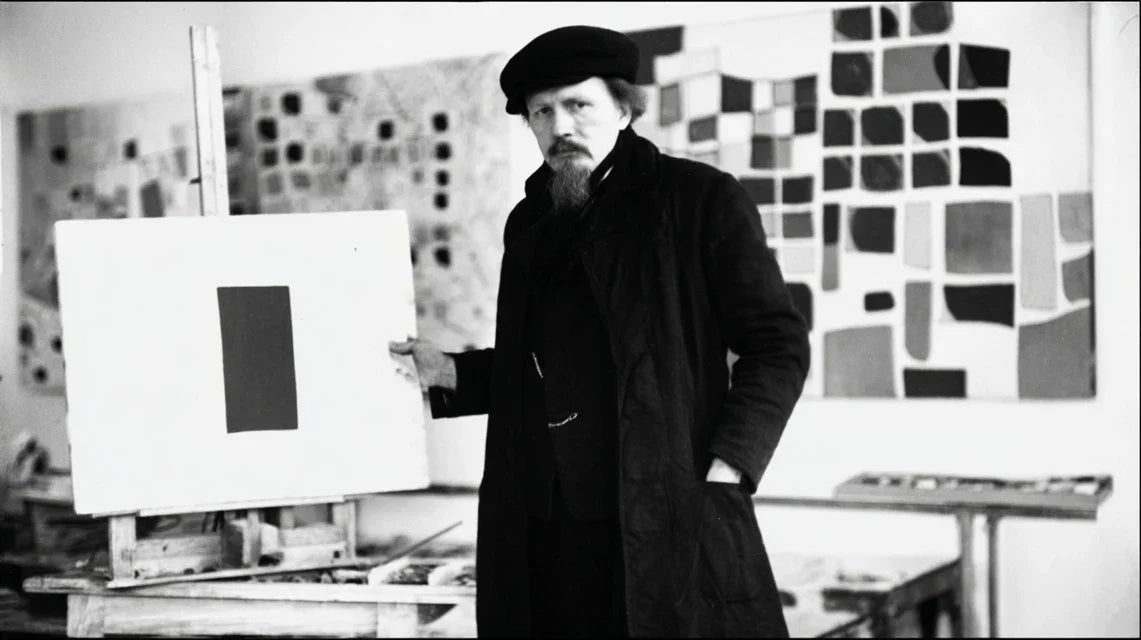
Kazimir Severinovich Malevich: the revolutionary of abstract art
Knowing the true story of Malevich helps to understand how an artistic revolution is born. Far from legends, let's discover the man who dared to defy the conventions of his time to create a completely new pictorial language.
| Biographical highlights | Artistic legacy |
|---|---|
|
Full name: Kazimir Severinovich Malevich Birth: February 23, 1879, Kiev (Russian Empire) Death: May 15, 1935, Leningrad (USSR) Nationality: Russian (of Polish origin) |
Movement: Suprematism, Russian avant-garde Style: Pure geometric abstraction Key work: Black Square on White Background (1915) Innovation: Total liberation from figuration |
From his figurative beginnings to his conquest of pure abstraction, let's follow the exceptional journey of this artist who reinvented art at the beginning of the 20th century.
Kazimir Malevich as a child: birth of a visionary in Imperial Ukraine
🏘️ Born into a Polish-origin family settled in Kiev, young Kazimir grew up in a rural environment where his father worked as a refinery foreman. This Ukrainian childhood imprints his sensitivity with peasant colors and Slavic folk traditions.
The revelation of Byzantine icons: At the age of fifteen, Malevich discovered religious icons in the Orthodox churches of Kiev. These stylized compositions with golden backgrounds and geometric figures profoundly mark his future artistic vision.
The awakening of the creative genius: From his early days in Moscow, Malevich manifested an obsession: to free art from the obligation to "copy" reality to reveal the spiritual essence of forms.
This mystical quest for artistic truth already guides his first experiments and foreshadows the Suprematist revolution to come.
Malevich and the revolutionary effervescence of Tsarist Russia
📅 The time of Malevich corresponds to a period of unprecedented political upheavals and artistic movements in Russia. Between the Revolution of 1905 and that of 1917, the Russian Empire lived its last hours in an extraordinary creative effervescence.
🏛️ In Moscow and Saint-Petersburg, avant-garde salons flourish. Collectors like Sergei Shchukin exhibit the works of Picasso, Matisse and Cézanne, creating an unprecedented dialogue between European art and Russian traditions.
His contemporaries Wassily Kandinsky, Natalia Goncharova and Mikhail Larionov are already exploring abstraction, but Malevich goes further: he totally rejects reference to the visible world to create an "non-object" art.
Social revolutions find their echo in this aesthetic revolution. Malevich believes that art must accompany the radical transformation of society by creating a universal language free from bourgeois conventions.
The genius of the time: Malevich intuitively understands that his era demands an entirely new art, capable of expressing the revolutionary aspiration towards a totally transformed world.
This acute historical awareness nourishes his determination to create prophetic art, heralding a regenerated humanity.
Malevich's formative years: between poverty and experimentation (1904-1912)
Arriving in Moscow with few resources, Malevich lived in precariousness while multiplying pictorial experiments. His first paintings, influenced by Neo-Impressionism, struggled to find their audience in a Russia still attached to academic art.
🎭 A decisive meeting with the patron Nikolai Riabouchinski allowed him to exhibit for the first time in 1907. Despite public incomprehension, this exhibition revealed a painter already seeking formal simplification.
In 1910, he joined the group "Tile Servant" led by Larionov, a laboratory of Russian avant-garde. This crucial period saw him experiment with cubo-futurism, a personal synthesis between Picasso's research and the aesthetics of the Italian movement.
Each commercial failure reinforced his belief: true art cannot be immediately understood. This creative solitude shapes his character as a radical innovator, ready to sacrifice immediate success for artistic truth.
This period of learning and constant research prepares the creative explosion that will revolutionize modern art.
Malevich and the Black Square scandal: birth of a major artistic controversy
🖼️ On December 19, 1915, at the "0,10" exhibition in Petrograd, Malevich presented thirty-nine Suprematist works including the revolutionary Black Square on White Background. The scandal was immediate and resounding.
Conservative critics denounced a "hoax", while the bourgeois public mocked what they perceived as a "joke". Some visitors even threatened to destroy the work, considered an insult to traditional art.
Malevich fully embraces this radical break. For him, figurative art has exhausted its creative possibilities. It is now necessary to explore the "pure sensations" that are provided by geometric shapes freed from any reference to the visible world.
The revolutionary philosophy: "Art no longer wants to be in service of the state and religion. It no longer wants to illustrate the history of customs. It wants nothing to do with the object as such." - This statement summarizes his prophetic vision.
These controversies consecrate Malevich as the leader of revolutionary art. Far from discouraging him, general incomprehension confirms that he has found a truly new artistic language.
This period of aesthetic combat forges his international reputation and prepares his influence on European avant-gardes.
Malevich's Suprematism: revolution of art by pure geometry
⭐ Between 1915 and 1920, Malevich developed his revolutionary theory of Suprematism. This movement, which he founded alone, definitively frees art from representation to explore "pure sensitivity" through elementary geometric shapes.
The year 1918 marks the apotheosis of this period with the creation of White Square on White Background, a ultimate work that pushes the Suprematist logic to its limit. This prophetic canvas foreshadows conceptual art of the 20th century.
Malevich's White Square on White Background: the absolute work of Suprematism
🔲 This revolutionary composition from 1918 represents the logical culmination of Malevich's research. By eliminating even chromatic contrast, the artist achieves an unparalleled formal purity that still influences contemporary art.
The work reveals the spiritual dimension of Suprematism: to liberate art from all material contingencies in order to reveal the very essence of artistic creation.
Suprematist techniques by Malevich: innovation of pure geometry
🎨 Malevich develops a pictorial technique of apparent simplicity but extreme sophistication. His geometric compositions are the result of precise calculations aimed at creating visual dynamics through the interaction of colored shapes.
Malevich facing Kandinsky and Mondrian: three visions of abstraction
Unlike Kandinsky who retains a lyrical expressiveness, or Mondrian who seeks harmonious balance, Malevich aims for the total abolition of reference to the sensible world. This unique radicalism distinguishes him from his contemporaries.
An enlightening anecdote: during their meeting in Weimar in 1927, Kandinsky admits that he does not understand how Malevich can "paint the void". Malevich's reply: "I do not paint the void, I reveal infinity."
OUR RECOMMENDED PRODUCTS
This revolutionary period definitively establishes Malevich as one of the inventors of modern art, preparing his lasting influence on future generations.
Malevich private life: mysticism and simplicity of an art revolutionary
👨👩👧👦 Married three times, father of five children, Malevich leads a private life marked by simplicity and spirituality. A convinced vegetarian, he advocates a lifestyle in harmony with his revolutionary artistic beliefs.
🏠 His house in Nemtchinovka, near Moscow, bears witness to his taste for functional architecture. He himself designs furniture with geometric lines that foreshadow modern design. This consistency between art and daily life reveals the sincerity of his approach.
Man of deep convictions, Malevich cultivates a mystical dimension which transpires in his theoretical writings. This personal spirituality nourishes his prophetic vision of art as revealer of a higher reality.
This personal authenticity explains the lasting impact of his work: Malevich does not just paint differently, he lives according to his artistic principles.
The late consecration of Malevich: from rejection to worldwide recognition
🏆 Paradoxically, Malevich’s international recognition truly begins after his death in 1935. Misunderstood during his lifetime in the USSR where official art favored socialist realism, he found his first admirers in Western Europe and the United States.
The first major Western exhibition in 1958 at the Museum of Modern Art in New York revealed to the international public the extent of his creative genius. This belated consecration launched his price on the contemporary art market.
Value and record prices for Malevich’s works on the current market
💰 The spectacular evolution of his price reflects the progressive recognition of his historical importance. His Suprematist works today achieve record prices that reflect their rarity and founding influence.
| Period | Average value | Record sale |
|---|---|---|
| 1920-1935 (living) | A few Soviet rubles | No documented sales |
| 1950-1990 (rediscovery) | 50,000 - 500,000 dollars | 1.2 million (1988) |
| 2000-2025 (consecration) | 5-50 million dollars | 85.8 million (2018, Suprematist composition) |
This exceptional valuation confirms Malevich’s status among the founding masters of modern art.
Malevich’s final years and his death in 1935: end of a prophet
⚫ The 1930s saw Malevich forced into creative silence by the Stalinist regime, which condemned avant-garde art. Despite this repression, he continued his theoretical research in secret, leaving for posterity visionary writings on future art.
His death on May 15, 1935 went almost unnoticed in the USSR, but European avant-gardes already sensed the loss of a genius. His discreet funeral symbolically marked the end of the heroic age of Russian revolutionary art.
Malevich’s influence on contemporary art and modern design
🎯 Malevich's legacy permeates all of 20th century art. From American minimalism in the 1960s to contemporary industrial design, his lesson in geometric simplicity continues to inspire creators today.
Artists such as Donald Judd, Dan Flavin or Ellsworth Kelly explicitly acknowledge their debt to the master of Suprematism. Even contemporary architecture and graphic design bear the mark of his formal innovations.
Recognizing the Malevich legacy: Observe pure geometry in contemporary art, minimalist architecture and industrial design - you will find the direct influence of the father of Suprematism.
Collections and museums: where to discover Malevich around the world today
🏛️ The main collections are found at the Russian Museum in Saint-Petersburg, the MoMA in New York, the Tate Modern in London, and the Centre Pompidou in Paris. These institutions offer a complete panorama of his artistic evolution.
Malevitch's art continues to nourish contemporary imagination, proving the accuracy of his prophetic vision.
🎁 Special offer for readers
Because you took the time to inform yourself, enjoy 10% discount on your first order :
⏰ Valid 72h after reading • Applicable on all our products
Frequently asked questions about Kazimir Severinovich Malevitch
Immense: American minimalist art, contemporary architecture, industrial design and even digital art bear his mark. His lesson in geometric simplicity and formal purity continues to inspire creators of the 21st century.
Malevich today: the eternal modernity of the prophet of Suprematism
✨ More than a century after the invention of Suprematism, Malevich continues to fascinate with his visionary ability to anticipate contemporary aesthetic issues. His "objectless" art resonates particularly well with our digital age where abstraction dominates our daily interfaces.
His fundamental lesson remains strikingly topical: to free creation from all conformism in order to reveal unexplored possibilities. This artistic philosophy continues to nourish innovation in all creative fields.
Discovering Malevich means understanding how an individual can revolutionize his discipline through the sheer force of his vision. His example inspires those who aspire to create something new rather than reproduce what already exists.
Art as personal revelation: Let yourself be touched by the geometric purity of Malevich - you may discover an unsuspected dimension of your own aesthetic sensitivity.