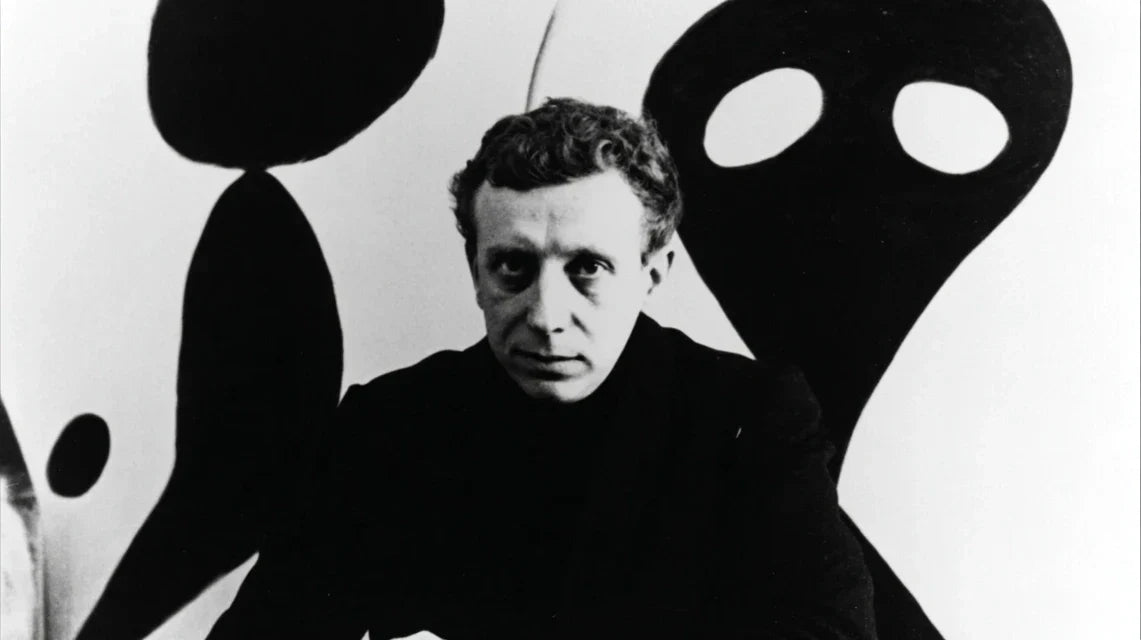
Jean Arp: A Pioneer of Organic Abstraction and Father of Creative Dadaism
Imagine a workshop in Zurich in 1916, at the heart of the turmoil of World War I. In an old butcher shop transformed into a cabaret, a young man with dark hair meticulously cuts out colored paper shapes, then lets them fall randomly onto a white surface. This gesture, which may seem trivial, revolutionizes 20th-century art.
This man is Jean Arp, born Hans Peter Wilhelm Arp, the one who would become the poet of organic form, the creator of an artistic language where chance and necessity blend, Dadaist destruction and abstract construction. His journey winds between borders, languages, and artistic movements, like a sculptural relief with fluid curves.
Why does Jean Arp fascinate art lovers so much today? How did this Franco-German artist manage to transform the chaos of his time into an artwork of astonishing serenity? What is this silent revolution that he led in the workshops of Zurich, Paris and Meudon?
Discover the man behind the biomorphic forms, the thinker who reconciled art and nature - a biography that reveals the eternal modernity of a visionary
Jean Arp : pioneer of organic abstraction and father of creative Dadaism
Knowing the true story of Jean Arp means understanding how an artist can transform the traumas of history into a universal poetic language. Far beyond the clichés about destructive Dadaism, Arp embodies a revolutionary approach: creating as nature creates, spontaneously and necessarily.
| Biographical Highlights | Artistic Legacy |
|---|---|
|
Full name : Hans Peter Wilhelm Arp / Jean Arp Born : September 16, 1886, Strasbourg Died : June 7, 1966, Basel, Switzerland Nationality : Franco-German |
Movement : Dadaism, Surrealism, Concrete Art
The Cosmopolitan Origins of Jean Arp: Between Strasbourg and the European Art Scene
Born in 1886 in Strasbourg to a Franco-German family, Hans Peter Wilhelm Arp grew up in a border city that changes nationality according to the upheavals of history. This geographical instability fosters in him a deconstructed vision of art and cultural identities.
The revelation of the destroyed sculpture: Around 1907, after studying at the School of Arts and Crafts in Strasbourg then Weimar and Julian Academy in Paris, Arp voluntarily destroyed his first non-figurative works. This iconoclastic gesture already reveals his quest for an art freed from conventions, an art that would be born from creative destruction.
Arp's founding principle: "We want to produce as a plant produces a fruit" - this sentence, spoken from the beginning, summarizes all his artistic philosophy: create according to the laws of nature, not against them.
Jean Arp and his time: art facing the upheavals of the 20th century
The Europe of 1900 to 1920 experienced an unprecedented mutation: massive industrialization, urbanization, then the catastrophe of 1914-1918. In this context, traditional art seems inadequate to express modernity and its traumas.
Arp evolves in the effervescence of avant-gardes: German Expressionism, French Cubism, Italian Futurism. Each movement brings its response to the crisis of representation, but Arp seeks a more radical path.
His contemporaries - Picasso, Kandinsky, Modigliani, Max Ernst - revolutionize painting and sculpture. Arp, for his part, revolutionizes the very process of creation by integrating controlled chance and automatism.
When World War I breaks out, Arp refuses German mobilization by feigning mental madness. This act of pacifist resistance profoundly influences his conception of art as an alternative to violence.
Art against war: For Arp, creating becomes an act of resistance against barbarity. Dadaism is born from this rejection of traditional art complicit with the belligerent society.
The apprenticeship years of Jean Arp: from academic training to creative breakthrough
The early professional years of Arp are marked by a complex artistic identity quest. Trained in traditional schools, he must gradually break away from conventions to invent his own language.
A revealing episode: in 1907, during his stay in Paris, Arp exhibited at the Galerie Bernheim-Jeune alongside Matisse and Signac. Despite this early success, he felt a deep malaise towards figurative art and destroyed his nascent non-figurative works.
The meeting with Sophie Taeuber in 1915 in Zurich radically transformed his trajectory. This dancer and textile creator, already engaged in geometric abstraction, revealed to him the possibilities of a total art integrating movement, color and pure form.
These years of difficult training forged in Arp a conviction: authentic art is born from inner necessity, not from the reproduction of the visible. This lesson guides all his future creation.
The emergence of the Dada movement at the Cabaret Voltaire finally offered him a theoretical and practical framework to express his revolutionary vision of art.
Jean Arp and Dadaist scandals: when art provokes and liberates
February 5, 1916 marks a turning point: with Hugo Ball, Tristan Tzara and Marcel Janco, Arp founded the Dada movement at the famous Cabaret Voltaire in Zurich. This collective adventure upsets established artistic codes.
Dadaist evenings scandalize the bourgeois public: phonetic poems, absurd performances, provocative collages. Arp presents his first works created "according to the laws of chance", challenging the very notion of controlled art.
His revolutionary method consists of cutting out shapes with a guillotine, letting them fall on a surface, and then gluing the result obtained. This technique divides critics and artists: genius or imposture?
The philosophy of controlled chance: "Dada is for nature and against art. Dada is direct like nature" proclaims Arp. For him, chance is not anarchy but a return to the organic laws of natural creation.
Unlike Duchamp or Picabia, Arp does not seek to criticize industrial society by diverting its objects. He prefers to create new forms that reveal the organic essence hidden beneath cultural conventions.
This unique approach makes him an atypical Dadaist, more constructive than destructive, already preparing his conversion to concrete art in the 1930s.
Jean Arp revolutionizes art: from Dadaist reliefs to organic sculptures
Between 1916 and 1920, Arp developed a revolutionary style that permanently influences modern art. His multicolored wooden reliefs and his geometric collages pave the way for biomorphic abstraction.
The creation of "Plant-Hammer" (1916) marks a decisive turning point: abandoning pure geometry, Arp invents forms that "swell and taper," evoking organic life without copying it.
The "Reliefs according to the laws of chance": manifesto of a new art
This emblematic series from 1916-1917 reveals Arp's artistic philosophy: to create by letting the natural forces of chance act, then intervening to reveal the hidden order. These works influence contemporary art to this day.
The technique is revolutionary: cut papers arranged randomly, then fixed while respecting this "natural" distribution. The artist becomes a collaborator of forces that surpass him.
Technical innovation: from collage to sculpture in space
Arp revolutionizes the use of materials: painted wood, colored papers, then bronze and marble in the 1930s. Each material reveals unprecedented expressive possibilities, always within the respect of organic laws.
Jean Arp facing his contemporaries: a unique creative singularity
While Picasso analytically decomposes reality and Kandinsky explores lyrical abstraction, Arp invents a third way: organic abstraction. His forms represent nothing but evoke everything: plant growth, the human body, the cosmos.
A revealing anecdote: during a studio visit, Paul Éluard asks Arp what his sculptures represent. Arp's reply: "They represent nothing, they present themselves. Like a tree presents itself, like a cloud presents itself."
OUR RECOMMENDED PRODUCTS
This philosophy of pure presence anticipates contemporary research on conceptual art and post-minimal sculpture.
The man Jean Arp: shared creativity and the love of Sophie Taeuber
Arp's private life sheds a particular light on his art: his marriage to Sophie Taeuber in 1922 creates one of the most creative couples of the 20th century. Their artistic collaboration revolutionizes the notion of a unique author.
Sophie brings Jean her mastery of geometric abstraction and textile art. He transmits to her his conception of controlled chance and creative automatism. Together, they create the famous "Duo-Collages" (1918), four-handed works of striking modernity.
A significant event: the accidental death of Sophie in 1943, asphyxiated by stove fumes at the home of their friend Max Bill. This tragedy plunges Arp into a deep crisis from which he never fully recovers, but which nourishes his late creation with a luminous melancholy.
Arp’s personality shines through in his poetic writings: a blend of Dadaist humor and Eastern wisdom, fascination for the correspondences between art and nature, rejection of all academic solemnity.
His installation at Meudon in 1926, in a house designed by Sophie, reveals his taste for synthesis of the arts: architecture, sculpture, garden form a harmonious ensemble where art dialogues with nature.
Jean Arp’s international recognition: from critical success to the art market
Arp’s recognition follows a remarkable upward curve: initially appreciated by the avant-garde, he gradually conquers institutions and collectors. The turning point comes in the 1950s with the major international prizes.
1954 marks his official consecration: Grand Prix de sculpture at the Venice Biennale. This institutional recognition confirms his position as a master of modern art, beyond school disputes.
The evolution of prices: Jean Arp on the contemporary art market
Arp’s price range reflects the evolution of taste for modern art: long confined to avant-garde collectors, it explodes in the 1970s-1980s with the democratization of contemporary art.
| 1920-1960 (during his lifetime) | 500 - 5,000 francs | First institutional sales |
| 1970-1990 (recognition) | 10,000 - 100,000 € | Bronze sculptures: 200,000 € |
| 2000-2025 (current market) | 50,000 - 500,000 € | "Demeter” (marble, 2018): 4.3 million € |
This constant progression is explained by the timeless modernity of his work: his organic forms dialogue as much with contemporary art as with current ecological concerns.
Jean Arp’s death in 1966: artistic testament of a visionary
The last years of Arp (1960-1966) are marked by renewed creativity and international recognition. His latest sculptures reach a monumental simplicity that influences emerging contemporary art.
He dies on June 7, 1966 in Basel, in Switzerland which had welcomed him fifty years earlier. His disappearance symbolically coincides with the emergence of new artistic movements that recognize him as a precursor.
Jean Arp’s influence on contemporary art: a living legacy
The impact of Arp on contemporary art is considerable: Land Art, Arte Povera, Minimal Sculpture draw from his formal vocabulary. Artists such as Richard Serra, Anish Kapoor or Jeff Koons extend his research on abstract organic forms.
His method of controlled chance inspires contemporary practices of generative art and creative artificial intelligence. His reliefs anticipate digital art and interactive installations.
Recognizing Arp's legacy today: Observe contemporary public sculptures, organic designs, biomorphic architecture: the forms invented by Arp a century ago are everywhere.
Where to discover Jean Arp today: museums and iconic collections
The works of Arp are held in the world's leading museums: MoMA New York, Centre Pompidou Paris, Tate Modern London. The Arp Foundation in Clamart preserves his studio and offers an immersion into his creative universe.
For an optimal discovery, visit the Museum of Modern Art in Strasbourg, which houses the largest European collection, or the Arp Museum Bahnhof Rolandseck in Germany, entirely dedicated to the Arp-Taeuber couple.
🎁 Special offer for readers
Because you took the time to inform yourself, enjoy 10% discount on your first order:
⏰ Valid 72h after reading • Applicable to all our products
Frequently asked questions about Jean Arp: everything you need to know about the master of organic art
Born Hans Peter Wilhelm Arp in 1886 in Strasbourg, he grew up in a Franco-German family. When Alsace became French again in 1918, he legally adopted the first name Jean while keeping Hans privately. This dual identity nourishes his cosmopolitan vision of art, beyond national borders. His childhood in Strasbourg, a city between cultures, explains his ability to navigate European artistic movements.
Arp has an eclectic training: School of Arts and Crafts in Strasbourg, Kunstschule in Weimar, Julian Academy in Paris. But his real school is the encounter with the avant-gardes: Blaue Reiter with Kandinsky (1912), then Dadaism with Ball and Tzara (1916). His collaboration with Sophie Taeuber from 1915 reveals his method: mixing controlled chance and organic necessity to create unprecedented forms.
In 1916, Arp invented a revolutionary method: cutting out shapes with a die-cutter (to avoid hand intervention), dropping them randomly onto a surface, and then gluing the result while respecting this "natural" arrangement. This technique abolishes traditional composition in favor of a spontaneous organic order. The artist becomes a collaborator with natural forces rather than an authoritarian demiurge.
Jean Arp today: the eternal modernity of a poet of form
More than fifty years after his disappearance, Jean Arp continues to fascinate by the burning relevance of his artistic questions. How to create in harmony with nature? How to integrate chance without descending into arbitrariness? These questions resonate strongly in our time of ecological crises and technological revolutions.
His genius lies in this ability to transform historical traumas into a language of reconciliation: between cultures, between art and nature, between order and chaos. Arp invents an art of harmonious synthesis that speaks to all sensibilities, beyond eras and borders.
Discovering Arp today means understanding that modern art is not a nihilistic break but a return to creative origins. His organic forms remind us that the most daring abstraction can be born from the most attentive observation of life.
Art as the breath of the world: Let yourself be carried away by the universe of Arp, where each sculptural form becomes a metaphor for vital growth, where each relief reveals the secret order that governs the cosmos and our emotions.