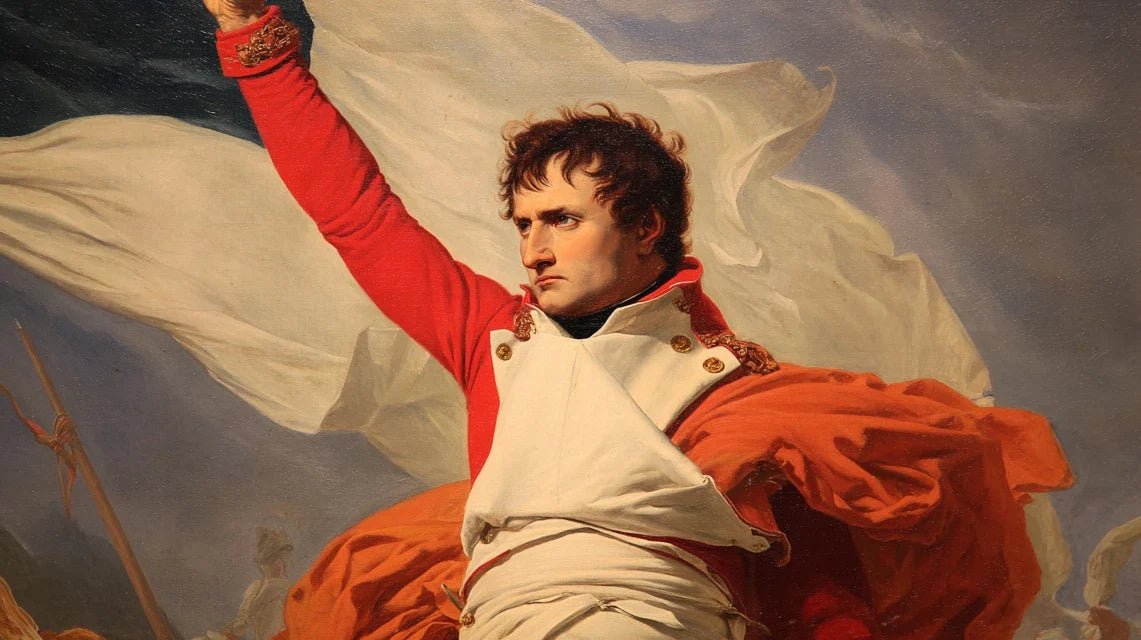
Imagine a man armed with a brush, capable of overthrowing a king and crowning an emperor... Jacques-Louis David was not only the greatest painter of his time, but also the visual soul of a revolution that shook Europe.
In the electric atmosphere of 18th century Paris, this artist with a scarred face transforms each canvas into a political manifesto. HIs brushstrokes trace the epic of a nation in turmoil, from The Oath of the Horatii which heralds the Revolution to The Coronation of Napoleon which crowns the Empire.
Behind the master of neoclassicism lies a passionate man, capable of voting for the death of a king as much as glorifying a dictator. A remarkable artistic and human journey, where art becomes an instrument of power and a privileged witness to History.
Discover how Jacques-Louis David revolutionized French painting and became the official chronicler of the greatest upheavals of his time - a captivating biography that reveals the man behind the masterpieces
Jacques-Louis David: The Neoclassical Genius Who Painted the History of France
To understand French art at the turn of the 18th and 19th centuries, you must know the extraordinary destiny of Jacques-Louis David. Far beyond a simple painter, he embodied the total artist: revolutionary, propagandist, organizer of national festivals and official portraitist of Napoleon.
| Biographical Highlights | Artistic Legacy |
|---|---|
|
Full name: Jacques-Louis David Birth: August 30, 1748, Paris Death: December 29, 1825, Brussels Nationality: French |
Movement: French Neoclassicism Style: Moralizing historical painting Key work: The Oath of the Horatii (1784) Innovation: Revolutionary art-politics alliance |
But it is in the depths of his personal life, marked by a scarred face and unwavering determination, that the true secret of his artistic genius is revealed...
Jacques-Louis David: Parisian childhood and early artistic vocation
On August 30, 1748, in a bourgeois Parisian family on rue Sainte-Croix-de-la-Bretonnerie, was born the man who would become the most influential painter of his time. The little Jacques-Louis grew up in an environment of merchant traders, where art is only a distant horizon.
The founding drama: A fatal duel changes everything: In 1757, when Jacques-Louis was only nine years old, his father Louis-Maurice David died in a mysterious duel. This trauma shakes the child and places him under the guardianship of his architect uncles, the Buron brothers, who quickly notice his exceptional artistic talents.
These benevolent uncles enroll him in the prestigious Collège des Quatre-Nations, but the young David proves to be a mediocre student, obsessed by only one passion: drawing. He will later confide: "I always hid behind the teacher's chair, drawing throughout the lesson."
The decisive encounter with art: In 1764, François Boucher, a distant cousin of his mother and official painter to Madame de Pompadour, agrees to receive the young man. Too old and ill to teach him, Boucher entrusts him to Joseph-Marie Vien, a pioneer of the return to antiquity who introduces David to the beauties of nascent neoclassicism.
Jacques-Louis David and the era of upheaval (1748-1825)
David's life perfectly mirrors the political upheavals of his time: waning Ancien Régime, French Revolution, Napoleonic Empire, and Restoration. Each period profoundly marks his art and shapes his worldview.
In the years 1760-1780, the Parisian artistic world experiences a veritable aesthetic revolution. The Rococo of Watteau and Fragonard, considered frivolous and decadent, gradually gives way to a return to the ancient values advocated by the Enlightenment philosophers.
David evolves among his contemporaries Greuze, Vigée Le Brun or Hubert Robert, but quickly distinguishes himself through a more intellectual and moralizing approach. Where others seek seduction, he favors exemplarity and grandeur.
The revolutionary events of 1789 radically transform his artistic conception. Art becomes for him an instrument of social transformation, capable of educating the people and forging a new civic consciousness.
The revolutionary citizen artist: David understands before anyone else that art can serve as a political weapon. His paintings no longer only please aristocratic elites; they address the entire nation and actively participate in the construction of a new republican French identity.
Jacques-Louis David facing adversity: learning perseverance (1766-1774)
David's artistic beginnings are far from a smooth journey. Entered Vien's studio in 1766, he discovers an ruthless universe where only the most talented can hope to succeed.
The young man faces a first crushing humiliation in 1771: his painting The Combat of Mars against Minerva obtains only the second Prix de Rome. The following year, another setback with a work deemed insufficient by the Academy jury.
The third failure of 1773 plunges David into deep despair. He begins a two-and-a-half day hunger strike, a dramatic gesture that reveals the staunch determination of this whole character.
But these setbacks forge his artistic personality: David learns that genius is earned through perseverance and that every defeat can become a lesson. This difficult period develops in him this compositional rigor which will characterize his future masterpieces.
Finally, in 1774, perseverance pays off: Erasistratus discovering the cause of Antiochus's illness earns him the coveted First Prize in Rome, opening the doors to the Villa Médicis and glory...
Jacques-Louis David and the political scandals of the French Revolution
From 1789, David chooses his camp with a radicalism that shocks his contemporaries. The king's painter gradually becomes one of the most uncompromising revolutionaries, not hesitating to renounce his aristocratic protectors.
The scandal erupts in 1793 when David, a Montagnard deputy to the Convention, votes for the death of Louis XVI. The artist who had benefited from royal favors becomes a "regicide", definitively transforming his reputation.
His proximity to Robespierre and the most extreme Montagnards earns him many enemies. David organizes the great revolutionary festivals, designs republican costumes and transforms art into political propaganda.
The Incorruptible and the brush: "Art must serve to moralize the people," David declares before the Convention. This sentence perfectly summarizes his revolutionary philosophy: the artist has a duty to participate in social regeneration and break with the “decadent” art of the Ancien Régime.
These positions earn him two imprisonments after the fall of Robespierre in 1794, proving that art and politics sometimes make a dangerous combination. But David fully assumes his choices, considering that the artist cannot remain neutral vis-à-vis the great issues of his time.
This tumultuous period profoundly marks his work, giving rise to compositions of unprecedented dramatic intensity...
Jacques-Louis David revolutionizes French painting: the birth of neoclassicism
The return from Rome in 1780 marks a complete metamorphosis in David's art. Nourished by the study of ancient and Renaissance masters, he develops a style of unprecedented rigor and nobility.
In 1784, he paints what will become one of the manifestos of French neoclassicism: The Oath of the Horatii. This royal commission paradoxically becomes one of the most revolutionary works in the history of French art.
The Oath of the Horatii (1784): when Jacques-Louis David announces the Revolution
This monumental canvas measuring 130 x 167 inches depicts an episode from Roman history: three brothers swear to die for their homeland. David transforms this ancient legend into a true lesson in republican civic virtue, opposing masculine virtue to feminine sensitivity.
The composition's perfect geometric rigor revolutionizes historical painting: straight and clean lines, frank colors limited to earth tones, red, and white, theatrical lighting concentrating attention on the heroic gesture of the oath.
Jacques-Louis David’s revolutionary technique: precision and idealization
David develops a method of work with exceptional meticulousness: countless preparatory drawings, study of each anatomical detail, in-depth research into ancient costumes and architecture. This scientific rigor completely renews the approach to historical painting.
David facing his contemporaries: a break with Rococo and the birth of a new language
While Fragonard still favors Rococo sensuality and Greuze cultivates bourgeois emotion, David imposes an art of moral grandeur. His painting refuses any concession to decorative pleasure in favor of a civic and patriotic message.
A revealing anecdote: when David exhibits *The Sabine Women* in 1799, he charges the public for entry, thus revolutionizing the artist’s relationship with his audience and foreshadowing modern art.
OUR RECOMMENDED PRODUCTS
This aesthetic revolution prepares for the advent of an art serving social transformation, whose apogee will be reached during the revolutionary period...
Jacques-Louis David: the man behind the brush, between wounds and passions
Behind the respected master lies a man marked by physical and psychological trials. A facial injury, resulting from a fencing accident, deforms his left cheek and impairs his pronunciation, profoundly complicating the artist.
This infirmity partly explains his gloomy character and tendency towards isolation. David compensates for this social handicap by a total investment in his art, transforming his personal suffering into creative strength.
His marriage in 1783 to Charlotte Pécoul, daughter of a building contractor, brings him stability and family happiness. This bourgeois union contrasts with the revolutionary image of the artist, revealing a man attached to traditional family values.
David’s personality shines through in his self-portraits: intense gaze, determined expression, proud bearing that hides intimate frailties. A man aware of his genius but haunted by his personal demons...
Jacques-Louis David: artistic glory and commercial success during his lifetime
Dès les années 1780, David enjoyed exceptional recognition within the Parisian art scene. His works elicit enthusiasm from critics and the public, making him the most sought-after painter in the capital.
The Triumph of the Horatii at the 1785 Salon definitively establishes his reputation. Diderot, Grimm and the great art critics unanimously hail the emergence of a new genius of French painting.
The value of Jacques-Louis David: evolution of prices and sales records
Unlike many artists, David experiences commercial success during his lifetime. His portraits sell for between 6,000 and 20,000 livres, considerable sums for the time, while his large historical compositions sometimes reach 40,000 livres.
| Period | Average value | Sales record |
|---|---|---|
| Living artist (1780-1825) | 10,000 to 40,000 livres | The Coronation of Napoleon (imperial commission) |
| Posthumous XIXth century | Relatively modest prices | Marat assassiné hidden and depreciated |
| Contemporary market (XX-XXI centuries) | 500,000 to 5 million euros | Portrait of Madame Récamier: record estimate |
Today, David's works reach peaks on the international market, with estimates sometimes exceeding 4 million euros for his major paintings...
Jacques-Louis David: death in exile and artistic posterity (1825-today)
David's final years are spent in exile in Brussels, where he settles after the fall of Napoleon and the Restoration of 1815. Forbidden from returning to France due to his revolutionary past, he continues to paint with the same rigor, exploring mythological themes with more sensual colors.
On December 29, 1825, David dies in a car accident in Brussels. Ironic twist of fate: the man who painted the French epic cannot be buried in France and rests in the cemetery of Brussels, while his heart joins his wife at Père-Lachaise.
The influence of Jacques-Louis David on contemporary and modern art
The Davidian legacy transcends centuries and continues to inspire contemporary creators. Ingres, his most famous student, perpetuates the tradition of pure drawing, while the Impressionists will react against his academic rigidity.
Surprisingly: artists of the 20th century like Picasso or Andy Warhol draw inspiration from his compositions for their own creations. The Marat assassiné notably influences conceptual art and contemporary political critique.
Recognizing the Davidian legacy today: Observe fashion photography, advertising or cinema: theatrical framing, dramatic lighting and geometric compositions by David still permeate our contemporary visual culture.
Where to discover the works of Jacques-Louis David: guide to global collections
To admire David today, visit the Louvre Museum (Oath of the Horatii, The Coronation of Napoleon), the Palace of Versailles (The Tennis Court Oath), the Royal Museums of Brussels (original Marat's Death) or the Metropolitan Museum of New York. Each museum offers a different perspective on the richness of his work.
David’s art continues to question our time: how should an artist position himself in relation to power? Can art change society?...
🎁 Special offer for readers
Because you took the time to inform yourself, enjoy 10% discount on your first order :
⏰ Valid 72h after reading • Applicable on all our products
Frequently asked questions about Jacques-Louis David’s biography
Jacques-Louis David (1748-1825) was the greatest French painter of the Neoclassical and revolutionary period. Born into a Parisian bourgeois family, orphaned by his father at age 9, he revolutionized historical painting by combining antique rigor and political commitment. He is famous for The Oath of the Horatii, Marat's Death and The Coronation of Napoleon, works that deeply marked French art.
David learned painting from Joseph-Marie Vien starting in 1764, after being recommended by François Boucher. He won the Prix de Rome in 1774 with "Erasistratus discovering the cause of Antiochus's illness" and spent five years in Italy (1775-1780), where he studied ancient and Renaissance art that definitively influenced his neoclassical style.
David developed an exceptional technique based on precise drawing, balanced geometric compositions and moralizing idealization of subjects. He prioritized line over color, used theatrical lighting and made numerous preparatory studies. His method revolutionized historical painting by combining technical perfection and civic message.
David became controversial because he fully committed to the Revolution: as a Montagnard deputy, friend of Robespierre, he voted for Louis XVI’s death and organized revolutionary festivals. His works like "Marat's Death" served Jacobin propaganda. After the fall of Robespierre, he was imprisoned twice before rallying to Napoleon, then definitively exiled to Belgium in 1815.
In the contemporary art market, David’s works achieve considerable sums: between €800,000 and €4 million for his major paintings. His drawings sell for between €5,000 and €140,000 depending on the technique. Portraits and historical scenes are the most sought after, with average estimates exceeding €100,000 for authenticated paintings.
Jacques-Louis David: The eternal model of the artist engaged in History
Two centuries after his death, Jacques-Louis David continues to fascinate by the exceptional breadth of his career. Few artists have marked their era so much, transforming art into an instrument of social and political transformation.
His modernity lies in this unprecedented fusion between artistic excellence and civic engagement. At a time when contemporary creators are questioning their social role, David offers the example of an artist who has never dissociated beauty and utility, aesthetic pleasure and civic responsibility.
Discovering David today means understanding how art can accompany major historical upheavals without ever sacrificing its aesthetic dimension. A lesson in humanism that goes far beyond the framework of neoclassical painting to touch on the very essence of artistic creation.
An enriching artistic journey awaits you: Exploring the universe of Jacques-Louis David is like embarking on a discovery of an art that reconciles classical beauty and revolutionary modernity, offering valuable keys to understanding our time and durably enriching your personal artistic culture.