Imagine a sun-drenched Italian square bathed in golden, unsettling light, where the shadow of an ancient statue stretches mysteriously towards empty arcades. In the distance, the silhouette of a train crosses this impossible landscape, creating a dreamlike atmosphere that defies all logic of time.
This is the universe into which Giorgio de Chirico leads us, the visionary painter who revolutionized 20th-century art by inventing metaphysical painting. Born under the Greek sun and shaped in the effervescence of Europe, this unique artist created a completely unprecedented pictorial language.
Why do his paintings continue to fascinate nearly a century after their creation? How did a young man born in Volos become the precursor of surrealism and the inventor of a revolutionary artistic style?
Discover the captivating story of the man who dared to paint the invisible and transform our dreams into eternal masterpieces - a journey into the heart of the most mysterious creative soul in modern art.
Giorgio de Chirico: The Greek-Italian Master of Metaphysical Painting
Understanding Giorgio de Chirico means unlocking the secrets of an artist who transformed empty squares into theaters of the unconscious and everyday objects into universal symbols. His story reveals how a visionary mind can revolutionize our perception of reality.
| Biographical Highlights | Artistic Legacy |
|---|---|
|
Full name: Giuseppe Maria Alberto Giorgio de Chirico Birth date: July 10, 1888 in Volos, Greece Death date: November 20, 1978 in Rome, Italy Nationality: Italian (born in Greece) |
Movement: Metaphysical painting, precursor of surrealism Style: Deserted squares, impossible perspectives, enigmatic objects Key work: The Enigma of an Autumn Afternoon (1910) Innovation: Invention of pittura metafisica |
But behind this artistic identity lies a fascinating European journey, where each visited city nourishes his creative imagination.
Giorgio de Chirico: Greek Childhood and Cosmopolitan Artistic Training
The story of Giorgio de Chirico begins in the Greek port of Volos, a mythical city of the Argonauts, where the future master of metaphysics was born on July 10, 1888. His father Evaristo de Chirico, a Sicilian engineer, oversees the construction of the railway linking Athens to Thessaloniki.
The revelation of Athenian shadows: From the age of 12, young Giorgio discovers the mysteries of Mediterranean light while studying drawing and painting at the Polytechnic School of Athens. The play of shadows on ancient statues under the Greek sun imprints in his memory these dramatic contrasts that will mark all his work.
The German philosophical awakening: In Munich, de Chirico delves into the writings of Nietzsche and Schopenhauer. This encounter with German philosophy shapes his revolutionary conception: art must transcend reality to reveal the mysterious essence of the world.
Giorgio de Chirico and the artistic effervescence of the early 20th century
When Giorgio de Chirico arrives in Paris in 1911, the French capital is brimming with artistic innovations. Picasso revolutionizes painting with Cubism, the Fauves explode colors, and traditional art wavers on its foundations.
In this effervescent avant-garde context, de Chirico develops a totally original approach. While his contemporaries deconstruct visible reality, he chooses to paint the invisible, to make tangible the unsettling strangeness of everyday life.
His first Parisian admirers - Guillaume Apollinaire, André Breton, Paul Éluard - immediately recognize the singularity of his vision. The poet Apollinaire becomes his first defender and opens the doors to him in the Parisian artistic milieu.
The era is marked by rising European tensions that will lead to World War I. This atmosphere of historical uncertainty resonates perfectly with the mysterious and troubled universe that de Chirico paints in his metaphysical canvases.
The prophetic intuition of modern art: As Europe prepares to plunge into the chaos of 1914-1918, de Chirico already paints urban landscapes devoid of humanity, foreshadowing with a disturbing prescience the traumas to come of modernity.
Giorgio de Chirico: years of training and first metaphysical paintings
De Chirico’s beginnings in Paris are not easy. In 1911, his first metaphysical works – The Enigma of an Autumn Afternoon and The Enigma of the Oracle – perplex with their strangeness. The Parisian public, accustomed to Fauvist and Cubist innovations, struggles to understand these enigmatic landscapes.
Living in poverty, the artist shares a modest studio with his brother Alberto Savinio, a talented musician and writer. This creative brotherhood becomes a refuge from the incomprehension of the official art scene. Together, they develop an aesthetic of enigma and mystery.
The turning point comes thanks to the insight of Apollinaire who, as early as 1913, introduces de Chirico to the art dealer Paul Guillaume. This decisive encounter allows the painter to sell his first canvas, The Red Tower, and sign his first artistic contract.
Despite these early difficulties, de Chirico perseveres in his vision. He gradually develops his unique plastic vocabulary: desert arcades, mysterious shadows, phantom trains and incongruous objects that will become the signatures of his style.
These years of Parisian training, between 1911 and 1915, lay the foundations for the metaphysical revolution which will permanently influence Western art.
Giorgio de Chirico: surrealist controversies and break with the avant-garde
De Chirico’s celebrity is quickly accompanied by misunderstandings and controversies. As early as 1919, the artist surprises the art scene by publishing the article "Return to Craftsmanship" in the review Valori Plastici, advocating a return to classical techniques.
This artistic volte-face provokes the fury of the surrealists who had adopted him as a precursor. André Breton and his friends organize in 1928 a provocative exhibition entitled "Here Lies Giorgio de Chirico", symbolically declaring the death of the artist who had so inspired them.
De Chirico fully embraces this break with the avant-garde. He develops an artistic philosophy resolutely anti-modern, asserting that true art must rediscover the techniques of the old masters rather than chase ephemeral innovations.
The 1919 artistic declaration: “Modern art has created monsters. We must return to the eternal beauty of the Italian masters. Only perfect technique can express metaphysical truth,” declares de Chirico, openly challenging the modernist orthodoxy of his time.
This iconoclastic position, which earns him lasting hostility from the Parisian art scene, paradoxically reveals his consistency: since his beginnings, de Chirico seeks the timelessness behind contemporary appearances.
Despite the controversies, his influence on modern art remains undeniable: Dalí, Magritte, Max Ernst continue to draw from his metaphysical imagination.
Giorgio de Chirico: the revolutionary invention of metaphysical painting
Between 1910 and 1918, de Chirico accomplished his most spectacular artistic revolution. He literally invented a new pictorial language: metaphysical painting (pittura metafisica), which transcends visible reality to reveal the mysterious essence of the world.
This transformation mainly takes place in Ferrara, where the artist is stationed during World War I. The shop windows of this medieval city, with their heterogeneous objects, inspire a series of revolutionary canvases where biscuits, geographical maps and geometry instruments are assembled.
The enigma of an autumn afternoon: a masterpiece by Giorgio de Chirico
The Enigma of an Autumn Afternoon (1910) marks the birth of metaphysical painting. This revolutionary canvas presents a deserted Italian square, bathed in golden and unsettling light, where a statue casts a disproportionate shadow towards empty arcades.
The work reveals de Chirico's genius: to transform a banal urban landscape into a theater of the unconscious. Suspended time, impossible perspectives and the troubling absence of human presence create an atmosphere of daydream that foreshadows surrealist aesthetics.
Giorgio de Chirico's revolutionary techniques and pictorial innovations
de Chirico’s metaphysical technique relies on several major innovations. He uses pure colors applied in smooth glazes, creating surfaces of crystalline clarity that reinforce the unreal aspect of his compositions. His vanishing perspectives defy the laws of classical optics.
Giorgio de Chirico compared to Picasso, Matisse and his contemporaries
Unlike Picasso who deconstructs reality through cubist geometry, or Matisse who exalts it through Fauvist color, de Chirico chooses to transform it by mystery. This unique approach radically distinguishes him from all his contemporaries.
While Braque fragments objects and Kandinsky dissolves them into abstraction, de Chirico isolates them in a metaphysical silence that reveals their hidden essence. This singularity explains his lasting influence on Western art.
OUR RECOMMENDED PRODUCTS
This exceptional creative period definitively establishes de Chirico as one of the major revolutionaries of modern art.
Giorgio de Chirico: the complex personality of the metaphysical master
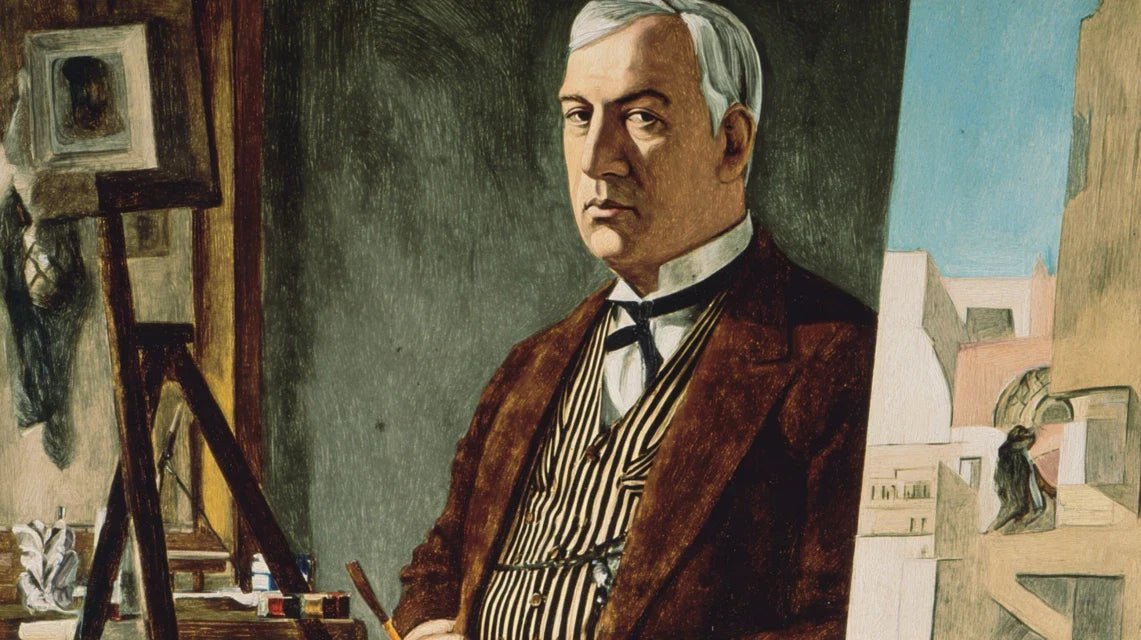
Behind the visionary artist lies a fascinating and contradictory personality. De Chirico deliberately cultivates his image as an art aristocrat, wearing a three-piece suit and tie even in his studio, displaying an elegance that contrasts with the bohemianism of his time.
His love life reflects this complexity. In 1925, he marries the Russian actress Raissa Gurievitch Krol, a passionate but tumultuous union that ends in separation. In 1930, his meeting with Isabella Pakszwer Far, a 21-year-old Russian, transforms his life: this lasting union accompanies him until his death in 1978.
The couple's installation in Rome in 1944 in a house near the Spanish Steps - now the Giorgio de Chirico Museum - reveals his deep attachment to eternal Italy. This residence becomes his creative sanctuary where he develops his neo-baroque period inspired by Rubens and old masters.
His artistic personality is reflected in this obsession with the cyclical time: De Chirico constantly repeats the same themes - horses, squares, mannequins - as if to exorcise a profound existential anguish.
Giorgio de Chirico: international success and artistic consecration
The international recognition of de Chirico gradually emerges from the 1920s. His participation in the Venice Biennale in 1924 marks his entry into the Italian artistic pantheon, followed by prestigious exhibitions in New York, London and Berlin.
The American success of the 1930s consolidates his international reputation. Private collectors and major museums compete for his metaphysical works, particularly sought after for their revolutionary originality and exceptional quality of execution.
Market value of Giorgio de Chirico and sales records
The evolution of De Chirico's price reflects the fluctuations in his critical reception. His metaphysical paintings today reach peaks at international auction sales, confirming their status as essential masterpieces of modern art.
| Period | Average value | Sales record |
|---|---|---|
| Metaphysical period (1910-1919) | 5,000 - 20,000 francs of the time | 50,000 francs for "The Red Tower" (1913) |
| Posthumous recognition (1980-2000) | $500,000 - $2 million | $5.2 million for “The Enigma of a Day” (1994) |
| Contemporary market (2000-2025) | $2 - $15 million | $24.5 million for “The Place in Italy” (2019) |
This exceptional valuation is a testament to the lasting influence of his metaphysical innovation on contemporary art.
Giorgio de Chirico: last creative years and death in Rome in 1978
The last decades of de Chirico are spent in his Roman villa where he continues to paint with astonishing productivity until his 90s. This late period sees the birth of his bronze sculptures inspired by ancient mythology and his last neo-baroque paintings.
His death on November 20, 1978 in Rome marks the end of one of the last witnesses of historical avant-garde. His funeral attracts the entire international artistic community, definitively confirming his status as an essential master.
Influence of Giorgio de Chirico on contemporary art
The legacy of de Chirico still irrigates contemporary art. Creators like David Hockney, Gerhard Richter or Neo Rauch draw from his metaphysical vocabulary to question our relationship with reality. His impossible perspectives inspire deconstructivist architecture.
More broadly, the digital revolution gives a striking topicality to his dreamlike universes. Video games, fantasy cinema and digital art explore aesthetic territories that de Chirico intuitively pioneered.
Recognizing the Chiricien heritage today: Observe contemporary advertisements, music videos or films: unsettling empty spaces, juxtapositions of incongruous objects and dreamlike atmospheres often bear the invisible mark of de Chirico's metaphysical genius.
Collections of Giorgio de Chirico in major museums worldwide
Today, de Chirico’s works enrich the most prestigious international collections. The Museum of Modern Art in New York, the Tate Modern in London, the Centre Pompidou and the Musée de l'Orangerie in Paris preserve his metaphysical masterpieces. In Italy, the Pinacoteca di Brera in Milan and his Roman house-museum offer the most complete panoramas of his creative evolution.
These institutions perpetuate the mission that the artist set for himself: to reveal the hidden poetry of everyday life and transform our view of reality.
🎁 Special offer for readers
Because you took the time to inform yourself, enjoy 10% discount on your first order:
⏰ Valid 72h after reading • Applicable to all our products
Frequently asked questions about Giorgio de Chirico and his work
Giorgio de Chirico (1888-1978) was an Italian painter born in Greece, the inventor of metaphysical painting. He is famous for his enigmatic canvases depicting empty places, mysterious arcades and incongruous objects that revolutionized modern art and influenced the surrealist movement. His cosmopolitan childhood between Greece, Germany and France nourishes his unique artistic vision.
De Chirico first studied drawing and painting at the Athens Polytechnic School from the age of 12, then at the Academy of Fine Arts in Munich starting in 1906. His training is inspired by the works of Böcklin and Klinger, as well as the philosophy of Nietzsche and Schopenhauer, creating a unique synthesis between classical technique and metaphysical vision.
Metaphysical painting is De Chirico’s revolutionary innovation developed between 1910 and 1918. It is characterized by depopulated urban landscapes, mysterious shadows, impossible perspectives and assemblages of enigmatic objects. This technique aims to reveal the hidden essence of reality beyond appearances, creating an atmosphere of waking dream that foreshadows surrealism.
Although a precursor to Surrealism, De Chirico broke with this movement as early as 1919 by advocating a "return to craft" and the techniques of old masters. This anti-modernist position provokes the anger of André Breton and the Surrealists who organized a symbolic exhibition in 1928 entitled "Here lies Giorgio de Chirico". The artist embraces this break, preferring the timeless to ephemeral innovation.