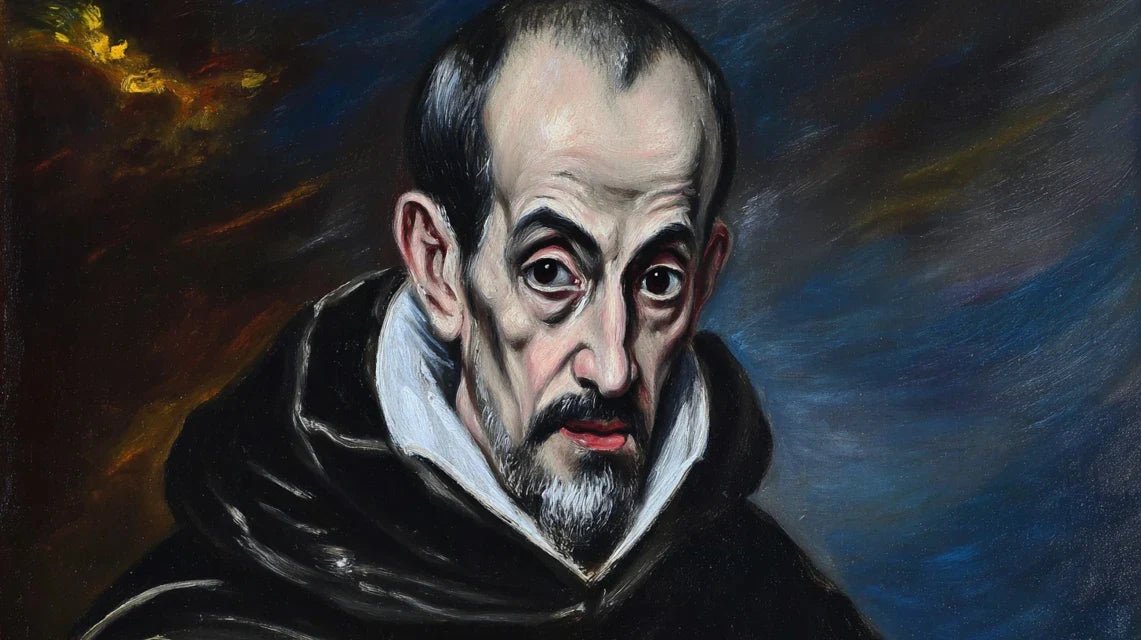
Imagine a Greek painter arriving in the mystical Spain of the 16th century, carrying with him the secrets of Byzantine art and the revolutionary audacity of Italian Renaissance. In the cobbled streets of Toledo, this visionary creator will revolutionize Spanish art by stretching his figures towards the heavens, as if his brushes captured directly divine light.
Domínikos Theotokópoulos, who history will remember as El Greco, was not just a painter: he was an alchemist of colors, an architect of the soul, a mystic armed with brushes. His incandescent canvases seem to vibrate with a supernatural energy, where each elongated silhouette tells a story of faith, passion and transcendence.
Between the golds of Venice, the grandeur of Rome and the ardent spirituality of Spain, this polymorphic artist forged a style so unique that it still defies all classifications today. His contemporaries found him eccentric, our museums venerate him as a brilliant precursor.
Discover the fascinating odyssey of an extraordinary creator who transformed his spiritual quest into artistic revolution - a captivating biography that reveals how a Cretan icon painter became the mystical soul of Spanish art.
El Greco : Domínikos Theotokópoulos, the Greek master of mystical Spanish painting
Knowing the true story of El Greco allows us to understand how an artist can transcend geographical and cultural boundaries to create a universal pictorial language. His exceptional journey perfectly illustrates the artistic mobility of the Renaissance and the emergence of a unique creative genius.
| Biographical highlights | Artistic legacy |
|---|---|
|
Full name : Domínikos Theotokópoulos Birth : October 1, 1541, Candia (Heraklion), Crete Death : April 7, 1614, Toledo, Spain Nationality : Greek, naturalized Spanish |
Movement : Late Mannerism and mystical Spanish Style : Elongated figures, incandescent colors Masterpiece : The Burial of the Count of Orgaz (1586) Innovation : Synthesis Byzantine-Renaissance-mysticism |
This extraordinary trajectory now leads us to the Cretan roots of the man who would revolutionize Spanish art with his celestial visions.
Domínikos Theotokópoulos : childhood in Crete of a future master painter
In the workshops of Candia, capital of Venetian Crete, young Domínikos grows up at the heart of a unique cultural crossroads. This Mediterranean island, possession of the Republic of Venice since 1204, vibrates with Byzantine, Venetian and oriental influences that will forever mark the artistic sensibility of the future El Greco.
The awakening of an icon painter: Around the age of fifteen, young Domínikos discovers the art of painting sacred icons in traditional Cretan workshops. His early works already demonstrate exceptional technical mastery and a profound spirituality that will characterize his entire future work.
The fundamental creative principle: From his early days in Crete, Domínikos develops this rare ability to paint not only what he sees, but what he feels spiritually. This intuitive approach to art, inherited from the Orthodox iconographic tradition, will become the signature of his artistic genius.
El Greco and the 16th century: an artist at the heart of late Renaissance
The 16th century of Domínikos Theotokópoulos corresponds to the apogee of the Renaissance, but also to the upheavals of the Catholic Counter-Reformation. This era of religious, political and artistic transformations creates the ideal context for the emergence of a mystical art like that of El Greco.
In Italy, late Mannerism dominates the artistic scene with masters such as Tintoretto and Veronese. Artists seek new expressions, moving away from the classical harmony of the High Renaissance to explore more expressive and personal paths. This creative atmosphere deeply stimulates the young Greek's artistic research.
His contemporaries include giants such as Michelangelo (whom he openly criticizes), Titian (his Venetian master), and Tintoretto (whose games of light he admires). But El Greco distinguishes himself by his totally original approach, refusing imitation to develop a personal pictorial language.
The Spain of Philip II lives the golden age of its colonial empire and European power. It is also the time of the Spanish mysticism with Saint Teresa of Avila and Saint John of the Cross, whose ecstatic writings resonate perfectly with the visionary art of El Greco.
The perfect cultural alchemy: El Greco brilliantly synthesizes the Byzantine heritage of his native Crete, the technical innovations of the Italian Renaissance, and the mystical fervor of post-Tridentine Spain. This unique combination creates an art unlike any other in the history of painting.
El Greco and his Italian beginnings: the difficult apprenticeship of a genius in training
Having arrived in Venice around 1566, young Domínikos discovers a dazzling but ruthless artistic world. Venetian workshops are full of talents, and competition between artists is fierce. His first Italian works bear witness to a constant struggle between his Byzantine heritage and the demands of the Venetian art market.
The most revealing episode of his determination takes place in the workshop of Titian. The venerable Venetian master accepts the Cretan young man as a collaborator, but their artistic visions quickly clash. Where Titian favors carnal sensuality and golden tones, Domínikos already aspires to a more transcendent spirituality.
A decisive turning point occurs during his meeting with Cardinal Alessandro Farnese in 1570 in Rome. This great Italian patron, enlightened collector and art lover, immediately recognizes the exceptional potential of the Greek painter. This patronage opens the doors for him to Roman artistic society, but also to terrible controversies.
These years of learning forge his artistic character: El Greco develops an unwavering confidence in his personal vision, refusing aesthetic compromises to preserve his creative originality. This intransigence, a source of immediate difficulties, will become his greatest strength.
But it is precisely this independence of mind that will lead him to the most resounding controversies of his Italian artistic career.
El Greco and the Roman scandal: when a genius defies Michelangelo
The most shocking episode in El Greco’s Italian career erupted in 1572 when he boldly proposed to Pope Pius V to repaint the entire Sistine Chapel of Michelangelo! This proposal, which seems audacious today, actually reveals the Greek painter's precocious artistic maturity.
The controversy quickly swelled in Roman artistic circles. El Greco openly criticizes Michelangelo, declaring that the Florentine master "did not know how to paint hair, nor imitate complexions, for lack of color". These iconoclastic remarks provoke the fury of the papal court and established artists.
But this controversy hides a profound artistic philosophy. El Greco defends a spiritual conception of art where color is paramount to drawing, where emotion transcends anatomical perfection. He already embodies this aesthetic revolution that will characterize his Spanish work.
The definitive break: In 1576, facing growing hostility from the Roman artistic milieu, El Greco makes a radical decision: to abandon Italy for Spain. This geographical shift is accompanied by a creative liberation that will give rise to his greatest masterpieces.
It is with this Italian experience, enriched by controversies and aesthetic certainties, that he approaches the most creative phase of his career in the mystical Toledo.
El Greco and the Toledo artistic revolution: the emergence of the mystic master
The arrival of El Greco in Toledo in the spring of 1577 marks the beginning of the most creative period of his career. In this Spanish city steeped in mysticism and secular traditions, the Greek artist finally finds the ideal environment to fully express his visionary genius.
The artistic transformation is immediate and spectacular. As early as 1577, he creates the 'Assumption of the Virgin' for the church of Santo Domingo el Antiguo, a first truly “Greek” work where appear these non-normative colors and this revolutionary spatial study that will characterize his mature style.
The Burial of the Count of Orgaz: El Greco’s absolute masterpiece
In 1586, El Greco receives the commission that will consecrate his genius: 'The Burial of the Count of Orgaz' for the church of Santo Tomé. This monumental work of 480 x 360 cm perfectly illustrates the local legend of the miracle that occurred during the funeral of don Gonzalo Ruiz in the 14th century, where Saint Augustine and Saint Stephen would have descended from heaven to bury this noble benefactor.
The genius of El Greco bursts forth in this revolutionary composition that divides the space into two distinct zones: the earthly world below, with its striking portraits of the Toledo nobility, and the celestial glory above, populated by elongated figures with unreal colors. This earth-sky duality becomes the signature of his mystic art.
El Greco’s revolutionary techniques: color and expressive deformation
The working method of El Greco revolutionizes the pictorial art of his time. He develops a palette of acidic and cold colors - electric blues, lemon yellows, pearly pinks - that give his canvases this supernatural luminosity so characteristic. His thick impastos and his technique of colored glazes create unique material effects.
El Greco facing his contemporaries: the originality of an isolated genius
Unlike Veronese or Tintoretto who prioritize decorative virtuosity, El Greco develops a deeply spiritual art. Faced with emerging naturalist trends, he asserts an aesthetic of mystical transcendence that places him outside the artistic currents of his time.
A revealing anecdote illustrates this difference in approach: when theorist Francisco Pacheco asks him in 1611 what is more difficult between painting and drawing, El Greco replies without hesitation: "to use color". This response perfectly summarizes his artistic philosophy.
OUR RECOMMENDED PRODUCTS
This Toledo aesthetic revolution also profoundly transforms the personality of the man behind the artist, revealing fascinating aspects of his private life.
El Greco the man: the complex personality of the Toledan genius
Behind the visionary creator lies a complex and fascinating man. El Greco leads in Toledo an existence as a bourgeois artistic, renting from the Marquis de Villena a sumptuous palace of 24 rooms where he installs his workshops, his library and his art collections. This residence quickly becomes an intellectual salon frequented by the cultural elites of the time.
The most significant event in his private life remains his relationship with Jerónima de las Cuevas, a Toledan noblewoman with whom he has a son, Jorge Manuel, in 1578. Although he never marries her - a surprising choice for the time - this free union testifies to his independent spirit and his rejection of social conventions. Jorge Manuel will himself become a painter, architect and sculptor under the name of Jorge Manuel Theotocopoli.
His personality is revealed in his daily habits: El Greco has musicians play during his meals, organizes philosophical debates in his workshops, and collects books on architecture and theology. This encyclopedic culture transpires in the symbolic richness of his works and explains his friendships with intellectuals such as the poet Luis de Góngora.
This refined and intellectual life nourishes his mystical art and prepares for the public recognition that will definitively consecrate his artistic genius.
El Greco and Toledan consecration: artistic success and fortune of the master
The recognition of El Greco gradually asserts itself from the 1580s. His religious commissions multiply: altarpieces for Santo Domingo el Antiguo, decorations for various Toledan churches, portraits of local nobility. This growing notoriety establishes his reputation as a "painter-philosopher" according to the expression of Francisco Pacheco.
The resounding success of "The Burial of the Count of Orgaz" in 1588 marks the peak of his career. From its inauguration, crowds flock to Santo Tomé to admire this masterpiece. This popular recognition is accompanied by financial prosperity that allows him to maintain a lavish lifestyle.
The value of El Greco: evolution of the art market over four centuries
The analysis of the market value of El Greco’s works reveals the fluctuations of artistic taste through the centuries. His current prices reflect the modern rediscovery of his genius, long misunderstood.
| Period | Average value | Record sale |
|---|---|---|
| 1580-1614 (during his lifetime) | 500-2000 ducats per altarpiece | 3000 ducats for "The Burial of the Count of Orgaz" |
| 17th-19th century | Near abandonment of the market | Derisory sales, forgotten works |
| 20th-21st century | 15-50 million euros | 76 million euros ("Saint Joseph and the Christ Child", 2013) |
This spectacular evolution perfectly illustrates the exceptional artistic destiny of El Greco: misunderstood then forgotten, before being rediscovered and venerated as a brilliant forerunner of modern art.
El Greco and his death in 1614: the legacy of a misunderstood visionary
The last years of El Greco’s life are marked by an increasing simplification of his art and an ever more intense mystical exaltation. His latest creations, such as "The Laocoon" (c. 1610-1614) or the decoration of the chapel of Saint Joseph, bear witness to a spiritual quest that reduces figuration to essential mysticism.
El Greco dies in Toledo on April 7, 1614, aged 72, in relative poverty despite his artistic glory. His unpaid last commissions and costly lawsuits have depleted his fortune. He is buried religiously in the church of Santo Domingo el Antiguo, where his first Toledo masterpieces flourished.
El Greco’s influence on contemporary art: a visionary forerunner
The rediscovery of El Greco in the 20th century reveals his prophetic influence on modern art. Pablo Picasso draws direct inspiration from "The Burial of the Count of Orgaz" for his "Evocation”, while Cézanne revisits the “Lady with an Ermine”. German Expressionists and French Fauves recognize in him a precursor to their chromatic research.
More recently, contemporary artists such as Francis Bacon or Anselm Kiefer draw from Greek aesthetics this unique ability to express spirituality through expressive deformation and unnaturalistic colors.
Recognizing the legacy of El Greco today: In contemporary art, look for these elongated figures, acidic colors, supernatural luminosity and mystical dimension that characterize the lasting influence of the Greek master on today's creators.
El Greco in worldwide collections: where to discover his masterpieces
Works by El Greco are now held in the most prestigious museums worldwide. The Prado Museum in Madrid has the largest collection with more than 30 paintings, including "Gentleman with his hand on his chest". The Metropolitan Museum of New York houses the famous "View of Toledo", while "The Burial of the Count of Orgaz" remains in its original location at the church of Santo Tomé de Toledo.
This geographical dispersion is a testament to the international recognition of an artist who transcends national borders to touch the universality of mystical and visionary art.
🎁 Special offer for readers
Because you took the time to inform yourself, enjoy 10% discount on your first order:
⏰ Valid 72h after reading • Applicable to all our products
Frequently asked questions about El Greco's (Domínikos Theotokópoulos) biography
El Greco, whose real name is Domínikos Theotokópoulos, was born on October 1, 1541 in Candia (present-day Heraklion) in Crete. Coming from a local bourgeois family, he grew up in a cosmopolitan society blending Byzantine, Venetian and oriental influences. His brother Manusso later joins him in Spain as a merchant, testifying to the strong family ties that characterize his personality.
His training begins in Crete with the art of post-Byzantine icons, then continues in Venice (1566-1570) in the workshop of Titien where he discovers the art of the Renaissance. In Rome (1570-1576), he studies the works of Michelangelo and the Tintoretto, developing this unique synthesis that characterizes his mature style. This triple training explains the originality of his pictorial language.
El Greco revolutionizes painting with his elongated figures with elongated proportions, his palette of cold and acidic colors (electric blues, lemon yellows), and his technique of colored glazes creating these supernatural effects of luminosity. His method of composition dividing the space between earth and sky becomes his distinctive artistic signature.
His visionary style, too avant-garde for his time, disconcerts his contemporaries who judge him "extravagant". Forgotten for two centuries, he was rediscovered by the French Romantics around 1850, and then consecrated by the exhibition at the Prado in 1902. His modern recognition coincides with the emergence of expressionist art which recognizes him as a genius precursor.
El Greco’s paintings reach peaks in the contemporary art market. Major works sell for between 15 and 50 million euros, with a record of 76 million euros for "Saint Joseph and the Christ Child" in 2013. This exceptional valuation reflects the rarity and historical importance of his work in Western art history.
El Greco profoundly influences modern and contemporary art. Picasso, Cézanne, German Expressionists and Fauves draw on his aesthetics. Today, artists like Francis Bacon or Anselm Kiefer perpetuate his mystical quest and chromatic innovations, confirming his timeless modernity.
El Greco: the eternal contribution of a mystic visionary to Western art
El Greco still fascinates us today because he embodies this rare synthesis between absolute technical mastery and transcendent spiritual vision. His exceptional journey - from Cretan icon painter to Toledo mystic master - perfectly illustrates the ability of art to transcend cultural boundaries to reach the universal.
His modernity lies in this genius intuition: true art does not copy visible reality, but reveals the invisible spiritual. His unreal colors, his figures stretched towards the heavens, his supernatural light continue to move our contemporaries because they express this quest for the absolute that inhabits humanity throughout time.
Discovering El Greco means understanding that authentic art always arises from this fertile tension between tradition and innovation, between faith and creative audacity. His example still inspires those who seek to express the inexpressible through artistic beauty.
Enrichment through mystical beauty: Let yourself be touched by the visionary art of El Greco, a conveyer of light who transforms every gaze cast upon his works into an enriching spiritual experience and a source of lasting personal elevation.