
André Masson: The Artist Who Transformed Trauma into Revolution
In the darkness of a shell crater at The Chemin des Dames, a 21-year-old soldier lies among the dead. André Masson, left for dead in April 1917, spends the entire night contemplating the shattered bodies of his comrades.
This night of horror forever shapes the soul of an artist who will transform trauma into artistic revolution. The man who survives this hell becomes the father of Surrealist automatism and the inventor of sand paintings, revolutionizing 20th-century art through his obsessive quest for the unconscious.
Why does this visceral nonconformist, this "rebel of Surrealism," still fascinate us today? How did his automatic drawings influence Jackson Pollock and the New York School? What universal truth does his art of metamorphosis reveal?
Discover the man behind the myth, the creator who dared to paint the violence of his time to better reveal the essence of humanity - an initiatory journey into the heart of modern art
André Masson, Revolutionary Automaton of French Surrealism
Understanding André Masson means grasping the very essence of French modern art: a creator who rejected all orthodoxy to invent a revolutionary pictorial language. 🎨 A pioneer of automatism, inventor of sand paintings, forerunner of American expressionist abstraction.
| Key Biographical Dates | Artistic Legacy |
|---|---|
|
Full name: André-Aimé-René Masson Born: January 4, 1896, Balagny-sur-Thérain (Oise) Died: October 28, 1987, Paris Nationality: French |
Movement: Surrealism (1924-1929, 1936-1943) Style: Psychic automatism, sand paintings Key work: The Four Elements (1924) Innovation: Automatic drawing and mixed techniques |
This seemingly simple biography hides an artistic journey of extraordinary richness, marked by ruptures and reconciliations with the avant-garde movements of his time.
André Masson as a Child: The Formation of a Rebellious Mind in Brussels
André Masson’s childhood was spent in provincial bourgeois life: his father, a wallpaper representative, moves the family from Oise to Lille in 1903, then to Brussels two years later. 🏛️ It is in the Belgian capital that his artistic vocation is born.
The Foundational Aesthetic Shock: At eleven years old, André discovers the hallucinatory paintings of James Ensor at the Museum of Fine Arts in Brussels. These visions of grimacing masks and macabre carnivals reveal to the young boy “the divergent character” of true art. This aesthetic revelation determines his taste for transgression and nonconformity.
Admitted to the Royal Academy of Fine Arts in Brussels in 1907, he studied under the direction of Constant Montald, a master of mural decoration and close to the poet Émile Verhaeren. 📅 From 1907 to 1912, he learned traditional techniques while rubbing shoulders with the Belgian symbolist avant-garde.
The original creative principle: From his earliest student works, Masson manifests a "visceral horror of conformity" that distinguishes him from his fellow students. This ability to reject traditional academicism already foreshadows the future revolutionary of modern art.
On the recommendation of Verhaeren, who recognized in him an exceptional talent, André went to Paris in 1912 to continue his training at the Fine Arts school.
André Masson and the artistic effervescence of Paris (1912-1920)
When André Masson arrives in Paris in 1912, the French capital is brimming with artistic innovations: Picasso and Braque revolutionize painting with Cubism, while the Ballets Russes scandalize with *The Rite of Spring*.
At the École des Beaux-Arts, Masson joins the workshop of the fresco painter Paul Baudoüin and frequents assiduously the Louvre and the musée du Luxembourg. 🎨 He discovers there the old masters and the Impressionists, forging his visual culture.
His contemporaries? Fernand Léger, Marcel Duchamp, Henri Matisse radically transform Western art. But unlike these avant-gardists, Masson still favors tradition: 📅 a study grant allows him to go to Tuscany to study Renaissance mural painting.
The outbreak of the First World War in August 1914 breaks this classical training. Enlisted in the infantry in 1915, the young artist aged 19 discovers a reality that will forever transform his vision of the world.
The paradox of training: While his contemporaries are already revolutionizing modern art, Masson follows a traditional academic curriculum. This classical training, far from being a handicap, will give him the technical foundations necessary to revolutionize surrealist art.
The artist in the making does not yet know that the horror of the trenches will forge the revolutionary of automatism.
André Masson in the hell of the trenches: the founding trauma (1915-1919)
The war years radically transform André Masson's existence and art. Enlisted in the infantry, he discovers modern industrial violence: 🎖️ wounded three times, seriously injured in the chest during the 'Chemin des Dames offensive' in April 1917.
This April 1917 night marks a major existential turning point. Left for dead in an shell crater, Masson spends long hours contemplating the shattered bodies of his comrades. This vision of apocalypse shapes his future aesthetic: violence, eroticism, and death now intertwine in his imagination.
Hospitalized until the November 1918 Armistice, he rubs shoulders with other artists traumatized by the conflict. This collective experience of horror creates a generation of avant-garde artists united by their rejection of the established order: 📅 Otto Dix, George Grosz, the Dadaists share this same revulsion for bourgeois civilization.
Deeply marked, Masson retains "a repulsion for belligerence throughout his life" which will transpire in his most famous works: the series of Massacres (1930-1934), directly inspired by his war memories.
Released from military obligations, he settles into a abandoned cabin on the Étang de Berre lake, then joins the artists' community of Céret where he truly begins to paint.
André Masson provocateur: scandals and ruptures with Surrealist orthodoxy
From his adhesion to Surrealism in 1924, André Masson stands out for his radical nonconformity. Unlike other members of the group, he refuses the Bretonian orthodoxy and develops his own conception of psychic automatism.
The first controversy arises around the very definition of automatism. When André Breton advocates for a "methodical, voluntary, extremely disciplined automatism", Masson claims spontaneous, Dionysian automatism, freed from any rational constraint.
His erotic drawings scandalize even the avant-garde circles. 📅 In 1949, his exhibition Erotic Earth at the Place Vendôme gallery is quickly closed by the authorities. These works explore sexuality and violence without modesty.
The rupture with Breton: "In fact, unlike Breton, I thought that the primary value would never be automatism, but the Dionysiac spirit," Masson confides. This fundamental philosophical divergence explains his multiple ruptures with the official Surrealist movement.
His friendship with Georges Bataille, a sulphurous figure of the time, enhances his reputation as a provocateur. Together, they explore the forbidden territories of art and literature, creating the review Acéphale, for which Masson designs the transgressive effigy.
This posture of "permanent rebel" earns him marginalization by the Surrealist establishment, as well as a total creative freedom that will define his singularity.
André Masson revolutionary: the invention of automatism and sand paintings
From 1924, André Masson invented a new way of creating that revolutionized Western art. Located at 45 rue Blomet in Paris, he shared his studio with Joan Miró and frequented writers Michel Leiris, Georges Limbour, Antonin Artaud.
This artistic laboratory became "the equivalent for Surrealism of the Bateau-Lavoir for Cubism". 🎨 Within this atmosphere of total experimentation, Masson developed his first automatic drawings as early as 1927.
The Four Elements by André Masson: The Work That Captivates André Breton
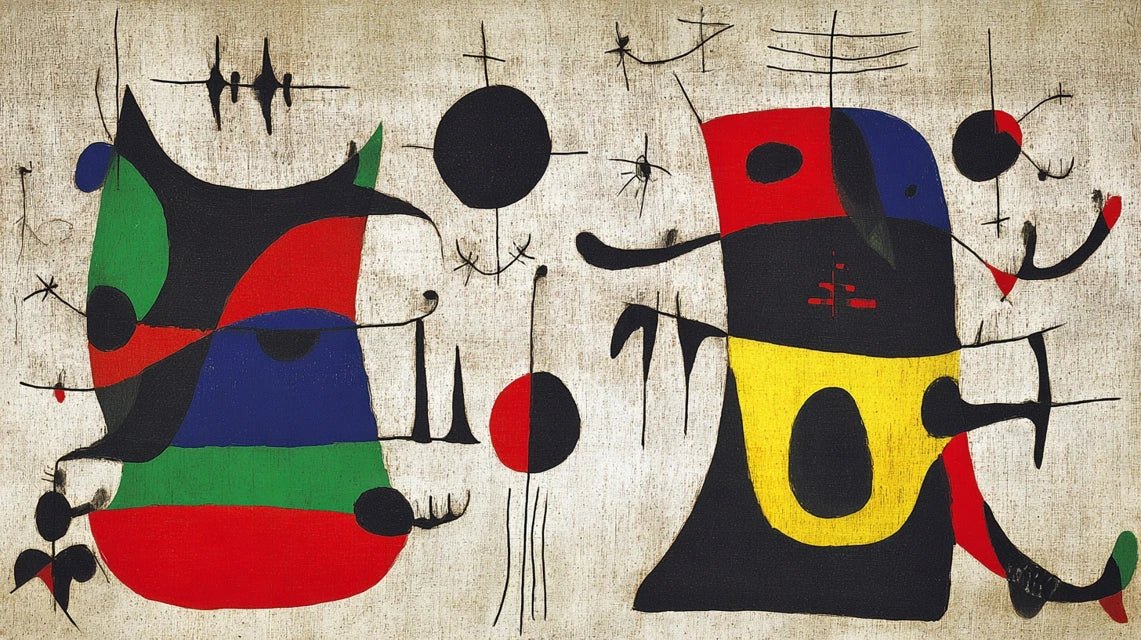
The Four Elements (1924) marks Masson's official entry into the Surrealist movement. This canvas, sold to André Breton during a studio visit, synthesizes the painter's revolutionary approach: 📅 organic forms, fluid lines, and elementary symbolism intertwine in a visionary composition.
The work already reveals "the spirit of metamorphosis" and "the invention of myth" which will characterize all of the artist's subsequent production. 🎨 References to Cubism (inherited from his training) blend with Surrealist innovations.
André Masson's Automatism: A Revolutionary Technique for Accessing the Unconscious
Unlike other Surrealists, Masson developed a radical automatism: he draws with his eyes closed, after long periods of fasting or under the influence of psychotropic substances. 🎨 This method aims to bypass reason in order to directly access the unconscious.
In 1926, he invented sand paintings: he spreads glue on the canvas randomly, throws sand onto it, then paints with oil on these accidental forms. This technique foreshadows gestural art and abstract expressionism.
André Masson and His Contemporaries: A Pioneer of Pictorial Modernity
While Joan Miró develops his own automatic language in parallel, Masson is distinguished by the violence of his line and the eroticism of his compositions. When Max Ernst explores the techniques of frottage, Masson favors gestural spontaneity and the direct expression of the unconscious.
A revealing anecdote: during a Surrealist evening, Masson automatically drew while Ernest Hemingway read his texts. This symbiosis between literature and visual arts illustrates the interdisciplinary approach of the Parisian Surrealist movement.
OUR RECOMMENDED PRODUCTS
This period of technical innovation prepares the decisive influence that Masson will exert on the young American school.
André Masson Intimate: The Man Behind the Revolutionary Creator
Behind the image of the revolutionary artist lies a man deeply marked by the traumas of his time. In 1920, he married Odette Cabalé in Céret, a union that gave him a daughter, Lily, who would become a painter. 👨👩👧 This family stability contrasts with the violence of his works.
In 1934, he remarried Rose Maklès, sister-in-law of Georges Bataille, who gave him two sons: Diego (future conductor) and Luis (actor). This new union coincides with his Spanish period and his discovery of bullfighting.
Masson cultivated passionate friendships with the intellectuals of his time: Michel Leiris, Jacques Lacan (his brother-in-law), Jean-Paul Sartre. 🎭 These relationships nourished his aesthetic reflection and theatrical collaborations (sets for Hamlet, Morts sans sépulture).
His visceral nonconformism is reflected in his political choices: 📅 signatory of the Manifesto of the 121 against the Algerian War in 1960, he maintained his antimilitarist convictions forged in the trenches of 1917.
André Masson recognized: from marginal avant-garde to international recognition
The recognition came gradually for André Masson. From 1922, the dealer Daniel-Henry Kahnweiler offered him an exclusive contract with the galerie Simon. 💰 This financial security allowed him to devote himself entirely to creation.
The decisive turning point occurred during his American exile (1941-1945). His works directly influenced Jackson Pollock, Arshile Gorky, and the New York School. 🏛️ The Museum of Modern Art organized his first retrospective as early as 1976.
André Masson's market value: evolution of prices and sales records
The evolution of Masson’s price reflects his gradual recognition by the international art market. From a creator of marginal avant-garde, he became an essential reference of French modern art.
| Average value | Sales record | |
|---|---|---|
| 1924-1940 (surrealist period) | 500-2000 francs | 5000 francs for The Four Elements |
| 1945-1987 (posthumous recognition) | 50,000-200,000 francs | 800,000 francs for Gradiva (1970) |
| 1987-2025 (contemporary market) | 100,000-2 million euros | 3.2 million euros for Iroquois Landscape (2010) |
📈 His automatic works and sand paintings today achieve record prices, confirming his status as a precursor of contemporary gestural art.
André Masson patriarch: the last creative years (1960-1987)
Les dernières décennies of André Masson’s life were spent in the Aix-en-Provence region, where he settled in Tholonet as early as 1947. 🏛️ This Provençal period, often overlooked by critics, nevertheless reveals intact creativity.
Despite his advanced age, he continued to innovate: 📅 commission of the ceiling for the Odéon by André Malraux in 1965, international retrospectives (Berlin 1964, New York 1976, Paris 1977). The revolutionary artist becomes a living heritage of French art.
André Masson’s influence on contemporary art: from automatism to street art
Masson's legacy extends far beyond the confines of historical Surrealism. His automatic techniques directly inspire American expressionist abstraction: 🎨 Jackson Pollock explicitly acknowledges his debt to the French master’s gestural “wanderings”.
More recently, contemporary art rediscovers his innovations: the street art, the performance, generative digital art take up his principles of automatism and controlled chance. 📱 Current creative algorithms update his dream of an art freed from rational control.
Recognizing the Massonian legacy: Observe contemporary works that prioritize spontaneous gesture, controlled accident, fusion between figuration and abstraction. From Gerhard Richter to Anselm Kiefer, many current creators unconsciously extend the research of the automatist.
André Masson collections: where to discover his works today
🏛️ Major works by Masson are held at the Centre Pompidou (Paris), the Museum of Modern Art (New York), and the Stedelijk Museum (Amsterdam). 📅 The exhibition "There is no finished world" at the Centre Pompidou-Metz (2024) reveals to the contemporary public the unsettling nature of his message.
To discover the artist’s complete universe, plan your visit to the Granet Museum in Aix-en-Provence, which preserves many works from his final Provençal period.
🎁 Special readers offer
Because you took the time to inform yourself, enjoy 10% discount on your first order:
⏰ Valid 72h after reading • Applicable to all our products
Frequently asked questions about André Masson: everything you need to know about the master of automatism
André Masson (1896-1987) was a major French painter of the 20th century, a pioneer of Surrealist automatism and inventor of sand paintings. Born in Oise, trained in Brussels and Paris, he was deeply marked by his war wounds at Chemin des Dames in 1917. This traumatic experience shaped his aesthetics of violence and metamorphosis. His importance lies in his role as a bridge between European Surrealism and American Expressionist abstraction, directly influencing Jackson Pollock and the New York School.
Masson was initially trained at the Royal Academy of Fine Arts in Brussels (1907-1912) under Constant Montald, a specialist in mural decoration. He met the poet Émile Verhaeren, who encouraged him to continue his studies in Paris. At the School of Fine Arts in Paris, he joined the workshop of fresco painter Paul Baudoüin and frequently visited the Louvre. A study grant allowed him to study mural painting in Tuscany. This classical training, interrupted by the war, gave him the technical foundations necessary for his later Surrealist innovations.
Masson's automatism consists of drawing without rational control to directly access the unconscious. Unlike the "methodical" automatism advocated by André Breton, Masson developed a "dionysiac" automatism: he drew with his eyes closed, after long periods of fasting, sometimes under the influence of psychotropic substances. He also invented "sand paintings" in 1926: glue spread randomly, sand projected, then oil paint on these accidental forms. These revolutionary techniques foreshadow gestural art and directly influence American Expressionist abstraction.
Masson's recognition was established gradually. As early as 1922, the dealer Daniel-Henry Kahnweiler offered him a contract with the Simon gallery. In 1924, André Breton bought his painting "The Four Elements" and integrated it into the Surrealist movement. The decisive turning point came during his American exile (1941-1945) where he influenced the young New York school. His international consecration was confirmed by retrospectives at MoMA (1976), the Grand Palais (1977), and official commissions such as the ceiling of the Odéon (1965) by André Malraux.
Masson's works have experienced strong appreciation since the 2000s. Automatic drawings sell for between €50,000 and €300,000, Surrealist paintings between €200,000 and €1 million. The absolute record is held by "Iroquois Landscape" (1942), sold for €3.2 million in 2010. Sand paintings and works from the American period are particularly sought after. This increase reflects the growing recognition of his role as a precursor to contemporary gestural art. Collectors appreciate his unique position between European Surrealism and American abstraction.
Masson's legacy extends far beyond historical Surrealism. His automatic techniques directly inspire Jackson Pollock and American expressionism. Today, contemporary art rediscovers his innovations: street art, performance, generative digital art take up his principles of automatism and controlled chance. From Gerhard Richter to Anselm Kiefer, many current creators continue his research on spontaneous gesture and controlled accident. His message about the need to free art from rational control remains strikingly relevant in the age of artificial intelligence.
André Masson visionary: the eternal relevance of an art of metamorphosis
Why does André Masson continue to fascinate nearly forty years after his death? Because his art transcends artistic movements to touch on the universal human experience. 🎨 His automatism reveals the unconscious forces that govern our existences, his sand paintings anticipate our era of digital creation and artificial intelligence.
Beyond historical Surrealism, Masson teaches us that true art is born from the ability to transmute trauma into beauty, to turn violence into creation, the unconscious into revelation. 📅 At a time when our era rediscovers the importance of creative gesture in the face of technological standardization, his message finds a prophetic relevance.
Discovering André Masson means understanding that authentic art refuses shortcuts and orthodoxies to perpetually invent new languages. 🌟 His "taste for risk" and visceral nonconformity offer a model of creative freedom particularly valuable in our formatted world.
Art as self-revelation: Masson's work invites us to explore our own creative depths, to dare spontaneity, to accept accident as a revealer of hidden truths. In a world that favors control and predictability, his Dionysian automatism reminds us of the liberating beauty of the unexpected and the authentic.