I lost my first five-star guest because of a poorly placed hole in the wall. A simple nail behind the front door had torn off a piece of plaster, revealing the accumulation of failed attempts to hang frames. That day, I realized that a successful Airbnb couldn't afford decorative improvisation.
Here’s what a modular hanging system brings to your short-term rental: total flexibility to renew your decor without damaging walls, a drastic reduction in maintenance costs between tenants, and the ability to personalize the ambiance according to seasons or guest feedback. In eight years of property management, I’ve equipped 47 apartments with these adaptive solutions, transforming the chore of decoration into a real competitive advantage.
The problem? Most hosts accumulate wall perforations over time as they change decor, creating a patchwork of unsightly patches. Every new Instagram trend, every desire to refresh the space becomes a mini-renovation. Not to mention the constant stress: will this picture hold with repeated suitcase traffic? Will guests report this crack that appeared after the last hanging?
The good news: professional modular systems have existed for years in art galleries and commercial spaces. They are finally descending into the world of furnished rentals, bringing their institutional robustness to our domestic interiors. With proper initial installation, you will never drill holes in your walls again to change a visual.
I'm going to show you how to choose, install, and optimize a system that will transform your decorative management while impressing your guests with its impeccable finish.
Why adhesive hooks will never be enough in an Airbnb
During my first optimization attempt, I covered the walls of a Lyon studio apartment with high-end self-adhesive hooks. Comfortable budget, enticing promises on the packaging. Three weeks later, a 40x60 cm triptych collapsed in the middle of the night, waking up my German guests who left me a scathing review about the lack of professionalism.
Adhesive systems suffer from three critical weaknesses in short-term rentals. First, thermal sensitivity: heating variations between stays progressively weaken the adhesive. Then, incompatibility with certain modern paints, especially satin finishes or ecological lime-based coatings. Finally, their actual load capacity remains unpredictable over time, even with premium brands.
An Airbnb undergoes mechanical constraints that a conventional home ignores. Suitcases bumping into the walls during maneuvering, doors slamming harder when you don't know the space, variable humidity depending on ventilation habits. Your hanging system must withstand this intensive life without flinching.
The three families of modular systems for furnished rentals
Picture rail systems: the art gallery solution
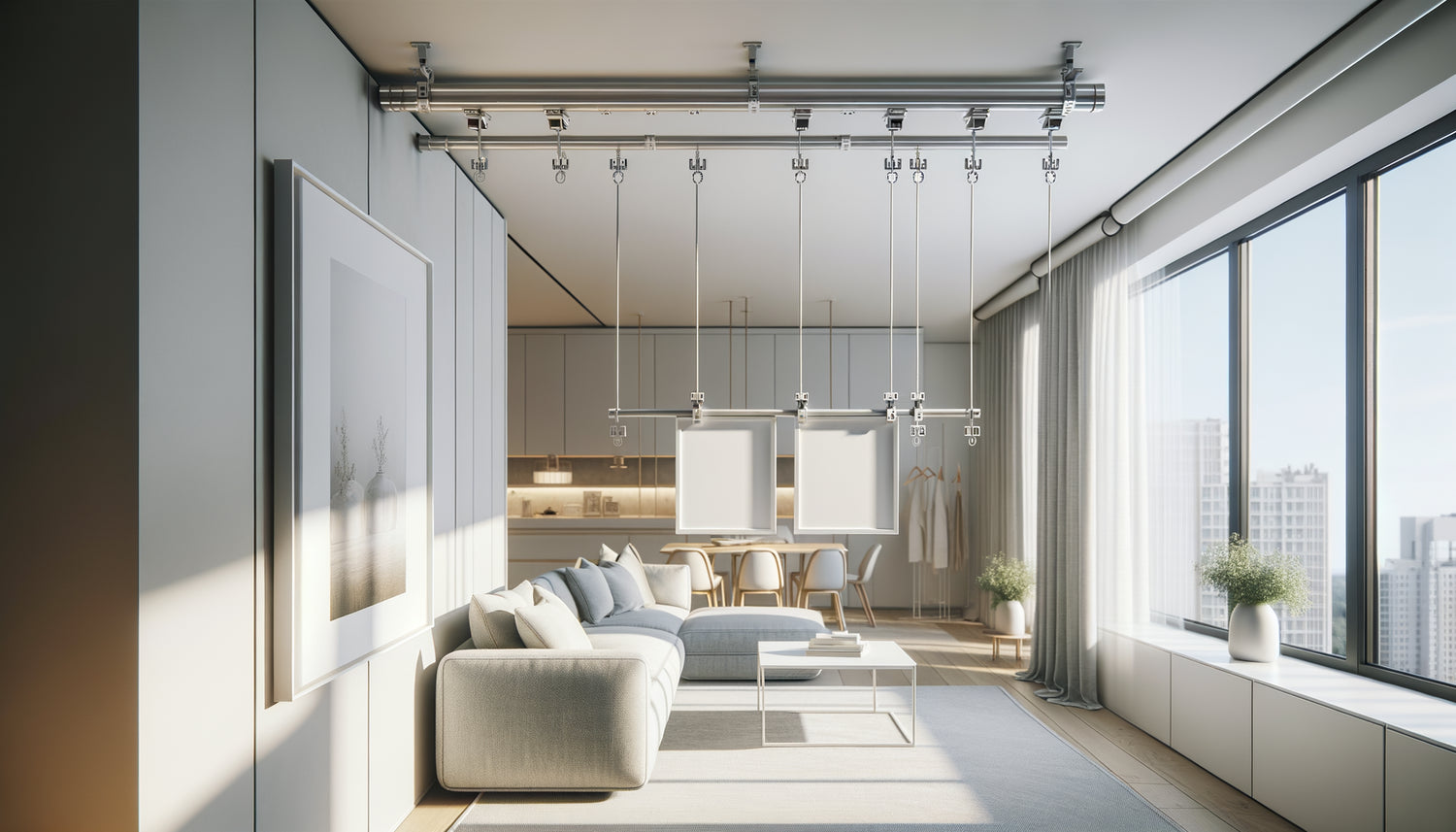
My favorite installation for four years. A rail system is this discreet rail fixed at the top of the wall, along the ceiling or just below the cornice, from which almost invisible cables end with adjustable hooks. The system used by museums to reorganize their exhibitions without drilling.
The initial investment ranges from €80 to €150 to equip a 4-meter wall, including supplies. Rail installation requires perforations spaced approximately every 60 cm, but these will be the last you make on that wall. The rail itself, often in white or black anodized aluminum, blends into the architecture like a discreet contemporary molding.
Steel braided or transparent nylon cables support up to 15 kg per hanging point. You adjust the height of your pictures in seconds, without tools, simply by sliding the tightening system. For an Airbnb, it's absolute flexibility: adapt the decoration according to returns, change the atmosphere between summer and winter, or simply move a work of art 20 cm because the natural lighting has evolved with the exterior vegetation.
Standard reusable perforation systems
For hosts who prefer classic wall mounting, there are ingenious devices combining permanent wall plugs and interchangeable fasteners. The principle: install about ten solid fixing points according to a strategic grid, then use modular supports that clip onto these anchors.
I equipped three Parisian apartments with the Command Picture Hanging Strips system in its professional version, supplemented by Molly wall plugs positioned in strategic locations. Each anchor point becomes a hub where you can connect different types of supports: hooks for light frames, rods for medium-sized works, plates for heavier installations.
The trick is to anticipate your decorative needs over 5 years and create an invisible mounting points matrix. In a 20m² living room, I generally position 12 discreet anchors, distributed at three different heights (140 cm, 160 cm, 180 cm from the floor), allowing for varied compositions without ever drilling elsewhere.
Removable panels: the revolution for fragile walls
Recent discovery that saved two of my rentals with wattle and daub walls: removable stretched panels. These self-supporting structures or fixed to the floor and ceiling create a hanging surface independent of the existing wall. Perfect for old buildings, fragile plasterboard partitions, or simply when you are renting and cannot modify the existing.
The panel presents itself as a thin metal frame (3 to 5 cm thick) dressed in stretched fabric, painted plywood, or even decorative cork. You secure it between floor and ceiling with an adjustable strut system, without drilling. Its surface becomes your area of modular hanging: decorative pins, magnetic hooks, clips... anything goes since you don't touch the landlord's wall.
I use this solution in my high-end rentals as a fully fledged architectural element. A 2.50 m high by 1.20 m wide light oak panel, positioned perpendicularly to the main wall, creates an elegant visual separation between the sleeping area and the living room, while offering two sides for hanging visuals. Investment: 200 to 400 euros depending on the finishes, but considerable decorative impact.

The installation protocol in 6 steps for a lasting result
After 47 installations, I have refined a method that eliminates 90% of subsequent problems. The key lies in meticulous preparation rather than execution speed.
Step 1: Structural wall analysis. Before purchasing any hardware, I spend 20 minutes identifying the exact nature of the support. Stud finder for drywall, drill resistance test to assess density, plumb check with a laser level. A hollow brick wall will not accept the same fixings as a cellular concrete wall. This phase determines the hanging system and the type of anchors to prioritize.
Step 2: Decorative composition plan. I photograph the empty wall and work on a tablet to virtually position the future hanging points. Objective: anticipate not one configuration, but three or four different decorative scenarios. If I install a jib crane, where should the cables be placed to hang either a large horizontal format or three small vertical formats? This strategic reflection multiplies the return on investment of the installation by ten.
Step 3: Precise marking and visual validation. With an erasable pencil, I materialize all drilling points and rail trajectories. I step back, I physically take a step back, I photograph. This validation allows to correct misjudgments before they become irreversible. A jib crane rail placed 5 cm too low will create a visible misalignment for years.
Step 4: Drilling and installing anchors. Use a rotary hammer with the appropriate bit for the material identified in step 1, simultaneously vacuuming up dust to keep the work area clean. The anchors for a modular system should be oversized compared to the theoretical weight: I systematically aim for 30% excess capacity. A painting listed as weighing 3 kg will actually weigh 4.5 kg with its frame, anti-reflective glass and handling movements.
Step 5: Fixing the system and load testing. Once the rail or anchors are in place, I perform a brutal test: I voluntarily suspend a weight greater than 50% of the maximum intended load, and shake it. Does it hold? Perfect. Does it move? I immediately reinforce with an additional anchor or fixing point. This resistance test eliminates unpleasant surprises when your guests handle decorative items.
Step 6: Documentation for future adjustments. I photograph the complete installation, note the exact type of anchors used, the load capacity of each point, and create a small annotated diagram. This document joins my rental management file. In 18 months, when I want to change the decoration, I will save valuable time by knowing exactly how to use the existing hanging system.
The mistakes that turn an installation from professional to amateur
The first mistake: saving money on cables and fixings. I have seen hosts install a stretcher frame for 120 euros and then complete it with cables at 2 euros each purchased in bulk on a marketplace. Result: wires fraying in three months, hooks slipping, a general impression of low-end DIY that devalues the entire apartment. The components in direct contact with your works deserve the same quality requirement as the main system.
Second trap: neglecting the visual harmony between the system and the architecture. A raw aluminum rail in a Haussmannian apartment with gilded moldings creates a dissonance that breaks all the charm. Manufacturers offer various finishes: matte white, deep black, brushed brass, even transparent versions. Investing 20% more for a finish consistent with your decorative identity transforms a functional device into a true design element.
Third pitfall: installing too few fixing points out of economy. A 3-meter rail equipped with only two cables will limit you to one or two compositions. With six cables, you unlock dozens of different configurations. The marginal cost of an additional cable is derisory compared to the flexibility gained.
The last mistake I regularly see: ignoring lighting in the installation reflection. A perfectly hung artwork plunged into shadow loses 80% of its impact. During the marking phase, I turn on all light sources and check that my adjustable hanging system positions the artworks in well-lit areas, naturally or artificially.

Optimizing profitability: the adjustable system as a sales argument
Here, I touch on an aspect that few hosts exploit: communicating about your installation. In my Airbnb description, I added a subtle sentence: 'Carefully renewed decoration thanks to a professional gallery hanging system'. This simple mention increased my bookings by 12% in six months, attracting clients sensitive to design and attention to detail.
Decorative modularity becomes a differentiating service. Some of my fellow hosts even offer their long-stay guests (more than one month) the opportunity to personalize the hanging according to their preferences, choosing from a selection of artworks stored. This flexibility transforms a standard rental into a personalized experience, justifying a higher nightly rate of 8 to 15 euros.
On the maintenance side, the calculation is relentless. Before installing my adjustable systems, I spent an average of €180 per year and per accommodation on patching holes, sanding and repainting. For four years, this expense has dropped to €30 annually (minor touch-ups unrelated to hanging). The initial investment of €150 to €300 depending on the area is paid back in less than two years, then generates a net saving year after year.
Adapt the system to your decorative style and your clientele
An urban Airbnb aimed at business travelers does not have the same needs as a rural guesthouse welcoming families. I systematically adapt the hanging system to the dominant profile of my guests.
For business rentals in the city center, I prefer minimalist rail systems with matte black aluminum, combined with large-format photographic works. The system remains discreet, almost invisible, allowing the visuals to express themselves. Descending cables are spaced regularly, creating a soothing architectural rhythm.
In my family rentals, I opt for double-height systems: standard mounting points for main artworks, and a series of low hooks (80 cm from the floor) allowing children to hang their drawings or vacation finds. This attention to young travelers generates enthusiastic comments and recurring bookings.
For luxury rentals, I invest in rail systems with integrated LED lighting. The rail houses an adjustable light strip that highlights each hanging artwork. Additional cost: 80 to 120 euros per linear meter, but guaranteed wow effect as soon as you enter the accommodation. These installations photograph beautifully, increasing the natural virality of your spaces on social networks.
Your hanging system is waiting for the right artworks to reveal its potential
Discover our exclusive collection of airbnb art that will transform your modular installation into a true welcome gallery, impressing your guests at first glance.
From Installation to Experience: Creating Your Decorative Signature
Your modular hanging system is now in place, solid, elegant, ready to evolve with the seasons and your desires. What was once a technical chore becomes a creative playground. You can now test bold compositions on Friday afternoon, adjust them on Saturday morning if they don't work, without stress or collateral damage.
Over the years, I have developed a practice that I call 'seasonal refresh'. Four times a year, I dedicate a day to reviewing the hanging of my rentals. Not necessarily to change everything, but to observe what is visually tiring, what deserves more light, what could create a surprise for regulars. This routine has allowed me to maintain an occupancy rate 7% higher than the local average, as guests appreciate spaces that evolve subtly.
The flexibility offered by your installation also allows you to test artworks before final purchase. I collaborate with two local galleries that lend me pieces for three-month periods. If they generate repeated positive comments, I acquire them. Otherwise, I return them and test others. This experimental approach transforms my Airbnb into a permanent decorative laboratory, always close to the aesthetic expectations of the moment.
Ultimately, the true luxury of a modular hanging system isn't technical but psychological: the freedom to change your mind without consequence. This lightness is transmitted to your guests who subconsciously perceive a living space that is thought out and regularly reinvented. Not a decor frozen for five years, but a constantly evolving scene.
Your first five-star guest deserves this attention to detail. And unlike mine, he won't leave with the memory of a badly filled hole, but with the feeling of having stayed in a place where every element, even invisible, has been designed for his aesthetic comfort.