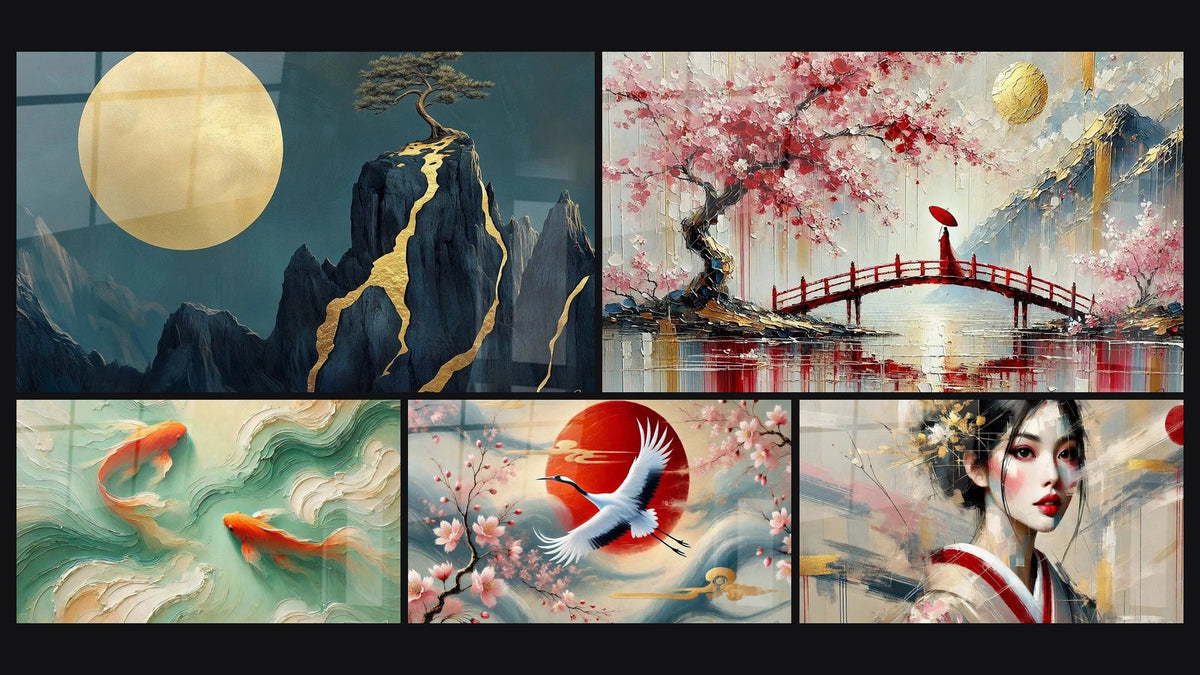
Japanese wall art for a zen bathroom : which material and location to choose based on humidity
8 λεπτά ανάγνωσης · από τη Walensky
ΙΑΠΩΝΙΚΟΙ ΠΙΝΑΚΕΣ
The fog clinging to the mirror after a shower, the droplets beading on the tiles, that damp smell that settles in if the window stays shut too long. A bathroom isn't a living room: it literally sweats. And a piece of art hung without considering this can warp, peel or lose its colours within a few seasons.
The direct answerFor a zen bathroom in Japanese style, choose a print on acrylic glass or Alu Dibond — never an unprotected paper or cardboard print — and hang it at least one metre away from any direct source of water, ideally on the wall opposite the shower or bath. A ventilated room (extractor fan or window) greatly limits the risk of condensation on the artwork.Japanese aesthetics — cherry blossom in bloom, koi swimming in cloudy water, Mount Fuji in the mist — lend themselves beautifully to this world of steam and calm. The support still has to survive the real-life use of the room.

- Acrylic glass and Alu Dibond both resist ambient humidity, unlike paper prints or classic canvas.
- The safe distance from a shower or bath is roughly one metre, outside the zone of direct spray.
- A bathroom without a window or extractor fan requires extra precautions: frequent manual airing and wiping the artwork after every hot shower.
Why humidity changes everything when choosing zen wall art
A few minutes of hot shower can push the relative humidity of a small bathroom well beyond what untreated paper can tolerate. The condensation forming on cold surfaces — mirror, tiles, sometimes the wall itself — looks for the slightest porous support to settle on.
In a living room, temperature and humidity variations are slow and moderate. In a bathroom, they are abrupt: you move from a cold, dry room to an atmosphere saturated with steam within minutes, then you close the door and everything drops again. This cycle, repeated day after day, is what wears out fragile materials.
The zen of a bathroom depends not only on the image hung there, but on its ability to survive hundreds of showers without flinching.
It is this repetition, more than occasional humidity, that doomed poor choices of support. An ill-suited artwork doesn't deteriorate on the first day: it wears down over time, discreetly, until the day the paper buckles or the edges come away.
Which materials really withstand humidity
Two finishes genuinely hold up in a bathroom: acrylic glass and Alu Dibond. These are the two supports used for all the artworks in the shop, printed in Italy, and neither is porous to water.
Acrylic glass vs canvas vs wood
Acrylic glass offers a glossy surface and very vibrant colours: steam slides over it without penetrating, a bit like on a window pane. Its drawback is that it reflects light — so it's best reserved for a room where lighting is controlled, away from a spotlight shining on it in broad daylight.
Alu Dibond, on the other hand, has a matt surface without reflection. The colours are softer, the rendering more refined, and it behaves very well facing a window or in full natural light — a real advantage in a bathroom with a basin in front of a window.
A classic canvas or raw wood support, by comparison, absorbs ambient humidity over time: fibres swell, risk of mould on the back, gradual fading. It's no accident that the shop doesn't offer them for its creations: they are simply not materials designed for this use.
Φινιρίσματα που πρέπει να αποφεύγετε απολύτως
- Paper print framed under non-waterproof glass: condensation seeps in through the edges.
- Foam board or foam support: warps at the slightest humidity spike.
- Untreated solid wood frame: swells, cracks, and draws mould into the corners.
Artworks printed on acrylic glass or Alu Dibond are delivered without a frame, ready to hang: no wooden joints to watch, no nooks where humidity could seep in.
For a japandi style — that blend of Japanese minimalism and Scandinavian simplicity much in demand right now — matt Alu Dibond naturally suits the minimalist spirit sought after. our article on japandi artwork in the bathroom details this choice of support for anyone who wants to take the clean atmosphere further.
Where to hang your artwork depending on the room's layout
Location matters almost as much as the material. An excellent support poorly placed will still suffer in the long run if it receives direct splashes or sits in a saturated pocket of air.
Shower and bath zone: safety distance
The ideal wall is the one you see when stepping out of the shower, not the one you brush under the jet. Above the toilet, beside the mirror or on the wall facing the bath work well, provided no direct splash can reach it.
Bathroom without a window or extractor fan: extra precautions
Without controlled mechanical ventilation or a window, relative humidity takes longer to drop after each shower. In that case, it's better to favour Alu Dibond, which tolerates staying in a charged atmosphere well, and remember to leave the door open for a few minutes after use to speed up the evacuation of steam.
For a small room, think in proportions rather than small size: an artwork ideally occupies 60 to 75% of the width of the wall or furniture beneath which it hangs, even if that means choosing a made-to-measure format from 80x46 cm rather than squeezing in too small a piece that would lose all presence.
The shop's bathroom artworks collection gathers precisely formats designed for these constrained configurations.
— Nuestra selección


A selection of Japanese artworks suited to damp bathrooms
Some visuals naturally carry the serenity sought in a zen bathroom, while benefiting from the two resistant finishes mentioned above.
The Koi in Symbiosis artwork plays on the motif of water itself — a koi carp swimming in a blue-green monochrome — a wink fairly apt for a room where water runs every day. Mount Fuji, for its part, brings a soothing horizontality that works very well on a long wall, facing the basin.

For a softer, more floral atmosphere, visuals of cherry trees in bloom remain a safe bet in the genre.
These three sakura variations, from pastel pink to a bolder red on black background, fit equally well into a light japandi style or a bathroom with darker tones. The Japan artwork collection lets you compare all the visuals available in these two finishes.
— Ανακαλύψτε επίσης


Caring for your zen artwork in a humid environment
Acrylic glass and Alu Dibond are simple to maintain, but not just any way. A slightly damp microfibre cloth is enough: the key is to avoid products containing alcohol or ammonia, which can dull the finish over time.
- Wipe the artwork once a week if the room is poorly ventilated, to prevent any build-up of dried condensation.
- Avoid abrasive products or scouring sponges, even on a stubborn stain.
- Check the wall fixings once a year: humidity can eventually affect the wall plugs if the wall was not perfectly dry at the time of fitting.
A simple habit often suffices: leave the bathroom door open for ten minutes after the shower. This noticeably reduces the time the artwork stays exposed to high relative humidity.
For a zen touch to complement the artwork, the zen decor selection offers other decorative pieces designed in the same minimalist spirit.

Άλλα επιλεγμένα έργα
Πίνακας Κάτω από τον Ουρανό της Ιαπωνίας - Έκδοση Ιαπωνικό Ασιατικό
Από 273,90 €
Ανακαλύψτε αυτόν τον πίνακα →Συχνές ερωτήσεις
Can I hang an artwork in a bathroom without an extractor fan?
Yes, provided you choose a waterproof support such as acrylic glass or Alu Dibond and air the room manually after each shower. Without ventilation, humidity takes longer to drop, so regular wiping of the artwork becomes important.
Which artwork material best resists humidity?
Acrylic glass and Alu Dibond both resist very well, unlike paper, cardboard or classic canvas which absorb ambient humidity over time. The choice between the two depends mostly on the room's light: glossy for controlled lighting, matt facing a window.
Σε ποια απόσταση από το ντους μπορούμε να κρεμάσουμε έναν πίνακα;
Allow at least one metre between the artwork and any zone of direct water spray, whether shower, bath or basin. The wall opposite or perpendicular to the shower is generally the safest.
How do you clean a Japanese artwork exposed to humidity?
A slightly damp microfibre cloth, without abrasive product or alcohol, is more than enough. Wiping once a week if the room is poorly ventilated prevents any build-up of dried condensation on the surface.
Zen, in a bathroom, doesn't depend only on the image you choose to hang there. An artwork poorly suited to humidity deteriorates silently, season after season, until it becomes the detail that spoils the room. A well-chosen one, on the other hand, gets through everyday showers without ever losing a shade of its colours — koi, sakura or Mount Fuji, still as serene years later.
Εξερευνήστε τις συλλογές μας