Dada city by city: Zurich, Berlin, New York, Paris and their forgotten figures
8 λεπτά ανάγνωσης · από τη Walensky
February 1916, Zurich, a back room of a cabaret where poems are recited in cardboard costumes while pots and pans are banged. A few thousand kilometres away, New York, Marcel Duchamp hangs a urinal under a false name and watches the scandal grow. Same word, Dada, but two atmospheres, two audiences, two ways of saying no. That is precisely the movement's interest: it never had a single face.
Dada is often told as a straight line — Zurich, then Berlin, then Paris, with Tzara as conductor. The reality is more scattered and more interesting: four centres existed in parallel, each with its own visual language, and several of its most inventive artists were women who are rarely cited first.
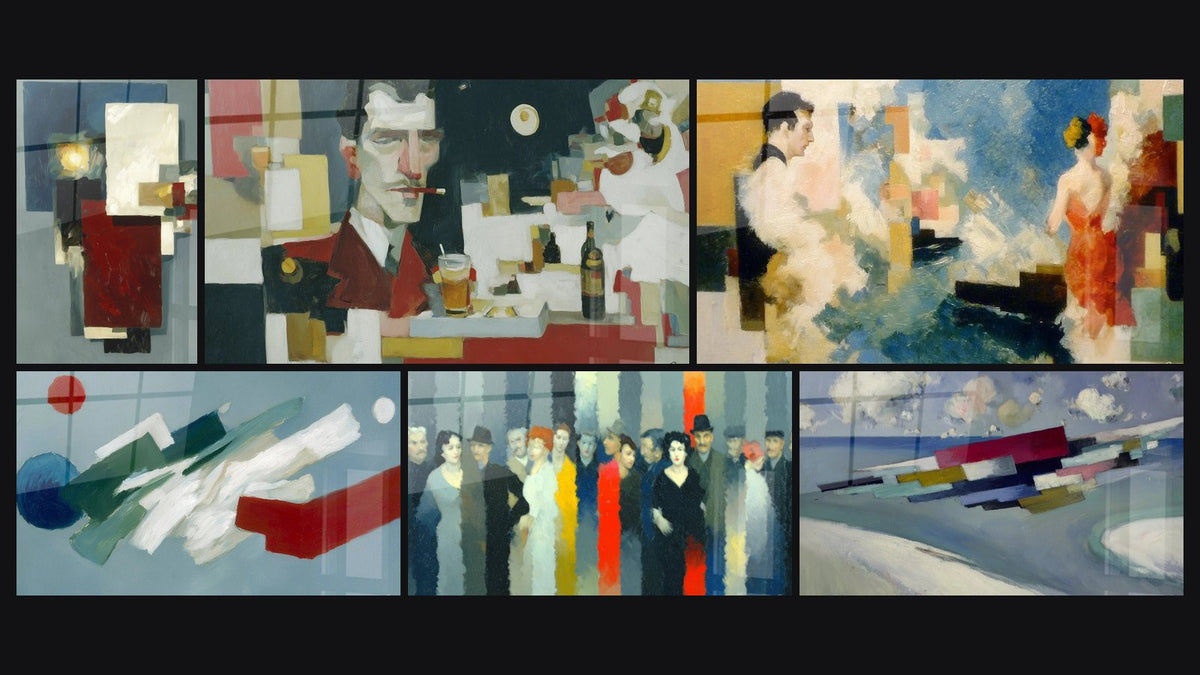
The direct answerDada was not born in a single city but in four almost simultaneous centres — Zurich, Berlin, New York, Paris — each developing its own style: the sonic and visual chaos of the Cabaret Voltaire in Zurich, political photomontage in Berlin with Hannah Höch, the diverted object and absurd mechanics in New York around Duchamp and Beatrice Wood, then a drift towards surrealism in Paris. These aesthetics — collage, fragmented portrait, the geometry of chance — directly feed part of today's decorative paintings inspired by Dadaism.- Dada is a choral movement: Zurich, Berlin, New York and Paris each had their own aesthetic, not a single "school".
- Major female figures — Emmy Hennings, Sophie Taeuber-Arp, Hannah Höch, Beatrice Wood — shaped the movement as much as the names usually cited.
- Collage, fragmented portraiture and the geometry of chance, born in these cities, can be found today in decorative paintings inspired by Dada.
Dada, a movement born from several simultaneous centres
The First World War scattered European artists into neutral cities or places far from the front, and it is this dispersion that created Dada. Zurich welcomed pacifist exiles, Berlin lived under direct political tension, New York received emigrés fleeing a Europe in flames, Paris took it all up after 1920. Each city imposed its own constraints and obsessions on the art being invented there.
So it is no accident that Zurich Dada sounds like a cabaret performance, that Berlin Dada resembles a leaflet, and that New York Dada has the air of an engineer's joke. Same rejection of bourgeois art, three radically different languages.
Zurich, the Cabaret Voltaire and the pioneers of chaos
The Cabaret Voltaire opened in February 1916 at number 1 Spiegelgasse, in the old town of Zurich. Here poems were recited made of invented syllables, makeshift tribal masks were worn, and music was played that was hardly music. The aim: short-circuit meaning to better insult a Europe tearing itself apart.
Hugo Ball and Emmy Hennings, a little-known founding duo
Hugo Ball founded the venue, but it was Emmy Hennings, singer and poet, who was often its linchpin — management, programming, stage presence. She is too often reduced to Ball's companion, although she wrote and performed in her own right, in a rawer, more physical register than her male counterparts.
Another key figure in Zurich: Sophie Taeuber-Arp, dancer and visual artist, who brought into Dada a geometric rigour and compositions of flat, almost abstract colour. She foreshadowed, without yet knowing it, the concrete art of the decades that followed.
In Zurich, Dada shouts in rhythm; in Berlin, it bangs its fist on the table.

Αγαπημένη επιλογή
Portrait Painting Fragmented Mind - Dadaism edition
Από 273,90 €
Ανακαλύψτε αυτόν τον πίνακαBerlin, political Dada and its collagists
Berlin Dada took shape amid revolutionary ferment, between 1918 and 1920, in a defeated and fractured Germany. Here the irony of the Cabaret Voltaire turned into a direct political weapon, aimed at the military, industrialists and the bourgeois press.
Hannah Höch, the inventor of Dadaist photomontage
Hannah Höch cut out magazines, advertisements and press photos, and recomposed them into hybrid figures — a woman's body with a machine's head, a dignitary with an animal's body. This technique, photomontage, became the visual signature of Berlin Dada, later taken up by Raoul Hausmann and John Heartfield. Höch nonetheless long remained the only woman tolerated in this very male circle, and the least credited.
Some Berlin collagists also diverted scientific imagery — star charts, astronomical diagrams — to make tools of political satire. Dadaist diversion of Berlin astronomical imagery describes this process precisely.
The fragmented portrait, inherited from this Berlin collage, today inspires pieces such as the Portrait Angles Perdus painting, where a face recomposes itself into coloured fragments rather than smooth lines.
— Nuestra selección


New York and Paris: towards abstraction and controlled chance
New York did not experience the war on its soil, and that changes everything: American Dada, around 1915–1921, is less shouting, more deadpan. Marcel Duchamp introduces there the idea of the readymade — an everyday object elevated to the rank of artwork by the artist's sole decision.
Beatrice Wood and Duchamp's circle
Beatrice Wood, later nicknamed "the mama of Dada", moved around Duchamp and Francis Picabia and published with them the satirical magazine The Blind Man. A painter and ceramicist, she developed a deliberately naive, almost childlike line, in counterpoint to Duchamp's cold mechanism. Another way of disobeying academic conventions.
From New York Dada to Parisian surrealism
From 1920, Tristan Tzara arrived in Paris and found there André Breton, Louis Aragon, Philippe Soupault. Parisian Dada wore itself out quickly in internal quarrels, but it left a method: controlled chance, that way of building a composition by accepting the accident while framing it formally. This idea of geometry in the service of the unforeseen slides directly towards the collection devoted to artistic movements, where several lineages of this same gesture coexist.
This tension between geometry and accident is found in works such as the controlled chance geometric shapes painting or the thinking disorder geometric shapes painting, two compositions playing with abstract forms and bold colours, never seeking perfect symmetry.
What these Dada centres bequeathed to contemporary decorative art
Three visual legacies have crossed a century without ageing: the fragmented portrait of Berlin, the coloured geometry of Zurich and Paris, the diverted object of New York. These are exactly the codes found in part of today's paintings of Dadaist inspiration — not period copies, but reinterpretations that keep the spirit of rupture.
- The collage and fragmented portrait : faces recomposed into planes of colour, as in the .
- The geometry of chance : blocks, angles, shapes that seem to have fallen there, as in the Brume cubiste abstract shapes painting or the .
- The displaced female portrait, inherited from figures like Hannah Höch or Beatrice Wood, found in the .
For a living room that already has a warm base — a terracotta sofa, raw parquet — these Dadaist compositions create a counterpoint without clashing, provided one simple rule is followed: the artwork generally occupies 60 to 75% of the width of the wall or piece of furniture beneath which it is hung.

También te puede interesar
Controlled chance flower painting - Dadaism edition
Από 273,90 €
Ανακαλύψτε αυτόν τον πίνακα →Συχνές ερωτήσεις
Who were the important women of the Dada movement?
Emmy Hennings and Sophie Taeuber-Arp in Zurich, Hannah Höch in Berlin, Beatrice Wood in New York: four central figures, too often relegated to the background behind Tzara or Duchamp.
Why was Dada born in several cities at the same time?
The 1914–1918 war scattered European artists towards neutral or distant areas. Each group organised itself without direct coordination, hence different aesthetics born from the same spirit of refusal.
What is the difference between Berlin Dada and Zurich Dada?
Zurich favoured sonic performance and cabaret, in a spirit of pacifist exile. Berlin, in the midst of revolutionary turmoil, turned towards photomontage and direct political satire.
How did Dada influence contemporary abstract art?
The controlled chance theorised in Zurich and Paris foreshadowed later abstract practices, in which composition accepts the accident while framing it through geometry — a principle still visible in works today.
Συμπέρασμα
Dada was never a style, but a mosaic of centres that did not quite speak the same visual language — the sonic chaos of Zurich, the political scalpel of Berlin, the mechanical wink of New York, the poetic drift of Paris. Choosing a painting of Dadaist inspiration is a bit like choosing your city or favourite figure: the Berlin collage of a Hannah Höch, or the New York geometry inherited from Duchamp and Beatrice Wood.
To go further into this graphic universe, the collection of Dadaist paintings brings together these different lineages, and the Romanticism collection offers a calmer counterpoint for anyone who wants to mix eras within a single interior.
Εξερευνήστε τις συλλογές μας